AirOps and Copy.ai both market themselves as AI platforms for business teams, but they have almost nothing in common in practice. AirOps is a content engineering platform - it helps SEO and content teams build repeatable workflows, track AI search visibility, and refresh underperforming pages at scale. Copy.ai has explicitly pivoted away from content marketing, repositioning as a GTM automation platform for sales, revenue operations, and inbound lead processing. Comparing them as substitutes is a category error. The buyer evaluating AirOps is a director of content or SEO. The buyer evaluating Copy.ai is a VP of Sales or RevOps lead.

What is AirOps?
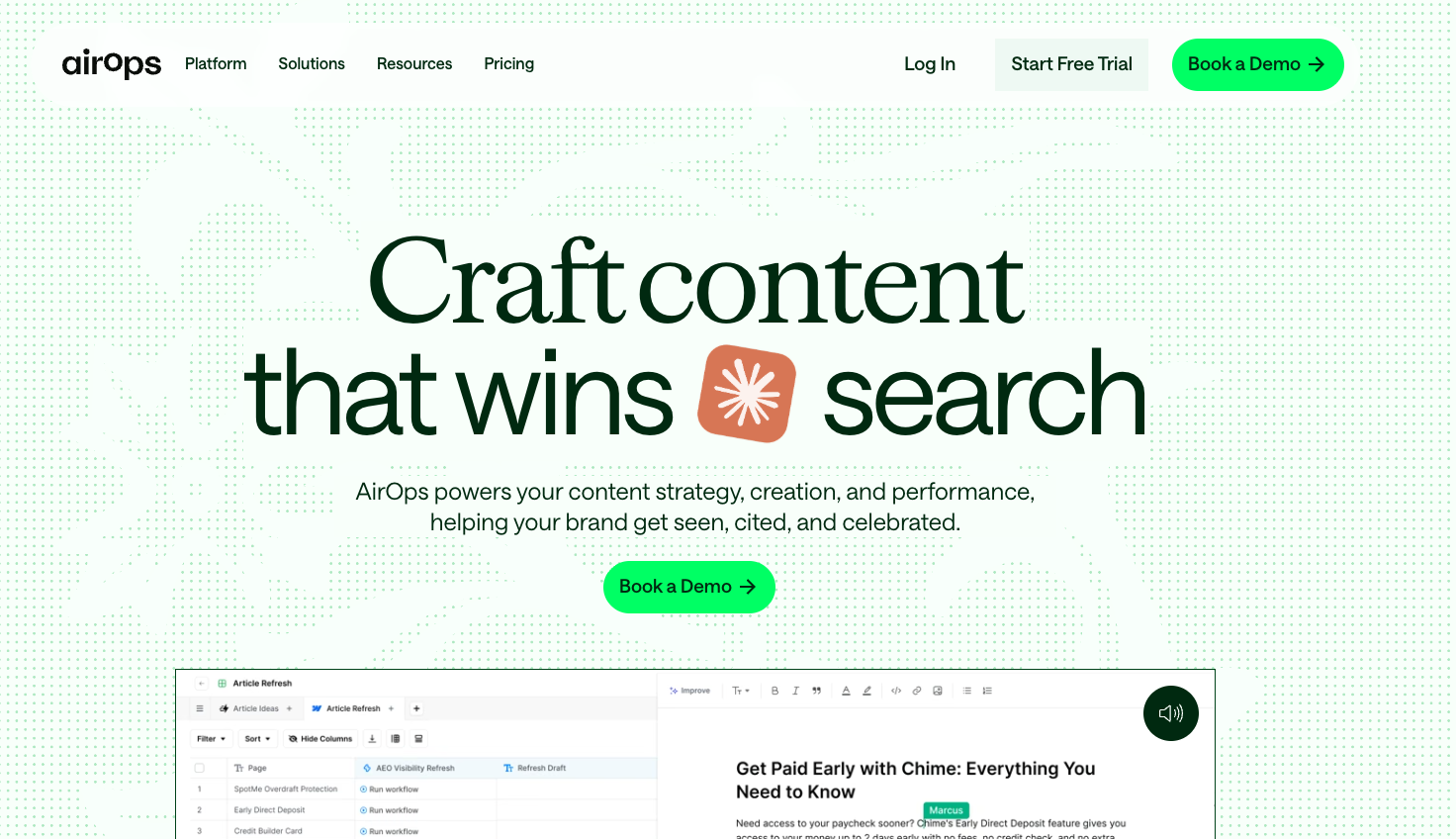
“Craft content that wins AI search”
AirOps positions itself as the first end-to-end content engineering platform - giving content and SEO teams visibility into what to create, workflows to create it, and human-review checkpoints to ensure quality before publishing. Its primary differentiator is AI search visibility tracking: surfacing where your brand appears (or doesn't) across ChatGPT, Perplexity, Google AI Overviews, and other LLMs, then feeding that data into configurable content workflows.
Visit AirOps
What is Copy.ai?
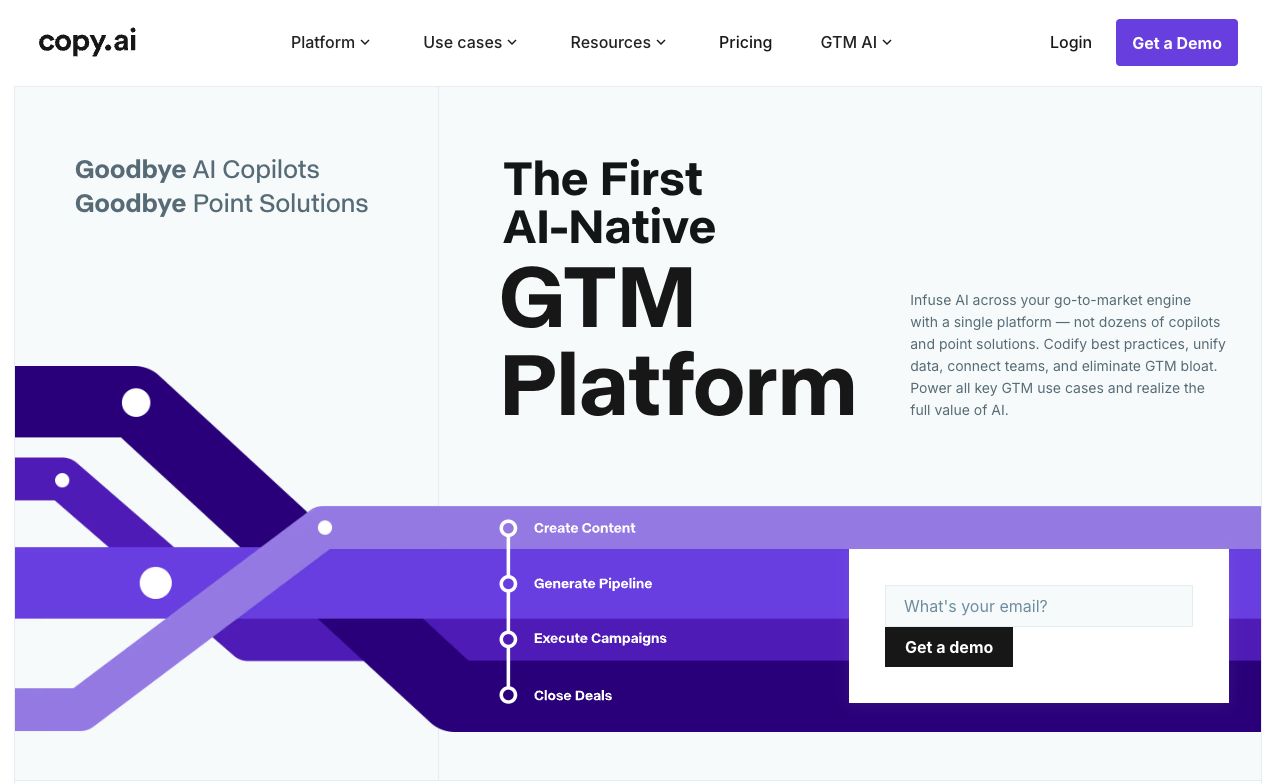
“Goodbye AI Copilots. The GTM AI Platform.”
These tools are not really competing. Copy.ai has explicitly pivoted away from being an AI writing tool - their current positioning is 'Goodbye AI Copilots, Goodbye Point Solutions.' It's now a GTM automation platform whose primary use cases are sales prospecting cockpits, inbound lead processing, CRM enrichment, deal coaching, and account-based marketing.
Visit Copy.aiNo comparison page should ever begin by acknowledging that the two tools barely compete, but this one has to. AirOps is built for content engineering: it helps content and SEO teams scale article production, track AI search citations, refresh underperforming pages, and build data-driven content pipelines. Every workflow, module, and feature traces back to a content or SEO outcome. Copy.ai is now a GTM automation platform. Its primary use cases are prospecting, inbound lead processing, CRM enrichment, deal coaching, and account-based marketing. Content creation is listed as one of nine total use cases, buried alongside sales functions that have nothing to do with blog strategy.
Users on Reddit and review platforms consistently note that Copy.ai's pivot has left content marketers behind. The tools they previously relied on for article drafting are now secondary features in a GTM platform that requires a $1,000/month Growth plan just to automate workflows. Meanwhile, AirOps has leaned further into content operations, expanding its Insights layer, AI search visibility tracking, and Content Refresh module. These two platforms were competitors two years ago. By 2026 they have diverged so significantly that most buyers should not evaluate them head-to-head at all. Winner depends entirely on whether your primary problem is SEO content operations (AirOps) or GTM revenue automation (Copy.ai).
This dimension has a decisive verdict: AirOps has it, Copy.ai does not. AirOps's Insights layer monitors where your brand does and does not appear in responses from ChatGPT, Perplexity, Google AI Overviews, and other LLMs. It surfaces the specific prompts, competitor mentions, and topic gaps driving visibility, then connects that intelligence directly into actionable content workflows. Carta achieved a 75% higher citation rate on AirOps-created pages. Chime grew from 24 to 68 priority question citations in weeks. Ramp built a 10x ROI Reddit strategy from AirOps offsite monitoring data. These are documented outcomes from teams using AirOps's AI search intelligence layer, not marketing claims.
Copy.ai has no equivalent. It does not track where your brand appears in AI search results. It does not surface which LLM prompts surface competitors but not you. It does not connect AI search intelligence to content creation decisions. For a content or SEO team where knowing your AI search presence is a strategic priority - which in 2026 it should be for any SaaS company - this is not a close comparison. AirOps wins this dimension with zero contest. Copy.ai is simply not trying to serve this use case.
For teams that need to produce SEO content at volume - blog articles, comparison pages, alternatives guides, product landing pages - AirOps has substantially more purpose-built infrastructure. Its Workflows are designed around content operations: chain AI model calls, pull keyword data from SEO integrations, insert human review checkpoints, and push finished articles directly into CMS platforms. The Grid handles bulk content production across hundreds of rows. Power Agents provide pre-built content workflow templates. Teams at Webflow and Ramp have used AirOps to build proprietary content pipelines that would otherwise require custom engineering.
Copy.ai can generate content through its workflow builder, but content creation is no longer its strategic focus. Building an SEO article workflow in Copy.ai means constructing it from scratch, without native SERP research, without content scoring, and without content-specific review steps. You are using a GTM automation platform to do a job it was not designed for - and to automate any of it, you need the $1,000/month Growth plan. Users evaluating Copy.ai specifically for long-form content production consistently discover this gap post-signup. For content production specifically, AirOps wins on depth, native tooling, and platform intent.
This dimension belongs to Copy.ai entirely, and it is not close. Copy.ai's platform is purpose-built for revenue operations: sales prospecting at scale, inbound lead qualification and routing, CRM enrichment from account intelligence, deal coaching workflows, account-based marketing campaigns, and win/loss analysis. Its Tables feature creates a queryable data foundation that connects CRM data, prospect lists, and account intelligence to automated workflows. Teams have used Copy.ai to send 100,000+ personalized outreach sequences from structured data in a single run - a use case AirOps was never designed for.
AirOps has no presence in GTM or sales automation. It does not integrate deeply with CRM platforms. It does not process inbound leads. It does not generate sales outreach. For a sales-led SaaS company where the primary AI investment needs to accelerate prospecting velocity and pipeline creation, AirOps is the wrong category of tool entirely. Enterprise tools like Jasper have also built sales-adjacent features, but none match Copy.ai's depth in revenue workflow automation. Copy.ai wins this dimension, and any buyers evaluating based on GTM needs should likely stop comparing and simply choose Copy.ai.
Both tools have pricing structures that punish small teams - but in different ways. AirOps starts with a free Solo tier at $0/month (capped at 1,000 tasks) and a paid Solo Plan at $199/month. Its Pro Plan is $1,999/month. The structural problem is task-based overage billing: Solo users pay $9 per 1,000 tasks above their allotment, Pro users pay $6 per 1,000. A Pro user running 100,000 tasks in a busy month pays $2,539 - not $1,999. Cost predictability is genuinely difficult to manage at scale.
Copy.ai's pricing cliff is more severe and more often misunderstood. The Chat plan at $29/month appears affordable, but it includes zero workflow credits and cannot automate anything. The first plan that enables workflow automation is Growth at $1,000/month. This is a 34x price jump between what looks like an accessible entry tier and what actually delivers the product's core functionality. Users on Reddit and review sites consistently cite this as the primary source of disappointment after signup. Between the two, AirOps's $199/month paid entry point and task-based model - while imperfect - is a significantly more accessible real entry into a functional product than Copy.ai's $1,000 automation floor. AirOps wins on pricing accessibility for any team that needs to start doing meaningful work before committing to enterprise-level spend.
Neither tool is cheap. AirOps's real entry tier is $199/month Solo Plan - a free Solo tier exists at $0 but caps at 1,000 tasks with no overages. The paid tier includes task-based overage billing at $9 per 1,000 tasks above the allotment, which makes the actual monthly cost variable and hard to predict at scale. The jump to Pro is steep: $1,999/month with a lower overage rate of $6 per 1,000 tasks - but a Pro user running heavy workflows can still see their monthly bill climb to $2,200-$2,500+ in high-volume months.
Copy.ai's pricing structure deserves a clear warning: the $29/month Chat plan has zero workflow credits and cannot automate anything. It is essentially unlimited access to an AI chat interface. Actual workflow automation starts at $1,000/month Growth (75 seats, 20,000 workflow credits) and $3,000/month Scale (200 seats, 75,000 credits). For a small content or SEO team evaluating Copy.ai as a content tool, the real budget conversation is $1,000/month, not $29. For content operations specifically, AirOps's variable $199-$2,000 range is more accessible than Copy.ai's workflow automation floor, even accounting for AirOps's task-metered cost unpredictability.
AirOps's most persistent limitation is the gap between what it promises and what a non-technical team can actually build. The platform markets itself as no-code, but user reviews across G2 and content marketing forums consistently describe a steep learning curve that takes weeks to climb. Building a useful multi-step content pipeline requires understanding data mapping, conditional logic, prompt engineering, and workflow architecture. Marketers who arrive expecting a plug-and-play content tool frequently find themselves in over their heads before delivering a single piece of content. For teams without a dedicated content operations specialist or someone with a technical lean, AirOps is often over-engineered for their needs.
Cost unpredictability is the second structural issue. Task-based overage billing at $6-$9 per 1,000 tasks above a plan allotment means your monthly bill is not fixed. Complex workflows that chain multiple AI model calls, data lookups, and validation steps consume tasks faster than most teams anticipate. The gap between the Solo Plan at $199/month and the Pro Plan at $1,999/month also creates a pricing cliff that can stall growth: teams that outgrow Solo face a 10x price jump with no intermediate tier.
AirOps also requires an existing strategy to be useful. The platform is an execution layer, not a strategy layer. It does not tell you what to create, which keywords to target, or what content gaps exist. Teams that arrive without a proven editorial direction risk automating the production of content that does not perform. Reviewers also note that AI-generated outputs still require significant editing - sometimes 2-3 hours per article - before they are ready to publish without obvious AI markers. For simpler content operations, tools like Copy.ai or Jasper offer faster paths to usable output.
Copy.ai's primary limitation for content and SEO teams is a positioning mismatch. The product is no longer trying to solve the problem those teams have. Its redesigned platform, primary use case marketing, and pricing structure are all oriented toward sales and revenue teams. Arriving at Copy.ai looking for an SEO content workflow builder means building that workflow yourself from scratch - without native SERP research, without content scoring, without keyword data, and without any content-specific templates. The platform's strongest features (Prospecting Cockpit, CRM enrichment, deal coaching) are irrelevant to a content marketing buyer.
The pricing cliff is the most commonly flagged issue across user reviews. The $29/month Chat plan catches teams off guard: it sounds accessible but has zero workflow credits and cannot automate any process. Teams sign up, discover they cannot actually run workflows on that plan, and face a jump to $1,000/month Growth they were not budgeting for. Many small teams simply churn rather than absorb the cost. This has become a pattern across Reddit threads and SaaS review platforms - the gap between apparent and actual entry cost is significant.
Content quality limitations compound the workflow problem. Even for teams that commit to the Growth plan and build content workflows, output quality reviews are mixed. Generic phrasing, inconsistent brand voice without careful configuration, and the need for substantial human editing before publishing are recurring themes. The platform relies on human review as the quality gate, which means the labor costs that teams hoped AI would eliminate still exist. For organizations evaluating AirOps alongside Copy.ai for content purposes, AirOps has more purpose-built tooling - and for SaaS-specific content, both tools leave meaningful gaps in the production chain.
These tools solve different problems, and most buyers should pick one based on their primary departmental need rather than a feature-by-feature comparison. If your primary need is SEO content operations - scaling article production, tracking where your brand appears in AI search results, refreshing underperforming pages, and building data-driven content pipelines - AirOps is the stronger choice. It was built for exactly that job, and its Insights layer provides AI search citation tracking that no other platform in this category matches. The learning curve and task-based pricing are real constraints, but for an established content or SEO team, AirOps provides depth that Copy.ai cannot.
If your primary need is GTM automation - sales prospecting, CRM enrichment, inbound lead qualification, account-based marketing, and revenue operations - Copy.ai is the right tool, and AirOps should not be in the evaluation. Copy.ai's platform is purpose-built for that buyer. Its Tables data layer, prospecting workflows, and deep CRM integrations serve a job that AirOps does not attempt to do.
The most common mistake is treating these as substitutes because they both use AI for 'workflows.' A content director evaluating AirOps should not also be evaluating Copy.ai as a content tool - Copy.ai has explicitly exited that positioning. A sales ops lead evaluating Copy.ai should not be running an AirOps trial for their GTM automation needs. The buyers are different, the departments are different, and the ROI is measured against entirely different metrics. If your team needs autonomous SaaS article production with zero human writing labor - comparison pages, alternatives guides, vs articles - neither tool was built for that job, and Alfa takes a different approach worth evaluating.
The gap that neither AirOps nor Copy.ai fills is this: neither produces factually verified, publication-ready SaaS content without a human writer in the loop. AirOps builds repeatable content workflows, but a team member still architects those workflows, connects brand context per pipeline, and reviews every output before publishing. Users consistently report spending 2-3 hours per article on editing after AirOps produces a first draft. Copy.ai requires configuring a content workflow from scratch at $1,000/month just to automate the process, with no SEO research, no content scoring, and no SaaS-specific pipeline depth baked in. Both tools are powerful. Neither removes the human from the writing chair.
For SaaS founders and growth leads who need comparison pages, alternatives guides, and vs articles produced without a writer, Alfa's 8-agent pipeline runs the entire production process autonomously. The Research Agent builds a live competitor dossier from DataForSEO data. The Strategy Agent maps BOFU keyword priority. The Writer Agent produces the full-length article. The Fact-Checker Agent validates every pricing claim and feature comparison against the research dossier before a word is packaged. The Sub-Editor Agent removes all detectable AI writing patterns. The Art Director Agent generates brand-aligned visuals. The SEO Optimizer Agent handles on-page optimization. The Packager Agent delivers a CMS-ready article directly to WordPress. No brief to write. No workflow to configure. No draft to edit.
The specific advantage over AirOps is the Fact-Checker Agent and the preconfigured pipeline depth for SaaS BOFU content. SaaS buyers in active evaluation mode read comparison pages and alternatives guides to make purchase decisions - a hallucinated pricing tier or misrepresented feature in that content breaks trust with exactly the buyer you are trying to convert. AirOps relies on human editors to catch those errors; Alfa catches them automatically before the article leaves the pipeline. The specific advantage over Copy.ai is that Alfa does not require a $1,000/month GTM platform subscription to produce a single SEO article.
Alfa is not the right tool if you need AI search citation monitoring (AirOps does that), sales prospecting automation (Copy.ai does that), or short-form marketing copy across channels. But for the SaaS content type that most directly drives trial signups - long-form BOFU articles that rank for commercial-intent queries and convert evaluating buyers - Alfa is the specialist pipeline that both AirOps and Copy.ai were not designed to be.