Outrank vs SEObot

Outrank vs SEObot

Both Outrank and SEObot auto-publish blog articles without a writer in the loop. The structural difference is in how they price and what they bundle. Outrank runs a single $99/month plan delivering 30 articles/month with a Backlink Exchange network and 150+ languages included from day one. SEObot opens at $49/month and stacks capabilities - AI news articles, interactive SEO tools, programmatic SEO pages, YouTube-to-article conversion - as you move up tiers.

Last updated: April 2026Honest comparison — no affiliate bias
The Tools

What are Outrank & SEObot?

Outrank screenshot

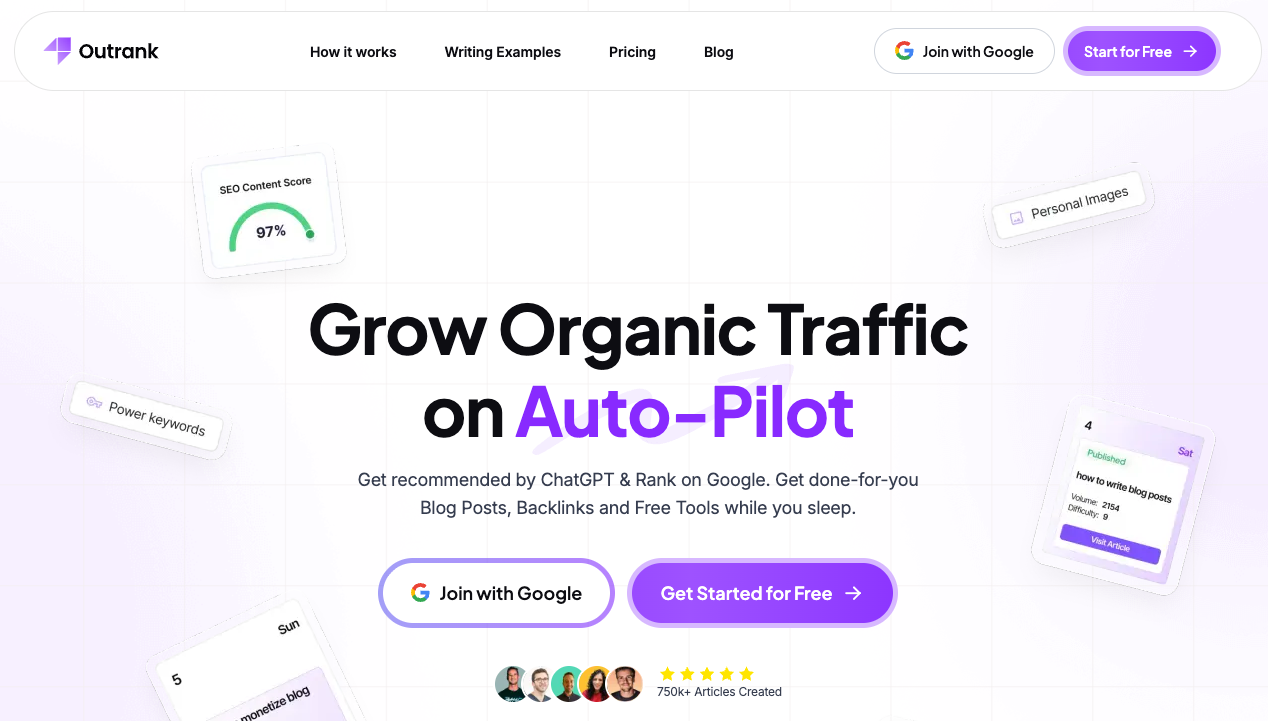
What is Outrank?

Outrank

Grow organic traffic on auto-pilot with done-for-you blog posts

Outrank and Alfa are both autonomous content systems. The difference is who they're designed for.

Visit Outrank
SEObot screenshot

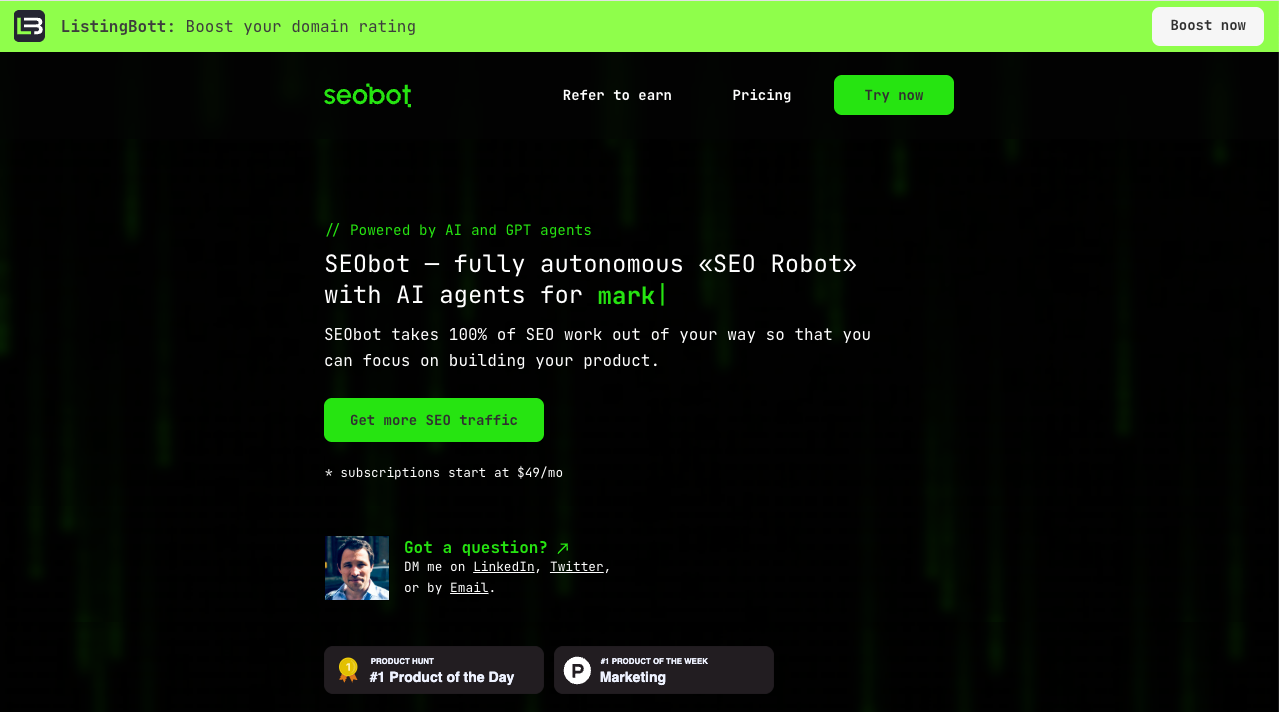
What is SEObot?

SEObot

Fully autonomous SEO robot - takes 100% of SEO work out of your way

SEObot and Alfa are both fully autonomous content agents. The fundamental difference is what they produce and for whom.

Visit SEObot
Feature Comparison

Outrank vs SEObot — Feature by Feature

Feature
Outrank
SEObot
Content Pipeline
Autonomous end-to-end article production
30 articles/month, fully automated
Weekly cadence, fully automated
Article volume (entry plan)
30/month at $99/mo — explicit
Weekly plan (~4-8/mo) at $49/mo — lower volume
Auto keyword research
Hands-free keyword research built in
Auto keyword research + weekly content plan
Programmatic SEO pages
Not available
Data-driven templates at scale (higher tiers)
AI news article generation
Not available
Auto news module — finds stories, publishes (higher tiers)
YouTube content to article
Embeds YouTube videos IN articles only
Full YouTube URL to standalone article (higher tiers)
Interactive SEO tools generation
Not available
Auto-generates calculators, analyzers, graders (higher tiers)
Output Quality
Fact-checking / anti-hallucination
Not a documented pipeline step
Anti-hallucination system + source citations
Brand voice configuration
Style matching via example articles provided
URL-based onboarding — no structured brand config
AI image generation
Multiple styles, embedded in articles
AI image gen + Google Image insertion
Unlimited AI rewrites
Unlimited rewrites on all articles
Not a documented feature
SEO & Linking
Internal + external link automation
Auto internal/external links in every article
Internal + external linking + monthly re-linking
Backlink building
Backlink Exchange — included at base $99 plan
AI backlink module — higher tiers only
Multi-language support
150+ languages supported
50 languages supported
Distribution
CMS publishing integrations
WordPress, Webflow, Shopify, Framer, Wix, Notion
WordPress, Webflow, Ghost, Shopify, Framer, Wix, Notion, HubSpot, Squarespace + REST API, Webhooks, Zapier, Make
Pricing & Plans
Entry price
$99/month — single plan, no tiers
$49/month — tiered plans available
Backlinks at entry price
Backlink Exchange included at $99
Backlinks require a higher tier
Satisfaction guarantee
Unlimited rewrites if output is poor
Full refund after first article if unsatisfied
Full support
Partial / limited
Not available
Feature Analysis

Where each tool actually wins

Pricing and Entry Risk

SEObot's pricing structure is the more buyer-friendly of the two. The $49/month Starter plan is a meaningful entry point for teams that want to test autonomous SEO without committing to near-triple-digit monthly spend. You get fact-checking, anti-hallucination layers, internal linking automation, and support for eight or more major CMSs right out of the gate - and a full refund if the first article doesn't meet your standards.

Outrank takes the opposite approach: one plan, one price, no tiers. The $99/month All-in-One plan includes 30 articles per month, the Backlink Exchange network, 150+ languages, and unlimited AI rewrites. For a team confident they need 30 articles a month with backlinks running immediately, the all-in-one price is fair at $3.30 per article - hard to argue with at that volume.

The problem is commitment level. At $99, you're doubling the entry cost before evaluating whether the article quality matches your standards. SEObot's lower floor makes the trial less financially risky. For teams in evaluation mode, that $50 difference matters more than it looks on paper.

SEObot wins on pricing structure for most teams starting out, though Outrank's per-article cost advantage is real at full volume.

SEObot has the edge

Content Breadth

This is where SEObot pulls meaningfully ahead. Beyond standard blog articles, SEObot's higher tiers add content types that Outrank simply doesn't offer: an AI news article module that finds relevant stories and publishes automatically, a YouTube-to-article conversion pipeline, programmatic SEO page generation from data templates, and interactive SEO micro-tools - calculators, analyzers, graders - auto-built for your niche and published as additional organic entry points.

Outrank publishes one content type: blog articles. It publishes 30 of them per month, and it embeds relevant YouTube videos within those articles, but it doesn't convert external video content or generate news articles or interactive pages.

The breadth gap matters depending on your SEO strategy. If standard blog content is your primary channel and 30 articles per month is your throughput target, Outrank's focus is a feature. If you want an autonomous SEO platform that scales into news, tools, and programmatic pages alongside standard articles, SEObot's architecture grows with those requirements.

SEObot wins on content breadth - it's a more complete autonomous SEO platform, not just a blog article publisher.
SEObot has the edge

Article Volume and Cadence

Outrank's most direct advantage: 30 articles per month at a flat rate. There's no ambiguity in the output. You connect your site, the system researches your niche, and 30 articles publish throughout the month across WordPress, Webflow, Shopify, or Notion.

SEObot's Starter plan runs on a weekly cadence - a weekly content plan with articles written accordingly. At $49/month this translates to roughly 4-8 articles per month, not the volume Outrank delivers. To approach comparable output, you'd need a higher SEObot tier, which brings costs closer to or above Outrank's $99.

There's a legitimate question about whether 30 articles per month is actually useful for most teams. AI-generated content at that volume can overwhelm editorial workflows and create indexing dilution if Google deems the output thin before the domain has established authority. For sites in active growth mode with clear keyword clusters to fill fast, 30 articles is a category-level advantage. For most teams publishing to a maturing domain, 4-8 well-targeted articles per month is likely more net useful.

Outrank wins on raw article volume - if throughput is your primary metric, it's not a close comparison.

Outrank has the edge

Link Building

Both tools include backlink automation, but Outrank's Backlink Exchange is available from the base plan and represents a more accessible mechanism. The Exchange works by placing your links in other Outrank users' content and vice versa - an automated network that passively grows domain authority alongside article publishing at no additional cost beyond the $99 plan.

SEObot offers an AI backlink module that analyzes your niche and identifies opportunities, but this feature is locked behind higher-tier plans. On the $49 Starter, you're getting solid internal and external link automation within articles - linking to relevant external sources and between your own pages - but proactive backlink acquisition requires more spend.

For teams actively trying to grow domain rating alongside content publishing, Outrank's backlink exchange being included from day one is a meaningful structural advantage. It's worth noting that reciprocal link exchange networks carry some quality tradeoffs - Google has historically viewed link schemes critically - but for early-stage sites trying to move domain rating, the practical impact is real.

Outrank wins on link building accessibility - the Backlink Exchange is built into their only pricing tier with no upgrade required.

Outrank has the edge

International and Language Reach

If your SEO strategy crosses language borders, Outrank has a structural advantage. 150+ languages for content generation means you can target Spanish-language SERPs, German content opportunities, or Japanese keyword clusters using the same autonomous pipeline without additional tooling or translation layers.

SEObot's language support caps at 50 languages. For teams targeting major European or Latin American markets, 50 languages is likely sufficient. For programs with broader international scope - Southeast Asian markets, Eastern European SERPs, or niche language clusters - the gap becomes relevant.

This is the least contested dimension for teams using either platform in English-first markets. Most autonomous SEO programs targeting US and UK audiences don't approach the edge of either tool's language limit. But it's worth flagging early: if international content is part of your current or near-future strategy, Outrank's 3x language advantage is a structural differentiator that's difficult to work around without switching tools at scale.

Outrank wins on international reach - 150+ languages versus 50 is a meaningful gap for multilingual SEO programs.

Outrank has the edge
Pricing

What you get at each price point

Outrank
All in One
$99/month
  • 30 articles/month generated and auto-published
  • Unlimited users in your organization
  • Auto keyword research (hands-free)
  • WordPress, Webflow, Shopify, Framer, Wix, Notion integrations
  • Backlink Exchange (auto link-building)
  • AI images in multiple styles
  • YouTube video embeds in articles
  • 150+ language support
  • Unlimited AI rewrites
SEObot
Starter
$49/month
  • Fully automated onboarding (enter URL and press go)
  • Auto keyword research + weekly content plan
  • Articles up to 4,000 words
  • YouTube embeds, AI image gen, Google Image insertion
  • Fact-checking + anti-hallucination + source citations
  • Internal & external linking automation
  • Monthly article re-linking
  • WordPress, Webflow, Ghost, Shopify, Framer, Wix, Notion, HubSpot, Squarespace
  • 50 languages
  • Full refund if unsatisfied after first article
Higher Tiers
From $49+/month
  • Higher article volume
  • Programmatic SEO (data-driven templates at scale)
  • YouTube video → article module
  • AI news article generation
  • Interactive SEO mini-tools generated on your site
  • AI backlink building
  • REST API, Webhooks, Zapier, Make integrations

The per-article math at base plan: Outrank delivers 30 articles at $99/month - roughly $3.30 per article. SEObot's Starter at $49/month produces approximately 4-8 articles/month - roughly $6-12 per article at that tier. If you solely optimize for cost-per-article, Outrank wins by a wide margin. If you optimize for total platform value per dollar spent - CMS reach, content type diversity, quality safeguards - SEObot's tiered structure gives you a more configurable spend profile. Moving up to SEObot's higher tiers to match Outrank's volume will typically cost more, but you unlock programmatic SEO, news articles, and interactive tools in the process.

Honest Assessment

Where each tool falls short

Where Outrank falls short

Outrank's biggest constraint is its pricing structure. There's one plan at $99/month - no smaller entry tier, no way to test the output at lower cost. For a team evaluating autonomous SEO for the first time, committing $99 upfront without a money-back guarantee creates real friction. Unlimited AI rewrites help recover poor articles, but you're still committing the full price before you know whether the output quality will hold up under your audience's scrutiny.

Content depth is the second recurring limitation. Producing 30 articles a month in an automated pipeline almost always involves tradeoffs at the individual article level. Outrank's pipeline optimizes for keyword coverage across a broad topic surface rather than depth on any single piece. Teams publishing to technically sophisticated readers - SaaS practitioners comparing specific tools, for example - consistently find that autonomous output at this cadence trends shallow on complex topics. The articles exist and rank; whether they build reader trust over time is a separate question.

Outrank is also a single-content-type platform: blog articles are the full scope. No news content, no programmatic SEO pages, no interactive tools. As your content strategy matures and these content types become relevant, Outrank doesn't grow with those requirements.

Where SEObot falls short

SEObot's primary limitation is the gap between what the Starter plan delivers and what 'autonomous SEO platform' implies. At $49/month, you're getting a weekly article cadence - roughly 4-8 articles per month - which is meaningful but far behind Outrank's 30. Teams expecting autonomous SEO to move organic metrics fast may find the starter-tier volume underwhelming against that expectation.

Feature gating is the second friction point. The capabilities that genuinely differentiate SEObot from a basic article generator - the YouTube-to-article module, AI news generation, interactive SEO tool creation, programmatic SEO pages, the AI backlink module - are all locked behind higher pricing tiers. The Starter plan's positioning can create a gap between what teams expect from an 'automated SEO platform' and what they actually receive at $49/month.

Transparency around volume per tier could also be stronger. Outrank states explicitly: 30 articles per month. SEObot's 'weekly content plan' framing requires buyers to infer actual article counts. Teams budgeting on a cost-per-article basis find Outrank's math more straightforward. SEObot's pricing model is more flexible overall, but the structure requires more due diligence to optimize correctly.

Our Verdict

Our pick: SEObot

For most teams evaluating autonomous SEO under $150/month, SEObot is the stronger overall choice. The lower entry point reduces the risk of a poor fit, the explicit refund guarantee after the first article is more buyer-friendly than Outrank's terms, and the platform's broader content architecture - news, tools, programmatic pages - provides a longer upgrade runway before you need to switch or layer in additional tooling.

Outrank is the right answer for a specific buyer: a team that needs 30 articles per month, wants backlinks running from day one without a separate upgrade, and operates across multiple language markets. At that throughput and configuration, Outrank's all-in-one price becomes genuinely cost-efficient. The per-article math at $3.30 is hard to compete with if volume is the primary KPI.

The honest recommendation: if you're unsure whether 30 articles a month is actually useful for your site's current stage, start with SEObot at $49 and measure what the weekly cadence produces. If you're burning through the article capacity and volume becomes the clear bottleneck, Outrank's flat-price model becomes more attractive. The two tools are more complementary than substitutes for teams that grow past the entry tier of either.

A third option worth considering

Consider Alfa instead

Both Outrank and SEObot share one structural gap: neither was designed around the specific content types that drive SaaS product conversions. They're volume-first generalists. A blog article about '10 productivity tips' and a buyer-grade comparison of 'Notion vs Confluence' require completely different research depth, factual verification, and competitive positioning. Autonomous pipelines optimized for keyword coverage and article throughput don't consistently produce the latter at the standard SaaS buyers expect.

Alfa's pipeline runs differently. Where Outrank and SEObot optimize for publishing frequency, Alfa optimizes for 8 article types that SaaS buyers actually read during product evaluation: comparison pages, alternatives guides, vs articles, product reviews, feature deep-dives, how-to guides, topic guides, and listicles. The Research Agent builds a competitor dossier per article. The Fact-Checker Agent cross-checks every pricing claim, feature claim, and positioning statement before packaging. The Sub-Editor Agent removes AI writing patterns so the output reads like it came from a practitioner - not a content engine.

If your primary content gap is comparison pages, alternatives guides, and vs articles - the pieces that rank for commercial intent keywords and move SaaS buyers toward trial signups - Alfa is the specialist tool for that job. Outrank and SEObot are the better choice if you need broad SEO coverage or news content across any topic. They're different jobs, and the right tool depends entirely on which job you're actually hiring for.

FAQ

Common questions

Continue reading

Alfa vs Outrank

See how Alfa compares directly to Outrank

Alfa vs SEObot

See how Alfa compares directly to SEObot

All Alfa comparisons

Browse all Alfa vs competitor pages

More head-to-head comparisons

See all tool vs tool comparisons