Frase and Surfer approach SEO from opposite ends of the writing process. Frase is a research-first platform that excels at topic clustering and generating structured content briefs before a writer begins. Surfer is an optimization-first NLP engine that analyzes what you've drafted against live SERP data and tells you exactly how to fix it to rank. Whether your bottleneck is blank-page syndrome or stuck rankings determines which tool you actually need.

What is Frase?
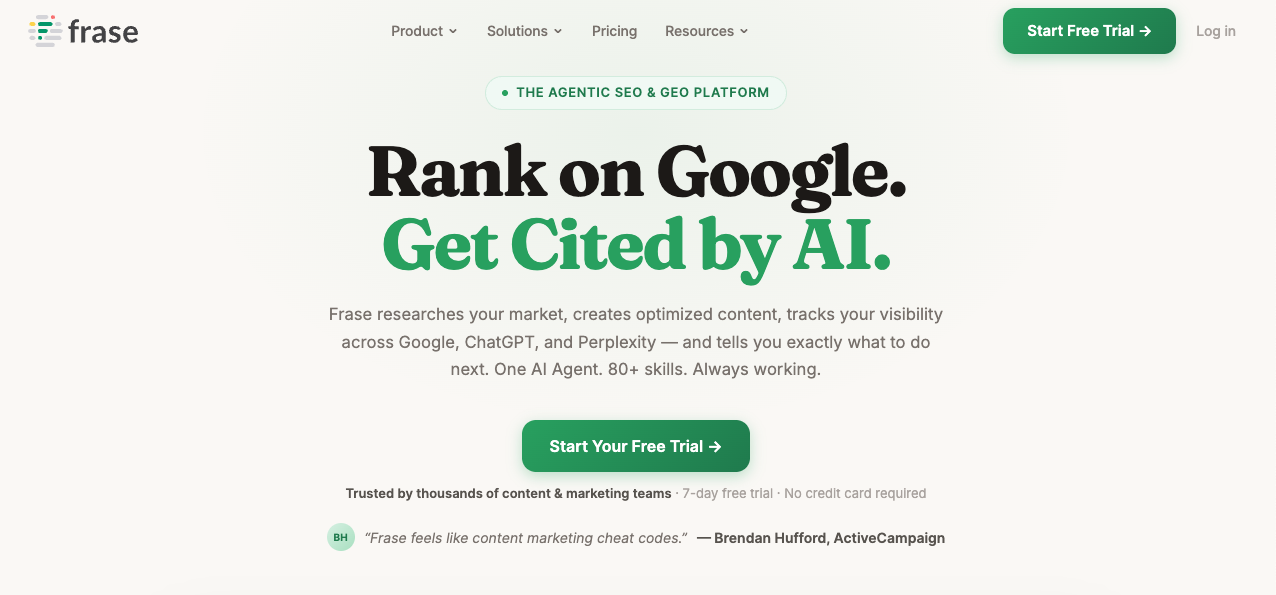
“Rank on Google. Get cited by AI.”
Frase and Alfa are both AI-powered content tools - and that's where the similarity ends. Frase is a full-stack SEO and GEO platform built for content marketing teams.
Visit Frase
What is Surfer SEO?
“Create content that ranks with real-time SEO data”
Surfer is the industry standard for SEO content optimization - it tells you exactly what your article needs to rank. Alfa does all of that, plus researches, writes, fact-checks, and publishes the article autonomously.
Visit Surfer SEOFrase approaches SEO with a research-first philosophy. Its strongest feature is the ability to scrape the top 20 Google results for a keyword and instantly distill their heading structures, statistics, and subtopics into a highly formatted, comprehensive content brief. For writers who struggle with the blank page, Frase removes the research bottleneck entirely.
Surfer offers outline suggestions within its Content Editor, but it functions more as an optimization checklist than a structured research document. Surfer assumes you generally know what you want to write about and need to know which specific NLP terms to include to rank.
If your team's primary friction point is planning the structure of an article before the writing begins, Frase wins on initial research depth.
This is what built Surfer's reputation. The Surfer Content Score is the industry standard for on-page optimization. It analyzes exact keyword density, partial NLP term matching, structural ratios (paragraphs to headings), and image counts against the specific SERP competitors actually ranking for your target keyword right now.
Frase includes a topic scoring feature to guide optimization, and it's highly competent. But Surfer's granular NLP analysis is widely considered more rigorous by career SEOs holding high-competition keywords. The gamification of reaching a 'green' Surfer score is a powerful workflow enforcement mechanism for freelance writers.
For the final mile of content optimization - guaranteeing that a finished draft hits every semantic signal Google expects to see - Surfer remains the gold standard.
For established domains, maintaining existing traffic is often more valuable than publishing new articles. Surfer's dedicated Content Audit tool allows you to plug in a published URL and a target keyword to instantly diagnose why rankings have slipped. It identifies missing backlinks, internal link opportunities, exact semantic gaps, and page speed issues.
Frase offers an audit feature that allows you to score published pages (Starter plan includes 50 audits per month). However, Surfer's audit infrastructure provides a deeper technical breakdown beyond just keyword usage, factoring in structural and off-page elements that contribute to decay.
If your strategy heavily relies on diagnosing and reviving an existing library of underperforming articles, Surfer provides a more comprehensive diagnostic tool.
Frase has aggressively pivoted toward Generative Engine Optimization (GEO). Its platform now actively tracks your brand's visibility across 8 different AI platforms, including ChatGPT, Perplexity, Gemini, and Claude. It tells you your share of voice, which competitors AI is citing instead of you, and what optimizations will increase your likelihood of being sourced in LLM answers.
Surfer focuses almost entirely on traditional Google SERP ranking. While it tracks your own team's AI prompts used within its editor, it does not offer GEO visibility tracking or specific scoring to increase citations in LLM interfaces.
As organic search shifts toward AI answer engines, this is a massive differentiator. Frase wins entirely on GEO tracking, providing a visibility layer that Surfer currently ignores.
For solo creators and small teams, the pricing gap often makes the decision. Frase's $49/month Starter plan provides full access to its AI agent, SEO/GEO optimization, and 10 AI-assisted articles. They also provide a 7-day free trial requiring no credit card to test the workflow.
Surfer's entry point is steep: $119/month for the Standard plan, which requires an annual commitment or a higher monthly rate. There is currently no free trial. Surfer AI features are often billed incrementally or gated entirely behind high-usage brackets.
Surfer's pricing reflects its enterprise and agency focus. But for a founder or a lean marketing team needing a content optimization co-pilot, Frase wins on pricing accessibility by offering a much lower barrier to entry.
The financial commitment between the two platforms is fundamentally different. Frase opens at $49/month, which includes 10 AI-assisted articles, 50 page audits, and full GEO tracking capabilities - an accessible entry point for small teams. Surfer begins at $119/month, positioning itself strictly as a premium, agency-grade optimization suite. For teams with high existing traffic looking to squeeze every drop of ranking potential out of their drafts, Surfer's premium pricing is justified by its rigorous NLP analysis. But if you are building your content engine from scratch, Frase provides a much heavily discounted on-ramp.
Frase's primary limitation is user interface bloat. Because it is a hybrid tool - combining automated brief generation, AI drafting, manual editing, ChatGPT tracking, and programmatic SEO - the dashboard can feel cluttered. Teams often find that while the research briefs are excellent, navigating the multitude of features distracts from the core goal of writing. Additionally, Frase's native AI drafting requires heavy human rewriting to sound natural. It lacks a reliable, automated layer for removing obvious AI writing tics before publication, relying entirely on human editors to catch robotic phrasing.
Surfer's biggest limitation is its steep entry cost and its focus on mathematical optimization over human readability. The notorious 'Surfer Score' often gamifies the writing process to a fault. Writers heavily constrained by Surfer requirements sometimes produce 'Franken-content' - paragraphs stuffed awkwardly with NLP keywords just to push the meter into the green. It optimizes for the algorithm, but without careful editing, it degrades the experience for the actual reader. Furthermore, at $119/month, Surfer is a purely supplementary tool. It assumes you already have the budget to pay a skilled writer to generate the content in the first place.
For content teams, agencies, and sites with established traffic, Surfer SEO remains the better investment. Its rigorous, mathematically-driven Content Score and unmatched Content Audit tool are the industry standards for a reason. If your primary goal is to squeeze top-3 rankings out of highly competitive terms - and you have the budget for both Surfer and skilled writers - it provides the most precise optimization roadmap.
However, for lean teams, founders, and those building their search presence from scratch, Frase is the smarter purchase. At $49/month, it provides a much lower barrier to entry while delivering excellent research briefs and the unique advantage of tracking your visibility in AI engines like ChatGPT.
The honest answer: Use Frase if you struggle to structure your thoughts and need a research co-pilot. Use Surfer if you already have a drafted article and need to theoretically guarantee it outranks the competition.
Both Frase and Surfer share one structural gap: they are co-pilots designed for human writers. They provide the map, the research, and the scoring criteria, but they still expect a human to drive. If you are a SaaS founder or a lean growth team without a dedicated content writer, neither platform actually solves your bottleneck. You still have to spend hours drafting the post, parsing the briefs, and manually wrestling the NLP score into the green.
Alfa's pipeline runs differently. Where Frase and Surfer optimize content you write, Alfa produces content you don't have to write. It specializes in the 8 article types SaaS buyers actually read: comparison pages, alternatives guides, listicles, and feature deep-dives. You enter a keyword, and 8 specialized agents run autonomously to research competitors, structure the outline, fact-check claims, remove AI writing tics, and inject internal links.
If you have a skilled writer who needs an optimization layer, Frase and Surfer are excellent tools. But if your goal is to publish high-converting SaaS articles and your primary constraint is a lack of writing bandwidth, Alfa replaces the entire workflow. It is not an assistant; it is the content engine.