AirOps vs Jasper AI

AirOps vs Jasper AI

Jasper is a writing tool that makes marketers faster. AirOps is an operations platform that makes content teams scalable. The confusion happens because both use AI for content, but they solve fundamentally different problems: Jasper answers 'how do I write this faster?' while AirOps answers 'how do I build a repeatable system that produces, optimizes, and tracks content across AI and traditional search?'

Last updated: April 2026Honest comparison — no affiliate bias
The Tools

What are AirOps & Jasper AI?
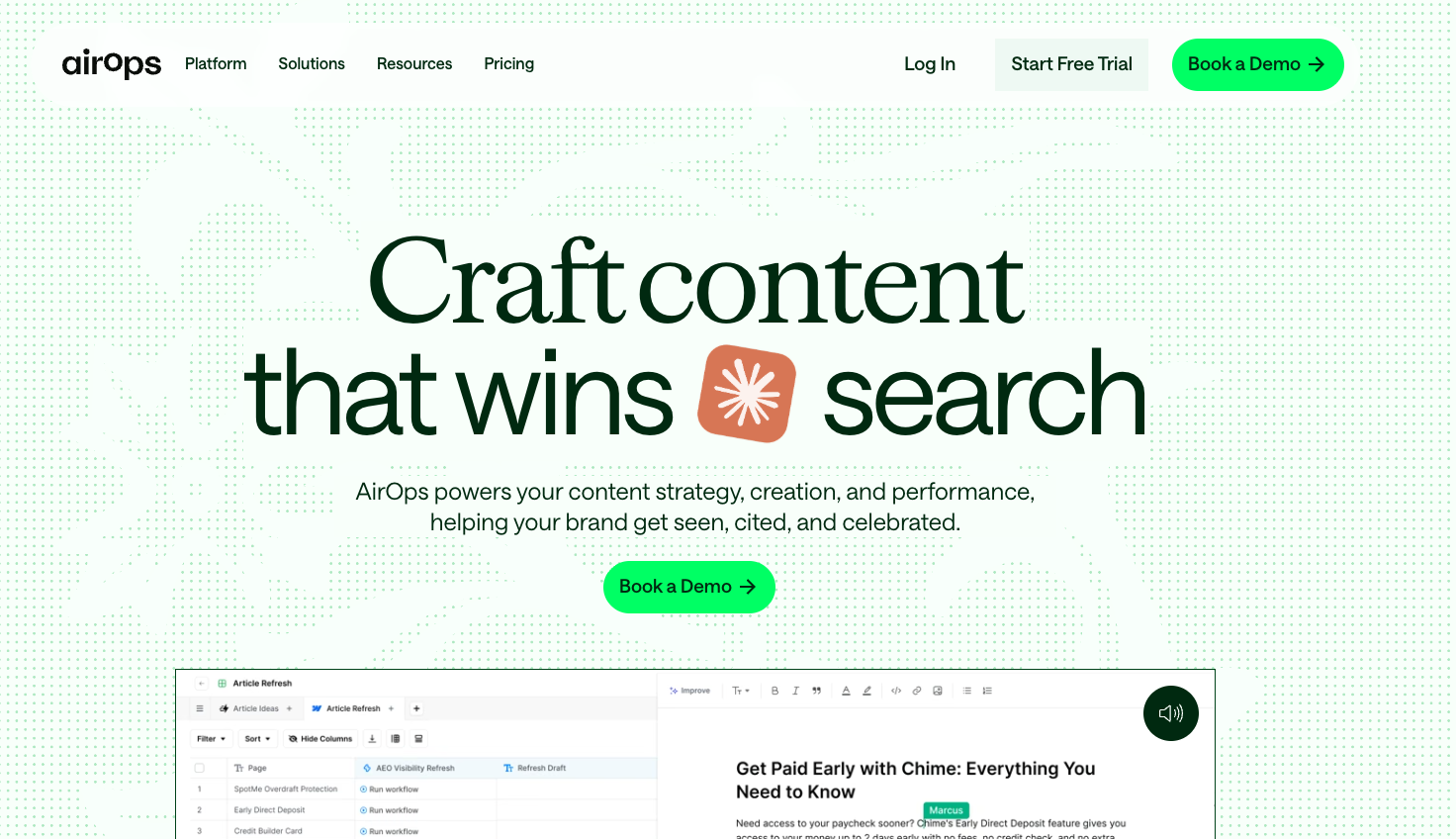
AirOps screenshot

What is AirOps?

AirOps

Craft content that wins AI search

AirOps positions itself as the first end-to-end content engineering platform - giving content and SEO teams visibility into what to create, workflows to create it, and human-review checkpoints to ensure quality before publishing. Its primary differentiator is AI search visibility tracking: surfacing where your brand appears (or doesn't) across ChatGPT, Perplexity, Google AI Overviews, and other LLMs, then feeding that data into configurable content workflows.

Visit AirOps
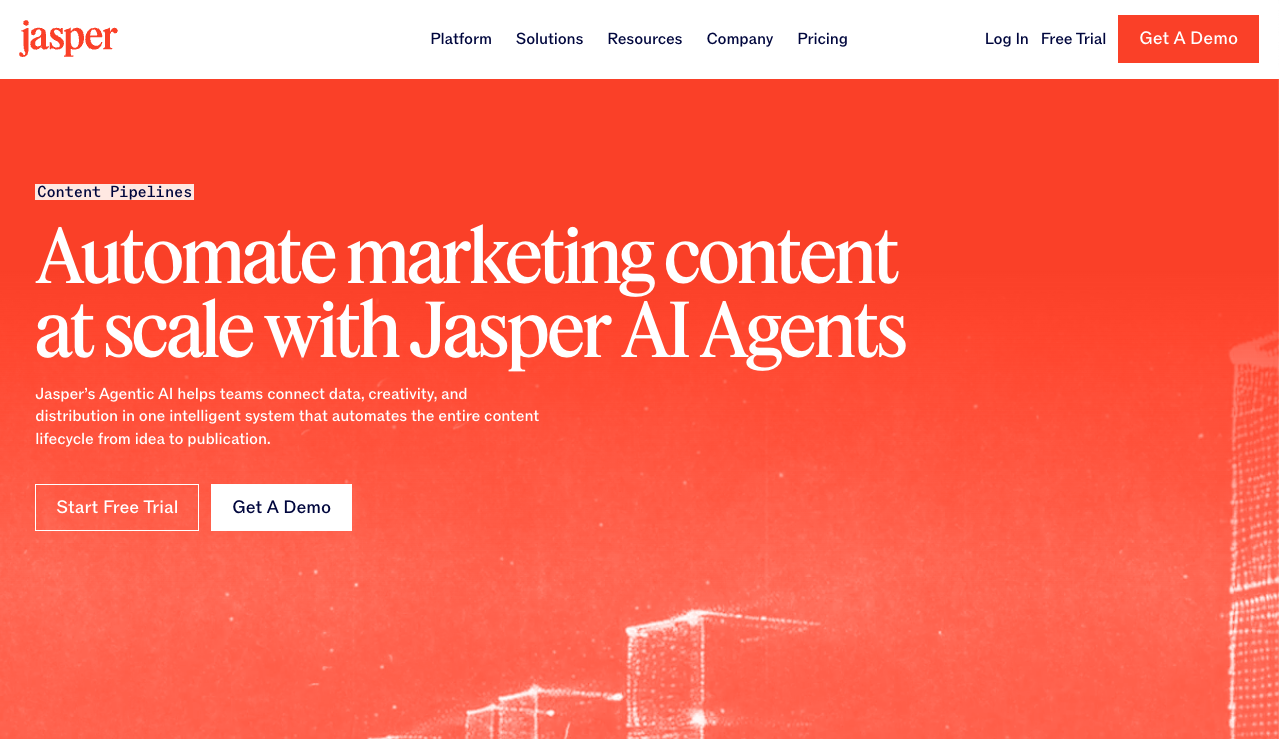
Jasper AI screenshot

What is Jasper AI?

Jasper AI

On-brand AI content, everywhere you create

Jasper is a general-purpose AI writing assistant built for any content type across any industry: ads, emails, social captions, blog posts, product descriptions, sales copy. It's a jack of all trades, and a capable one.

Visit Jasper AI
Feature Comparison

AirOps vs Jasper AI — Feature by Feature

Feature
AirOps
Jasper AI
Content Pipeline
AI writing assistant (drafting, editing, ideation)
Content generated via workflow outputs, not an interactive writing interface
Core feature - 100+ marketing apps, Canvas editor, Jasper Chat
Content workflow automation
Core product - multi-step Workflows, Grids, Power Agents
Content Pipelines feature - simpler orchestration than AirOps
Content refresh and optimization
Dedicated Content Refresh module - identifies and updates underperforming pages
New content generation only - no page-level refresh workflow
Short-form copy (ads, emails, social)
Workflow platform, not a writing tool for short-form copy
Core strength - 100+ marketing apps for every content type
Programmatic content at scale
Grid + data-driven templates for hundreds of pages
Jasper Grid for bulk generation - less sophisticated pipeline
AI Search & SEO
AI search citation tracking (ChatGPT, Perplexity, AI Overviews)
Core Insights layer - tracks brand mentions across all major LLMs
No AI search visibility tracking feature
Offsite monitoring (Reddit, 3rd-party mentions)
Dedicated Offsite module - find, secure, measure 3rd-party mentions
No offsite monitoring capability
SEO optimization for content
Built into workflows with live SEO data integrations
SEO mode via Surfer SEO integration (separate subscription)
Brand & Voice
Brand voice configuration
Brand Kit + Knowledge Base - connected to workflows by operators
Brand Voice + Style Guide + Visual Guidelines (Pro plan)
Multi-brand support
Multiple Brand Kits on Pro; unlimited on Enterprise
Multiple Brand Voices on Pro; unlimited on Business
Output Quality
Human-in-the-loop review workflows
Configurable approval gates and review steps at every workflow stage
Collaborative editing in Canvas - no structured approval workflows
AI image generation
Supported through workflow integrations
AI Image Suite - generation and editing built in
Ease of Use
Time to value / learning curve
Steep learning curve - requires workflow engineering skills
Intuitive interface, template-driven, low barrier to entry
Browser extension
Web app only - no browser extension
Chrome & Edge - works in Gmail, Docs, LinkedIn, WordPress
Integrations
CMS publishing integrations
WordPress, Webflow, and other CMS integrations on Pro+
Via Zapier or copy-paste - not natively integrated
API access
Available on paid plans
Business plan only (custom pricing); MCP integration available
Multi-language content production
Enterprise plan supports multiple regions, personas, and languages
30+ languages supported on all plans
Pricing & Plans
Entry price (paid plan)
$199/month Solo Plan (task-metered)
$69/month Pro plan (flat per-seat pricing)
Free tier available
$0 Solo Free - 1,000 tasks/month, no overages
7-day free trial only, credit card required
Cost predictability (no usage-based overages)
Task-based pricing - $6-$9 per 1,000 tasks overage above plan allotment
Flat per-seat pricing, no task metering or overage charges
Full support
Partial / limited
Not available
Feature Analysis

Where each tool actually wins

Ease of Use and Time to Value

Jasper is one of the fastest AI content tools to get started with. Sign up, pick a template from the 100+ marketing app library, configure your brand voice, and start generating content. G2 reviewers consistently rate Jasper higher on ease of use and onboarding satisfaction than most competitors in the AI writing space. The Canvas editor feels natural to anyone who has used Google Docs, and the browser extension drops AI writing assistance into Gmail, LinkedIn, and WordPress without switching tabs.

AirOps requires a fundamentally different investment. It is an operations platform, not a writing tool, and users on Reddit and G2 consistently flag the steep learning curve as the primary barrier to adoption. Building a useful AirOps workflow means understanding data mapping, prompt engineering, and multi-step pipeline logic. Some users report needing weeks to get meaningful value from the platform, and the Grid interface can lag when handling large datasets. For teams with dedicated content operations staff and the patience to architect workflows, AirOps delivers significant scale advantages. For marketers who need to start writing today, it is over-engineered.

Jasper wins on time to value for any team that does not already have workflow engineering capacity. If you need to produce content this week, not design a content system this quarter, Jasper is the practical starting point.

Jasper AI has the edge

AI Search Visibility Intelligence

This is AirOps's most differentiated capability, and Jasper has no equivalent. AirOps's Insights layer monitors where your brand does and does not appear in responses from ChatGPT, Perplexity, Google AI Overviews, and other LLMs. It surfaces the specific prompts, topics, and competitor mentions driving visibility, then connects that intelligence directly to actionable content workflows.

The results are measurable. Chime grew from 24 to 68 priority question citations in weeks using AirOps's AI search data. Carta achieved a 75% higher citation rate on pages created with AirOps insights. Ramp built a 10x ROI Reddit strategy from offsite monitoring data. These are not theoretical benefits - they are documented outcomes from established SaaS companies running AirOps at scale.

Jasper has an SEO, AEO, and GEO solution page, and its Content Pipelines can be configured for search-optimized content production. But Jasper does not track where your brand appears in AI search results. It does not surface the prompts driving competitor visibility. It does not connect AI search intelligence to content creation workflows. For a content team where AI search visibility is a strategic priority, and where knowing exactly which LLM queries surface your competitors but not you is decision-relevant intelligence, AirOps provides something Jasper simply cannot.

AirOps wins decisively on AI search intelligence - it is the only tool in this comparison that offers it.

AirOps has the edge

Content Workflow Automation

AirOps was built as content automation infrastructure. Its workflow builder allows teams to construct complex, multi-step content pipelines that chain AI model calls, pull data from external sources, integrate human review checkpoints, and push finished content directly into CMS platforms. Teams at Ramp, Carta, and Webflow have used it to build proprietary content operations that would otherwise require custom engineering. The Grid interface handles bulk content operations across hundreds of rows, and Power Agents provide pre-built workflow templates for common content tasks.

Jasper has moved toward workflow automation with Content Pipelines and Jasper Grid, but these features serve a different purpose. Jasper's pipelines are designed to help marketing teams create content faster within a structured flow, not to build and maintain programmable content infrastructure. The automation depth is meaningfully shallower - you can move content through stages, but you cannot chain arbitrary data sources, fork workflows conditionally, or build the kind of data-driven programmatic content engines that AirOps supports natively.

The gap matters most for teams producing content at enterprise scale. If you need to generate hundreds of location pages from a data template, refresh 50+ articles per month based on performance signals, or build a localization pipeline that adapts content for multiple markets, AirOps has the operational architecture for that work. For teams that want simpler automation, tools like Copy.ai have also moved toward workflow features, though none match AirOps's infrastructure depth. AirOps wins on workflow automation for teams with the technical capacity to use it.

AirOps has the edge

Brand Voice and Content Quality

Jasper's Brand IQ system is among the most sophisticated brand governance layers in the AI content space. Brand Voice captures tone and terminology rules. Style Guide enforces editorial standards across all outputs. Visual Guidelines maintain design consistency. Knowledge Base grounds outputs in company-specific context. Together, these layers ensure that whether a junior marketer or a senior strategist uses Jasper, the output sounds like the same brand.

AirOps has a capable Brand Kit and Knowledge Base system that stores tone rules, references, and contextual data. The difference is in how that context gets applied. In AirOps, operators connect brand context to specific workflows during configuration, meaning consistency depends on how carefully each workflow was built. In Jasper, Brand IQ is applied automatically across every content interaction, from Chat to Canvas to browser extension. The enforcement is structural, not operational.

Users on Reddit and G2 frequently cite Jasper's brand voice as one of its strongest features, and the primary reason larger marketing teams choose it over cheaper alternatives. For teams producing across many channels where ad copy, social captions, blog posts, and email sequences all need to sound like the same company, Jasper's automatic brand enforcement is a genuine competitive advantage. AirOps's brand system works well within configured workflows, but Jasper's is more comprehensive and easier to maintain across a diverse content program. Enterprise-grade tools like Writer also compete in this brand-governance space, but Jasper leads for most marketing teams.

Jasper wins on brand voice for teams that prioritize consistent, multi-channel content quality.

Jasper AI has the edge

Pricing and Accessibility

The price gap between these tools is stark. Jasper Pro starts at $69/month per seat with unlimited AI writing, all templates, brand voice controls, and the browser extension included. The cost scales linearly with seats - add a marketer, add $69/month. No usage caps. No task metering. No overage charges.

AirOps's paid Solo Plan starts at $199/month - nearly 3x Jasper's entry price - and includes task-based overage billing at $9 per 1,000 tasks above your monthly allotment. The Pro Plan jumps to $1,999/month with a lower overage rate of $6 per 1,000 tasks. A Pro user running 100,000 tasks in a busy month pays $2,539, not $1,999. AirOps does offer a free Solo tier capped at 1,000 tasks with no overages, which gives teams a way to test the platform before committing. Jasper's 7-day trial requires a credit card, which multiple users on Reddit have flagged as a friction point when comparing onboarding experience.

For solo marketers and small teams, Jasper is the accessible option by a wide margin. AirOps's pricing makes sense for established content operations teams where the workflow automation and AI search intelligence justify the investment, but the entry cost and task variability create a higher barrier. If your content budget is under $500/month and you need to start producing now, Jasper is the clear choice. If you are building infrastructure for a content program at scale, AirOps's pricing reflects the platform's depth.

Jasper wins on pricing accessibility for the majority of buyers evaluating these tools.

Jasper AI has the edge
Pricing

What you get at each price point

AirOps
Solo (Free)
$0month
  • 1 user
  • 1,000 tasks/month included
  • No overages — tasks capped at allotment
  • Basic templates
  • Live chat support
Solo Plan
$199month
  • All Solo (Free) features
  • Expanded template library
  • $9 per 1,000 tasks overage (above monthly allotment)
  • Community and live chat support
Pro Plan
$1,999month
  • Unlimited users
  • Advanced workflows
  • $6 per 1,000 tasks overage (above monthly allotment)
  • Priority support
Scale / Enterprise
Custom
  • Unlimited tasks
  • Brand kits, SSO, and enterprise integrations
  • Multiple regions, personas, and languages
  • Dedicated Account Manager and 1:1 expert onboarding
  • Contact sales for pricing
Jasper AI
Pro
$69/month
  • Unlimited AI writing & content generation
  • 100+ purpose-built marketing apps
  • Jasper Chat + Marketing AI Editor
  • Brand Voice + Style Guide + Visual Guidelines
  • Multi-modal knowledge base (text, video, image, audio)
  • AI image generation & editing suite
  • Chrome & Edge browser extension
  • 30+ languages
  • 7-day free trial (credit card required)
Business
Custom
  • Everything in Pro
  • Unlimited user seats
  • Custom AI agents & workflows (Jasper Studio)
  • API access + MCP integration
  • SSO / SAML / SCIM
  • Advanced admin controls & role-based permissions
  • Dedicated Customer Success Manager
  • SOC 2 certified, enterprise-grade security

The per-seat math at entry tier: Jasper Pro at $69/month gives one marketer unlimited AI writing, brand voice controls, 100+ templates, and a browser extension. Scaling to a 5-person team costs $345/month with no usage variables. AirOps Solo Plan at $199/month gives one user access to the workflow platform with task-based overages at $9 per 1,000 tasks. A team moving to AirOps Pro pays $1,999/month for unlimited seats but still faces task-based metering at $6 per 1,000 tasks above the plan allotment. The fundamental pricing difference is model type: Jasper charges per seat with unlimited usage; AirOps charges per plan with usage-based overages. For teams with predictable needs and modest budgets, Jasper's model is simpler and cheaper. For teams running high-volume content operations where the workflow automation and AI search tracking deliver measurable ROI, AirOps's higher price point can be justified, but the total cost requires careful monitoring against task consumption.

Honest Assessment

Where each tool falls short

Where AirOps falls short

AirOps's steepest barrier is the learning curve. This is not a tool you sign up for and start using productively in an afternoon. Building useful workflows requires understanding data mapping, prompt engineering, conditional logic, and multi-step pipeline architecture. Users on G2 and Reddit consistently report needing significant onboarding time before the platform delivers value. For a marketing team without dedicated content operations staff, that ramp-up period can stall adoption entirely.

Cost unpredictability is the second systemic issue. AirOps's task-based pricing means your monthly bill is not fixed. Every AI call, API action, and validation step within a workflow consumes tasks. A team running complex workflows at volume can blow past their plan allotment quickly, and overage charges of $6-$9 per 1,000 tasks accumulate faster than most teams expect. The gap between the Solo Plan at $199/month and the Pro Plan at $1,999/month is also significant - teams that outgrow Solo face a 10x price jump to reach the next tier.

The platform also requires an existing content strategy to be effective. AirOps is designed to scale what already works, not to tell you what to create in the first place. Teams without a proven editorial process or clear keyword strategy will find themselves automating the production of content that does not perform. The Grid interface can also become sluggish when handling large datasets, which limits the velocity that power users expect at scale. For teams evaluating simpler content tools, Writesonic or Jasper offer faster paths to output.

Where Jasper AI falls short

Jasper's fundamental limitation is that it is an assistant, not an engine. Every piece of content Jasper produces requires a human in the loop - someone to write the brief, pick the template, steer the output, and review the result. For teams with experienced writers who want to move faster, that is exactly the right model. For a founder or growth lead who wants published articles without any writing labor at all, Jasper does not solve that problem. It accelerates writing; it does not replace it.

Per-seat pricing creates real budget pressure as teams scale. At $69/month per seat, a 10-person marketing team pays $690/month for Jasper. This is manageable for enterprise organizations, but for mid-market teams trying to justify AI writing tools against shrinking budgets, the per-seat cost is a frequent complaint on Reddit. Users also note that Jasper's most powerful SEO capabilities require a separate Surfer SEO subscription, which adds another recurring cost to the stack.

Jasper has no AI search visibility layer. In a market where AI-generated answers are increasingly replacing traditional search clicks, Jasper gives you no data on where your brand appears or does not appear in LLM responses. You can write content with Jasper, but you cannot track whether that content earns citations in ChatGPT or Perplexity. There is also no content refresh capability - Jasper is exclusively a creation tool, not a maintenance tool. For teams where content lifecycle management and AI search monitoring are strategic priorities, Jasper leaves significant operational gaps.

Our Verdict

The honest answer

For most marketers evaluating AI content tools under $200/month, Jasper is the stronger choice. It is accessible, intuitive, and begins delivering value within hours of signup. The $69/month Pro plan gives any marketer unlimited AI writing with brand voice controls, a browser extension that works everywhere, and a Canvas editor that handles both short and long-form content. It is the tool you pick when you need to write better content, faster, starting this week.

AirOps is the right choice for a specific buyer: an established content or SEO team that needs infrastructure, not a writing assistant. If your primary need is tracking where your brand appears in AI search results, building automated content production workflows, or refreshing 50+ articles per month at scale, AirOps provides operational depth that Jasper does not attempt to match. The teams getting the most value from AirOps - Ramp, Carta, Webflow, Chime - are organizations with dedicated content operations staff and clear content strategies already in place.

The honest test: if you have a content team with workflow engineering capacity, a content budget above $500/month, and a strategic need for AI search intelligence, evaluate AirOps. If you need a tool that helps one marketer or a small team write faster today, Jasper is the more practical starting point. These tools do not compete head-to-head - they solve different problems for different organizational stages. For teams that need bottom-of-funnel SaaS content without any writing labor at all, neither tool was built for that job, and Alfa takes a different approach worth evaluating.

A third option worth considering

Consider Alfa instead

Both Jasper and AirOps share one structural gap: neither produces factually verified, publish-ready SaaS content without human involvement. Jasper accelerates a writer's output but still requires someone to research, brief, draft, review, and fact-check every article. AirOps automates content workflows at scale but expects a team to configure those workflows, connect brand context per pipeline, and manually review outputs before publishing. For the SaaS founder or growth lead who needs comparison pages, alternatives guides, and vs articles produced without a content team, both tools leave the core problem unsolved.

Alfa's pipeline runs the entire production process autonomously. There is no brief to write, no workflow to configure, no draft to review. You provide a keyword. The Research Agent builds a competitor dossier from live SERP data. The Strategy Agent maps commercial intent. The Writer Agent produces the full article. The Fact-Checker Agent validates every pricing claim and feature comparison against the research dossier. The Sub-Editor Agent removes AI writing patterns. The Art Director Agent generates brand-aligned visuals. The SEO Optimizer Agent handles on-page optimization. The Packager Agent delivers a publication-ready article.

For SaaS companies where the primary content gap is BOFU articles that convert evaluating buyers - comparison pages, alternatives guides, and vs articles - Alfa is the specialist tool for that specific job. Jasper is the better choice for broad marketing copy across channels. AirOps is the better choice for content operations infrastructure and AI search intelligence. If what you need is a pipeline that autonomously produces the articles SaaS buyers read during product evaluation, without any writing labor or workflow configuration, that is a different job entirely, and Alfa was built specifically for it.

FAQ

Common questions

Continue reading

Alfa vs AirOps

See how Alfa compares directly to AirOps

Alfa vs Jasper AI

See how Alfa compares directly to Jasper AI

All Alfa comparisons

Browse all Alfa vs competitor pages

More head-to-head comparisons

See all tool vs tool comparisons