Copy.ai and Writesonic are both AI platforms that originated as writing tools and have since pivoted into different strategic directions. Copy.ai repositioned as a GTM automation platform for sales and revenue teams - its core product is now workflow automation for prospecting, CRM enrichment, and outbound sequences. Writesonic pivoted to become an AI Search Visibility platform - it tracks how your brand gets cited across ChatGPT, Perplexity, Gemini, and 10+ AI platforms, while also providing an article writer and SEO audit tooling. The platforms now serve meaningfully different buyers.

What is Copy.ai?
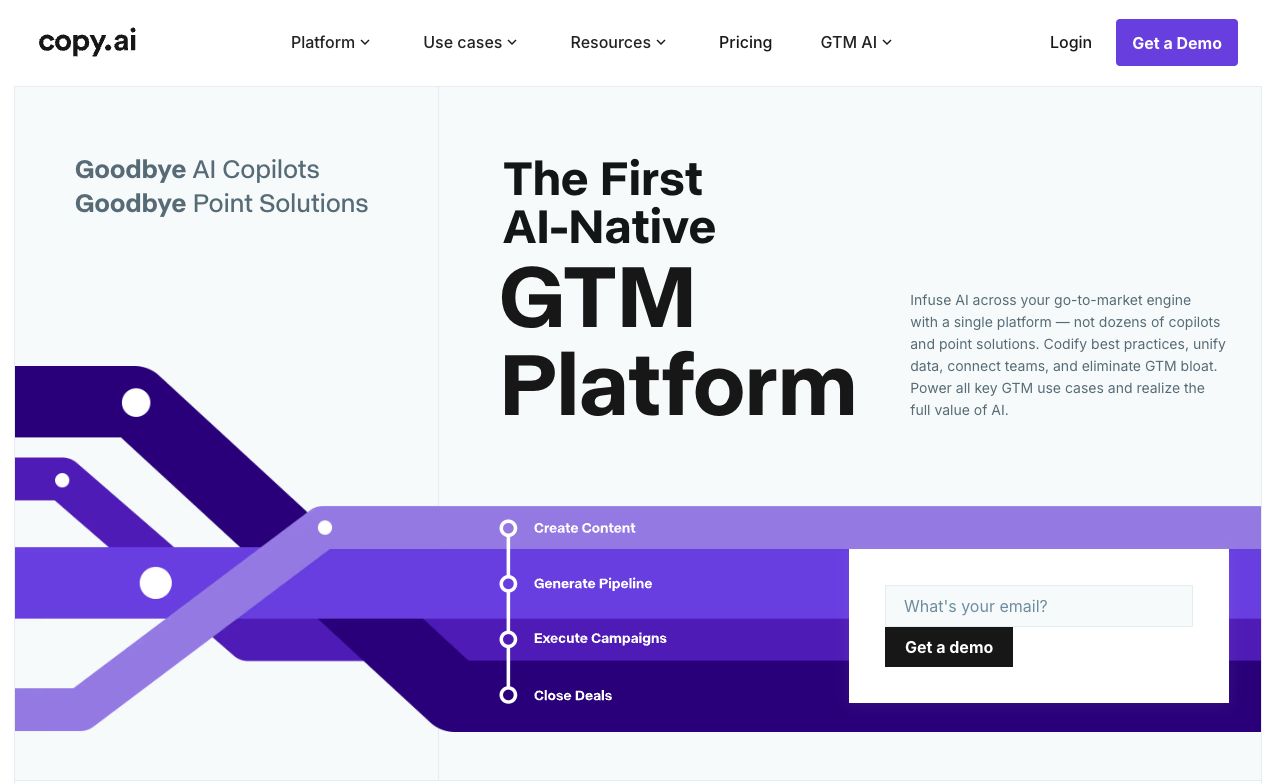
“Goodbye AI Copilots. The GTM AI Platform.”
These tools are not really competing. Copy.ai has explicitly pivoted away from being an AI writing tool - their current positioning is 'Goodbye AI Copilots, Goodbye Point Solutions.' It's now a GTM automation platform whose primary use cases are sales prospecting cockpits, inbound lead processing, CRM enrichment, deal coaching, and account-based marketing.
Visit Copy.ai
What is Writesonic?
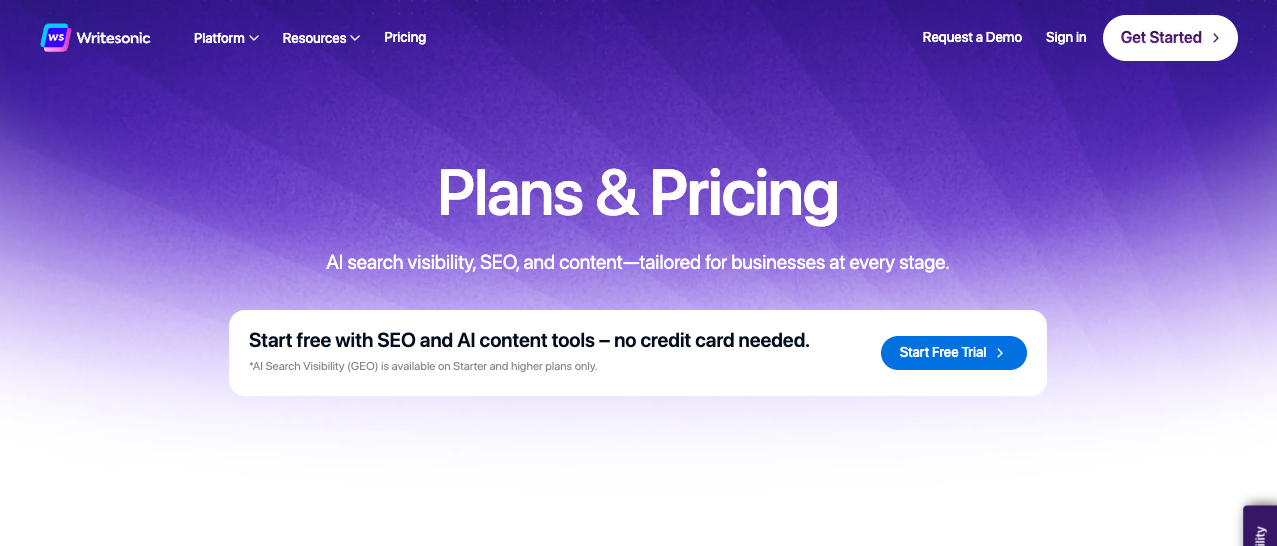
“AI Search Visibility Tracking & Optimization — from $39/month”
Writesonic has made a clear strategic pivot: it's no longer primarily an AI writing tool — it's an AI Search Visibility platform. The homepage leads with brand monitoring across ChatGPT, Perplexity, Gemini, and 10+ AI platforms.
Visit WritesonicWritesonic wins this category with complete dominance - it is one of the few platforms that has made AI brand monitoring its primary product. The platform tracks how your brand is cited across ChatGPT, Claude, Perplexity, Gemini, and 10+ additional AI platforms, measuring share of voice, citation rate, sentiment, and competitor citation comparisons. Its AI Visibility Action Center then translates that monitoring data into specific recommended actions: which pieces of content to create, which existing pages to refresh, and which high-authority sites to target for mentions. The proprietary dataset of 120M+ real AI chatbot conversations gives it genuine visibility into what users are actually asking AI systems that no traditional SEO keyword tool can provide. Copy.ai has no AI visibility monitoring of any kind. It is a GTM automation platform with no generative search presence tracking.
Copy.ai wins this dimension equally decisively. Its Workflows engine is the central product: configurable multi-step automations for sales prospecting, CRM enrichment, inbound lead processing, personalized outbound sequence generation, and account-based marketing campaigns. Teams have used it to process large-scale lead databases and generate hundreds of thousands of personalized content pieces from structured data without manual intervention. Writesonic is a content and SEO platform. It has no prospecting tools, no CRM automation, no workflow builder for sales sequences, and no lead processing infrastructure. Revenue operations teams should look only at Copy.ai for GTM automation needs.
For content creation specifically, Writesonic has the more accessible and complete offering at a lower entry price. Its $39/month Starter plan includes the AI Article Writer, 80+ short-form content templates, SEO site audit, Google Keyword Planner integration, and Chatsonic for real-time AI-assisted research. The article writer includes source citations and brand voice configuration. Copy.ai's Chat plan at $29/month provides a conversational AI interface that can generate short-form copy through prompting, but it cannot automate content production workflows. Content marketing teams that need an accessible tool for article drafting, short-form copy, and SEO optimization in one platform will find Writesonic a more complete option than Copy.ai. The caveat: Writesonic's article output, like most AI writing tools, still benefits significantly from human review before publishing - the 'AI vibe' that Reddit users describe is a real quality ceiling.
Writesonic's pricing is straightforward: $39/month Starter for the complete platform, $99/month Basic for more volume and Ahrefs integration, $249/month Growth for scaling teams. Annual billing gives 20% off across all plans. The $39/month Starter genuinely delivers usable GEO tracking, article production, SEO audit, and keyword research capability - it's not a stripped-down half-product. Copy.ai's pricing structure continues to generate buyer frustration: the $29/month Chat plan has no workflow automation capability. Meaningful automation starts at $1,000/month on the Growth plan - a pricing cliff that catches teams off guard when they were expecting a writing tool, not an enterprise GTM platform. For any team evaluating on price and accessibility, Writesonic's transparency is clearly better.
Both tools suffer from a breadth-vs-depth tradeoff that users consistently flag in community reviews. Writesonic bundles GEO tracking, article writing, SEO audit, keyword research, Chatsonic, and community targeting into one platform - impressive scope at $39/month but the breadth means none of the individual tools go as deep as specialized alternatives. The article writer is capable but not autonomous. The GEO tracking is genuinely useful but some reviewers note it 'identifies opportunities but doesn't execute them.' Copy.ai's breadth tradeoff is different: it is deeply capable for revenue operations automation at the Growth tier, but the gap between the entry price ($29) and the capability tier ($1,000) means most buyers experience a shallow product before discovering what the platform actually does. Both tools leave users wanting more depth in the specific category they bought them for.
Writesonic Starter at $39/month delivers: GEO tracking for 1 project, AI Article Writer, SEO site audits, Chatsonic, and Google Keyword Planner integration. Writesonic Basic at $99/month adds Ahrefs integration, more audits, and additional domains. Writesonic Growth at $249/month is for teams scaling content production with higher volume and more seats.
Copy.ai Chat at $29/month is a conversational AI interface; no workflow automation is included. Copy.ai Growth at $1,000/month unlocks meaningful workflow automation for GTM teams. Copy.ai Scale at $3,000/month for enterprise.
From a content-only perspective, Writesonic at $39/month provides far more accessible capability than Copy.ai at any comparable price point. For GTM automation, Copy.ai's $1,000/month plan has no Writesonic equivalent.
Copy.ai's core limitation for content and SEO teams is that it's no longer trying to serve them at an accessible price. The GTM repositioning has moved SEO article production, AI visibility tracking, keyword research, and content scoring entirely out of scope for the affordable tiers. The $29/month Chat plan generates copy conversationally but cannot automate any content workflow. Meaningful content automation requires the $1,000/month Growth plan plus custom workflow configuration with no SERP research, AI visibility monitoring, or SEO tooling built in.
Users who signed up for Copy.ai as a content tool frequently discover they need a fundamentally different product category. For content marketing teams evaluating AI writing tools, Copy.ai's current positioning means it's the wrong tool for the job.
Writesonic's most consistent user complaint across Reddit is that its article output still requires significant human editing before publishing. The 'AI vibe' - generic phrasing, clichéd openings like 'in today's world,' the detectable AI rhythm - is frequently cited as a quality ceiling that makes Writesonic articles unsuitable for publish-ready content without manual polish. Experienced users treat it as a draft generator and ideation tool, not a publisher.
The platform's second limitation is platform overload: 80+ tools across content writing, GEO tracking, SEO auditing, keyword research, and community targeting creates a cluttered dashboard that overwhelms new users who wanted a simple writing tool. The breadth makes it feel less like a focused product and more like a suite that's trying to do everything. Key advanced features - including the full GEO tracking capability and Ahrefs data - are gated behind more expensive tiers, which means the $39/month Starter has meaningful limits on the platform's core differentiating feature.
These tools answer different questions. If you're asking 'where does my brand get cited in AI search, and how do I improve that?' - Writesonic is the purpose-built answer. Its GEO tracking, AI search volume data, and Action Center recommendations make it the most focused platform in this space for AI brand visibility optimization. The $39/month Starter is an accessible entry point.
If you're asking 'how do we automate our sales prospecting, CRM enrichment, and outbound sequences with AI?' - Copy.ai at $1,000/month is the purpose-built answer. The GTM workflow automation, Tables data layer, and Prospecting Cockpit are built for revenue operations teams.
Neither tool is ideal for SaaS teams that need autonomous conviction-quality content production. Writesonic's articles require human editing and GEO key features are premium-gated. Copy.ai's content capability is buried behind $1,000/month of GTM-oriented features. For SaaS comparison pages and alternatives guides that require factual precision and brand authority, look beyond both.
The gap both tools leave is the same one that affects every tool in the content-adjacent market: producing SaaS-specific buyer-stage content that is factually precise, brand-authentic, and genuinely conversion-oriented without requiring a writer. Writesonic tracks AI citations and generates SEO articles - useful tools, but the article output needs human editing and the GEO tracking tells you what to fix rather than fixing it. Copy.ai automates GTM workflows but isn't trying to solve content production at any accessible price.
For SaaS companies, the articles that matter most - comparison pages, alternatives guides, vs articles - are the ones that intercept buyers who are actively deciding between your product and competitors. These articles need accurate competitor pricing, correct feature representations, and writing that sounds like an expert practitioner wrote it rather than an AI that consumed a training corpus. Writesonic's instinct to connect AI search visibility with content production is correct, but the article production side doesn't yet match the aspiration.
Alfa completes that loop. It produces the articles that build the citation-worthiness that Writesonic tracks. The Research Agent pulls live SERP data so every factual claim is grounded. The Fact-Checker Agent validates pricing and features before the article ships. The Sub-Editor Agent removes the AI phrasing that makes Writesonic outputs trigger detection - the generic transitions, the clichéd openings, the detectable rhythm. The output is a CMS-ready article you can publish, not a draft you spend an hour editing.
For SaaS teams that want to be cited by AI search: the content Alfa produces is why AI platforms cite products. Content that is authoritative, factually precise, and structured around buyer intent becomes the source that ChatGPT and Perplexity reference when someone asks 'what's the best [category] tool.' Writesonic shows you where the gap is; Alfa fills it.