Frase and SEObot are both positioned around automated SEO content, but they draw the automation boundary at very different places. Frase researches, briefs, and scores content - then hands off to a human writer who produces the article. SEObot is the full loop with no handoff: it discovers keywords, writes articles up to 4,000 words, generates images, embeds YouTube videos, builds internal links, and publishes to your CMS automatically. At the same $49/month entry price, you are choosing between better research for a writer you already have, or a fully autonomous SEO robot replacing the writer entirely.

What is Frase?
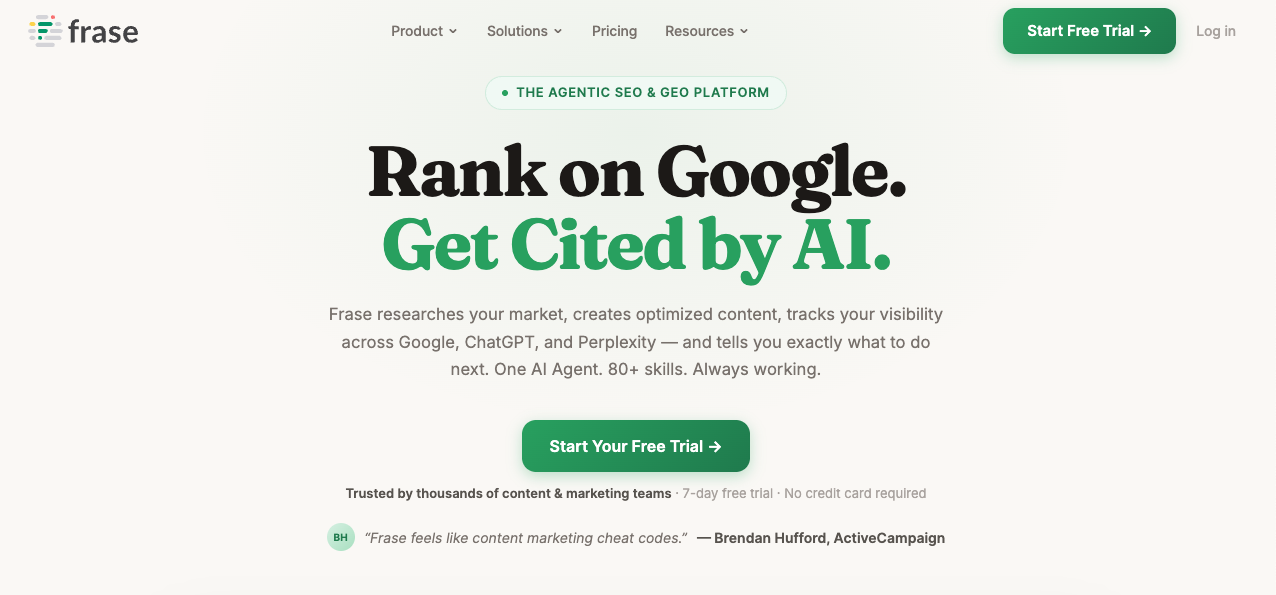
“Rank on Google. Get cited by AI.”
Frase and Alfa are both AI-powered content tools - and that's where the similarity ends. Frase is a full-stack SEO and GEO platform built for content marketing teams.
Visit Frase
What is SEObot?
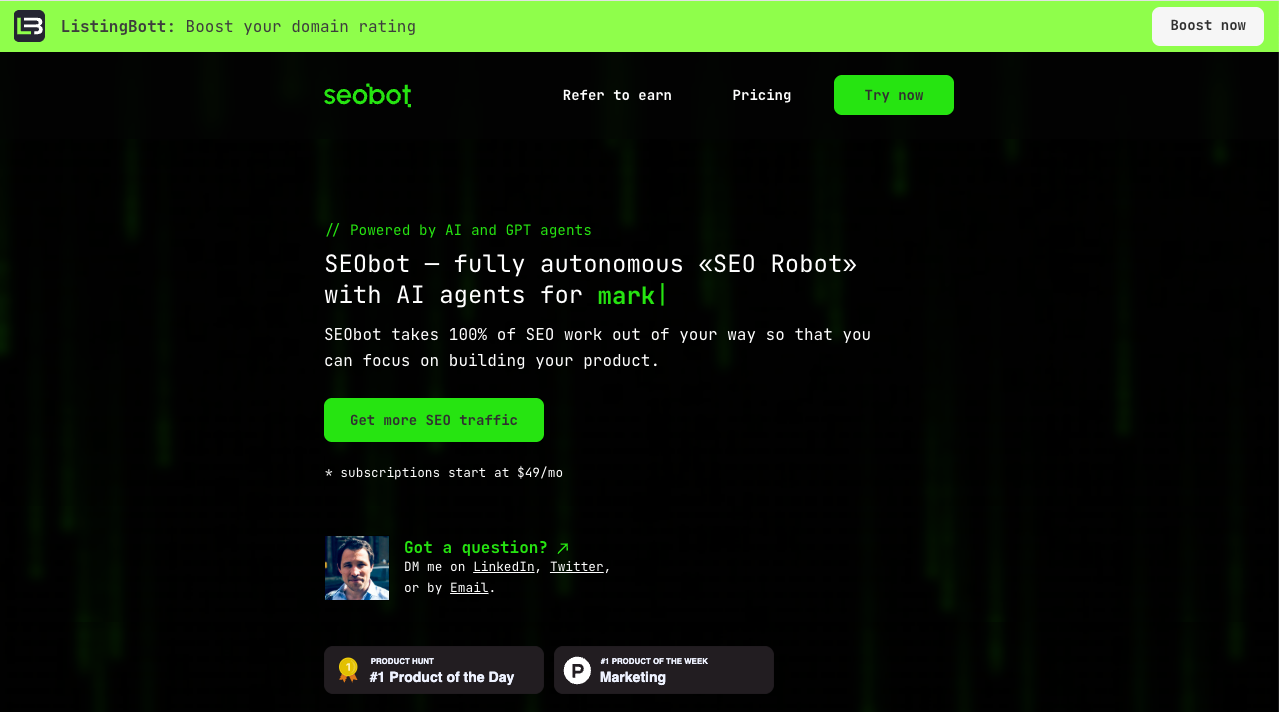
“Fully autonomous SEO robot - takes 100% of SEO work out of your way”
SEObot and Alfa are both fully autonomous content agents. The fundamental difference is what they produce and for whom.
Visit SEObotThis is the fundamental design split. Frase is built around a human content team: the SERP Analyzer, content brief, and Content Score are all designed to make a writer's output better. A writer opens Frase, enters a keyword, reads the brief, writes in the editor, watches the score climb, and publishes when it's ready. The human is the critical path. SEObot removes the human entirely: connect your domain, set your niche, and the robot discovers keywords, generates articles up to 4,000 words, inserts AI images, embeds YouTube videos, builds internal links, and publishes to your CMS automatically. Which is 'better' depends entirely on whether you have a writer. For teams with writers, Frase's research depth produces better articles. For founders and small teams with no writer, SEObot is among the most complete autonomous content robots available at any price point.
Frase leads significantly on Generative Engine Optimization and has made this a strategic product priority. The Professional plan at $129/month includes AI brand monitoring across 8 AI platforms - tracking citation rates, share of voice, and sentiment analysis for your brand across ChatGPT, Perplexity, Gemini, and others. The Action Center translates this monitoring data into specific recommended actions: which pages to refresh, which content gaps to fill, which high-authority sites to target for mentions. Even the Starter plan at $49/month includes GEO optimization scoring built into the article editor. SEObot has no GEO features. Its articles are optimized for traditional search signals without any AI citation awareness or tracking. As AI search becomes a growing discovery channel for B2B and SaaS buyers specifically, the absence of any GEO layer in SEObot's pipeline is a meaningful gap for brands that care about how AI platforms represent their product.
Both tools claim some level of content quality assurance, but in meaningfully different ways. SEObot markets 'fact-checking + anti-hallucination + source citations' on its Starter plan - a genuine differentiator relative to simpler autonomous tools. However, this fact-checking operates at the LLM output level: validating that generated content cites sources and doesn't produce obvious factual errors. Frase gains its quality advantage from human review: a writer sees the SERP data, reads what's actually ranking, and makes editorial decisions about what the article should claim and how it should be structured. For general informational content, SEObot's automated fact-checking is reasonable. For competitive niches or claim-dense SaaS content where specific pricing, features, and positioning must be accurate, Frase's human-in-the-loop model provides the oversight that catches errors before publication.
As a pure SEO robot, SEObot's feature surface is substantially broader than Frase's. Beyond basic article generation, SEObot's higher tiers include: YouTube video-to-article conversion, AI news article generation, interactive SEO mini-tools embedded directly on your site (a genuinely differentiated link-building mechanism), AI backlink building, monthly article re-linking, and integrations with 9 CMS platforms (WordPress, Webflow, Ghost, Shopify, Framer, Wix, Notion, HubSpot, Squarespace). REST API, Webhooks, Zapier, and Make integrations allow custom automation workflows on top of the core pipeline. Frase is focused on the research-to-publish workflow for human writers and doesn't compete in any of these robot-specific features. For teams evaluating the maximum autonomous SEO capability in one system, SEObot's feature set goes significantly further than Frase's scope.
Both tools enter at $49/month, which makes the comparison direct. Frase Starter includes SERP analysis, content briefs, 10 AI-assisted articles/month, real-time content scoring, GEO optimization basics, 50 audit pages/month, and WordPress publishing - all requiring a writer. SEObot Starter at the same price includes fully autonomous keyword research, article generation (up to 4,000 words), AI images, YouTube embeds, internal and external linking automation, monthly re-linking, publication to 9 CMS platforms, and 50 languages - all without a writer. If you have a content team, spend the $49 on Frase and get substantially better research infrastructure. If you have no writer and just want content published, spend the $49 on SEObot and get an autonomous robot doing work that would otherwise require significant freelancer spend. The entry price is identical; the buyer need determines the correct choice.
Frase Starter at $49/month: SERP research, 10 AI-assisted articles/month, content scoring, GEO optimization, 50-page audits, WordPress publishing. 7-day free trial, no credit card. Frase Professional at $129/month: adds 3 user seats, 5 domains, 40 articles, 250 audit pages, AI visibility monitoring across 8 platforms, content repurposing. Frase Scale at $299/month for agencies and programmatic SEO at volume.
SEObot Starter at $49/month: full autonomous pipeline, auto keyword research, articles up to 4,000 words, AI images, YouTube embeds, internal/external linking, 9 CMS integrations, 50 languages, and a full refund guarantee after the first article. Higher tiers from $49+/month add programmatic SEO, YouTube-to-article, news generation, interactive mini-tools, AI backlinking, and REST API/Webhook access.
The $49 entry point is the same. The value calculus differs entirely by whether you have a writer. With a writer, Frase produces better articles at better quality through research depth. Without a writer, SEObot's autonomous pipeline produces more published articles per dollar than Frase ever could.
Frase's fundamental limitation in this comparison is its dependency on the human writer it is designed to assist. Every feature - the SERP Analyzer, the content brief, the Content Score - is scaffolding for a person who does the writing. For a solo founder, lean startup, or any team without a dedicated content role, Frase solves the research problem while leaving the production problem entirely untouched. Its 10 articles/month on the Starter plan reflects the reality that manual content production doesn't scale the same way autonomous generation does.
The GEO monitoring feature, which represents Frase's most compelling differentiation against SEObot, is gated behind the Professional plan at $129/month - nearly three times the Starter price. A team that deploys Frase Starter for research and scoring gets GEO optimization scoring in the editor but no cross-platform citation monitoring or Action Center recommendations. They'll need to upgrade to unlock the feature most relevant to AI search visibility, which means the $49 entry price undersells the capability that makes Frase genuinely differentiated.
SEObot's core limitation is the quality ceiling set by the editorial oversight it removes. Autonomous generation without human review means whatever the AI produces at generation time is what appears on your site - including factual errors, generic phrasing, and content that is technically keyword-optimized but lacks the nuanced judgment an editor would bring. The 'fact-checking + anti-hallucination' claim on the Starter plan describes output-level LLM validation, not the claim-by-claim verification that a human editor or dedicated fact-checking agent would provide. For general informational blog posts on low-competition topics, this quality ceiling matters less. For SaaS companies where articles make specific competitive claims that buyers scrutinize, the absence of human editorial review is a meaningful risk.
SEObot also lacks any GEO capability. As AI search engines like ChatGPT, Perplexity, and Gemini become meaningful traffic and brand discovery channels, the absence of any AI citation tracking or GEO optimization in SEObot's pipeline means teams running it have no visibility into or influence on how their content appears in AI-generated answers. Frase's GEO features - even at the Starter tier's optimization scoring - address a gap that SEObot is currently not designed to close.
The verdict splits cleanly along one variable: do you have a writer? If yes: Frase. Its SERP analysis, content brief generation, real-time scoring, and GEO optimization infrastructure make every article your writer produces better-researched and more competitive. At $49/month, Frase Starter is among the strongest pure research-to-optimization setups for a content team. If AI search visibility matters to your team, upgrade to Professional at $129/month for citation monitoring across 8 platforms.
If no: SEObot. At the same $49/month, SEObot runs the complete autonomous content pipeline: keyword research, generation, images, YouTube embeds, internal linking, multi-CMS publishing, and 50-language support. The quality will be lower than Frase-assisted human writing, but it will be published and indexed without requiring a writing resource you don't have.
The edge case to note: Some teams use both. Frase handles high-priority strategic content where quality is non-negotiable - pillar pages, competitive comparisons, high-intent commercial pieces. SEObot runs autonomously in the background to build long-tail keyword coverage and topical authority across informational queries. The combined cost is $98/month for a two-track content program - not unreasonable for a growth-stage team that needs both quality and breadth.
The gap both tools share is specific to SaaS companies: neither is optimized for the content that converts SaaS buyers. Frase produces better research scaffolding for whatever a writer creates, and SEObot produces autonomous blog articles for any business without topic specialization. What neither provides is an autonomous pipeline that produces SaaS-specific comparison pages, alternatives guides, and vs articles where every competitive claim is verified before publication.
For SaaS companies, the articles that drive trial signups are not informational blog posts about industry topics - they are commercial-intent pieces where a buyer is comparing your product against competitors and making a purchase decision. These articles name competitor pricing tiers. They describe feature gaps. They make specific assertions about what your product does better. A wrong pricing number, a misrepresented feature, or a claim that was accurate when the LLM was trained but is outdated today destroys credibility with exactly the buyer who was about to convert. Frase's SERP research doesn't validate product claims. SEObot's fact-checking doesn't perform claim-by-claim accuracy audits at the article level.
Alfa handles this specific problem with dedicated infrastructure. The Research Agent builds a live competitor dossier from DataForSEO so every factual assertion is grounded in current information. The Fact-Checker Agent validates specific pricing and feature claims against that dossier before the article is packaged. The Sub-Editor Agent removes the AI writing patterns that both Frase-drafted and SEObot-generated content carries without a dedicated cleanup step. The entire 9-agent pipeline - Research, Strategy, Outline, Writer, Fact-Checker, Sub-Editor, Art Director, SEO Optimizer, Packager - runs end-to-end for a single article type: SaaS BOFU content.
Alfa is not a replacement for Frase's GEO monitoring, site audit tooling, or research infrastructure for general content teams. It is also not a replacement for SEObot's breadth-first autonomous publishing for high-volume, general-topic coverage. But for SaaS companies whose primary content goal is comparison pages and alternatives guides that convert buyers into trials, Alfa is the purpose-built pipeline neither tool can replicate.