Frase and Writesonic are converging - both now offer AI brand monitoring, SEO content writing, and GEO optimization, which makes this comparison more genuinely competitive than most tool-versus-tool pairings in this space. The meaningful differences are in emphasis: Frase is research-first, with the deepest SERP analysis and content scoring in the category. Writesonic is breadth-first, with more AI monitoring platform coverage (10+ AI platforms vs Frase's 8), a 120M+ real AI query dataset, and 80+ short-form content templates for multi-channel marketing teams. Both require a writer. Both track AI citations. The question is which research and production workflow fits your team's actual bottleneck.

What is Frase?
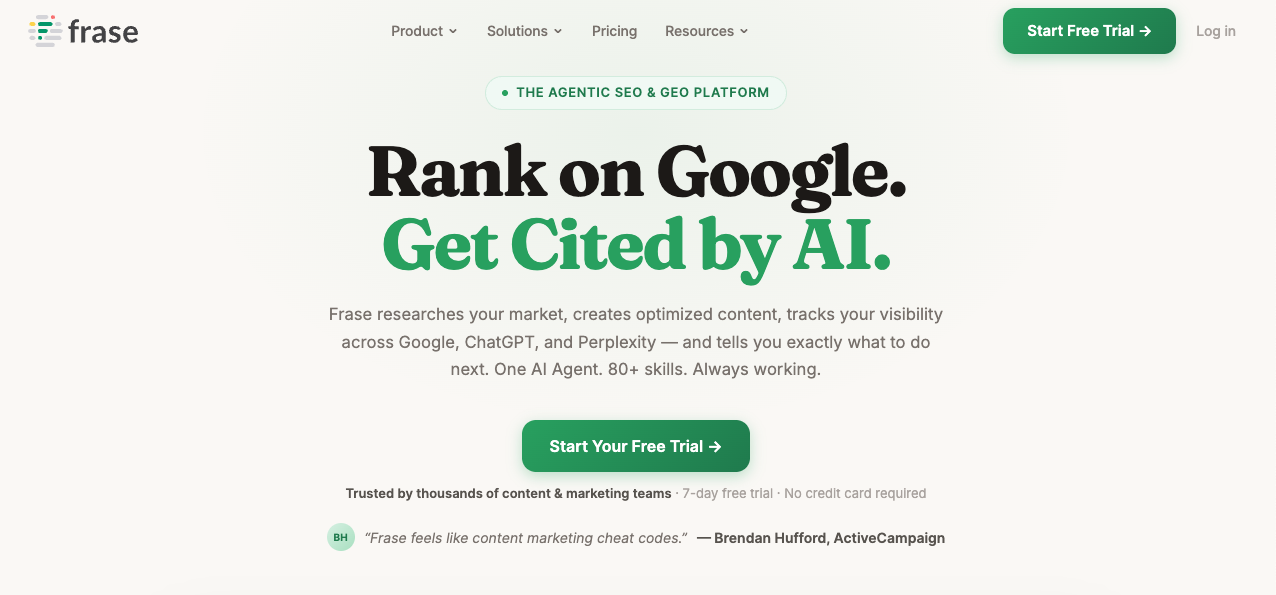
“Rank on Google. Get cited by AI.”
Frase and Alfa are both AI-powered content tools - and that's where the similarity ends. Frase is a full-stack SEO and GEO platform built for content marketing teams.
Visit Frase
What is Writesonic?
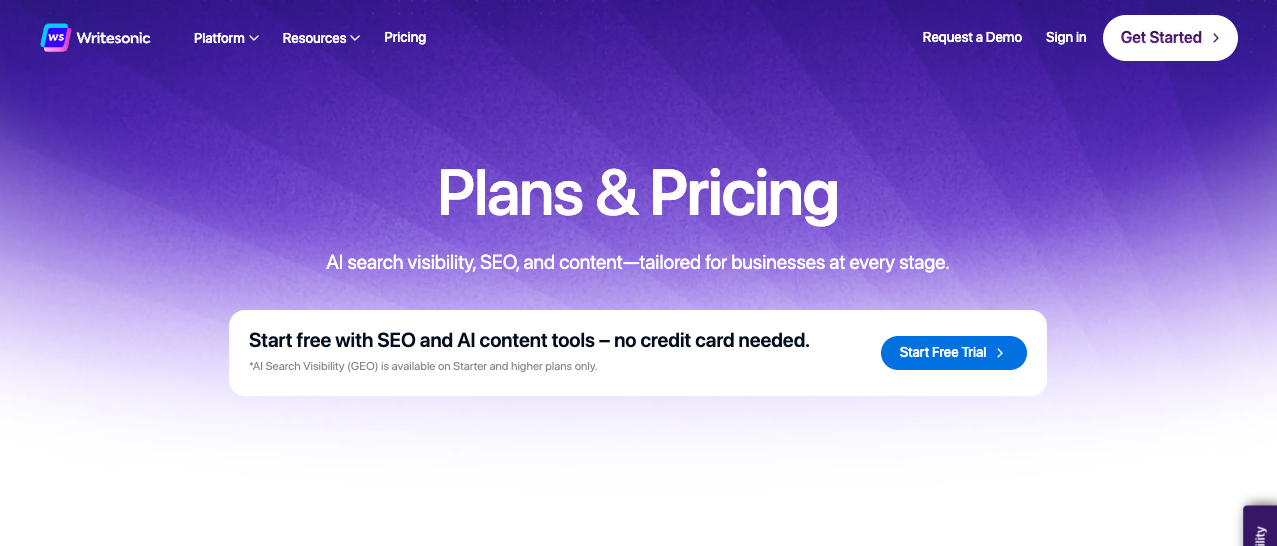
“AI Search Visibility Tracking & Optimization — from $39/month”
Writesonic has made a clear strategic pivot: it's no longer primarily an AI writing tool — it's an AI Search Visibility platform. The homepage leads with brand monitoring across ChatGPT, Perplexity, Gemini, and 10+ AI platforms.
Visit WritesonicFrase is the stronger research tool and wins this dimension among all tools in this space, not just this comparison. Its SERP Analyzer pulls real-time data from the top 20 search results for any keyword, maps competitor heading structures, identifies NLP keyword gaps, suggests word count targets, and generates a structured content brief a writer can execute within the same interface. The Content Score updates in real time as a writer types - giving immediate feedback on whether the article is hitting the topical coverage and keyword density needed to compete with what's actually ranking. Writesonic has SEO optimization capabilities and site audit tools, but the community consensus across third-party comparisons consistently positions Frase's SERP analysis depth as more granular and more actionable than Writesonic's equivalent. For writers and SEO strategists who need precise competitive intelligence before and during writing, Frase's research infrastructure is the best available at its price point.
Both tools monitor AI search citations - but Writesonic has the edge on breadth. Its GEO monitoring covers 10+ AI platforms on the Starter plan at $39/month, while Frase's AI brand monitoring is gated behind the Professional plan at $129/month and covers 8 platforms. Writesonic's AI Search Volume Explorer is genuinely differentiated: its proprietary dataset of 120M+ real AI chatbot conversations surfaces what users actually query across ChatGPT, Google AI Mode, and other platforms - real natural language prompts with volume data, not traditional keyword approximations. This is a data layer that Frase doesn't have. Writesonic also targets Reddit threads and UGC forums where target buyers ask questions - a community citation signal that feeds directly into AI search visibility. For brands prioritizing maximum AI platform coverage and real AI query intelligence at the lowest entry cost, Writesonic's GEO infrastructure is currently broader than Frase's.
Writesonic wins multi-channel content production decisively. Its 80+ purpose-built marketing templates cover every format a marketing team produces - ad headline sets, email subject lines, product descriptions, social captions in platform-specific formats, landing page copy, YouTube scripts, press releases. This breadth is built into every Writesonic plan, not gated at higher tiers. Frase added content repurposing on its Professional plan - turning a blog post into LinkedIn and Twitter formats - but this is a secondary feature layered on top of a research platform, not a purpose-built multi-channel content engine. For marketing teams producing content across multiple formats and channels simultaneously, Writesonic's template breadth is structurally more complete. If your team's content need is exclusively long-form SEO articles, this dimension matters less - but most marketing teams need both.
Writesonic delivers more total platform features at the lower entry price. The $39/month Starter includes GEO monitoring across 10+ AI platforms, an AI Article Writer with auto-citations, SEO site audit tools, Google Keyword Planner integration, and Chatsonic for real-time AI-assisted research - a genuinely complete toolkit for a solo content marketer. Frase's Starter at $49/month includes excellent SERP research, content scoring, and article production, but the GEO monitoring that makes Frase competitive in the AI visibility category is gated at $129/month. A team that wants Frase's full positioning (research + SERP scoring + GEO tracking) pays $129/month. Writesonic's equivalent capability costs $39-99/month. For budget-conscious teams, Writesonic delivers more accessible platform breadth. For teams that prioritize SERP research depth above all else, Frase's $49 plan is still the better research investment even without GEO monitoring.
Frase wins the programmatic SEO dimension without contest. Its Scale plan at $299/month includes infrastructure for generating 1,000+ data-driven pages from structured templates and data sources - the canonical use case for location pages, product directory entries, integration pages, and other template-driven SEO content at volume. Writesonic has no programmatic SEO module. Its content production approach is article-by-article through the AI Article Writer, not template-driven bulk generation. For SaaS companies or agencies that need to build out large-scale programmatic page sets - 'best [category] tools in [city]' or '[product] alternatives' landing pages at scale - Frase is the only tool of the two with an architecture designed for it. Writesonic's breadth in formats does not extend to programmatic scale.
Frase Starter at $49/month: SERP research, 10 articles/month, content scoring, GEO optimization in editor, 50-page audits, WordPress publishing (7-day free trial, no credit card). Frase Professional at $129/month: 3 seats, 40 articles, 250 audits, GEO monitoring across 8 platforms, content repurposing, API access. Frase Scale at $299/month: programmatic SEO at 1,000+ pages from data.
Writesonic Starter at $39/month: GEO tracking (10+ platforms), AI Article Writer, SEO audit tools, Chatsonic, Google Keyword Planner integration, 80+ templates, no credit card for trial. Writesonic Basic at $99/month: adds Ahrefs integration, higher volumes, additional domains. Writesonic Growth at $249/month: scaling teams with more audit and article volume. Annual billing gives 20% off.
Key pricing insight: Writesonic's full GEO monitoring is available from $39/month. Frase's equivalent feature requires $129/month. Teams that want AI visibility monitoring alongside content production get it at a lower price point from Writesonic. Teams that prioritize SERP research depth and content scoring get better infrastructure from Frase at $49/month even without GEO monitoring.
Frase's critical limitation in this comparison is that its most differentiated feature - AI brand monitoring across 8 platforms - is gated behind a 3x price jump from Starter to Professional. A team evaluating Frase for both SEO research and GEO tracking is looking at $129/month, not $49. At $129/month, the comparison against Writesonic's $39/month Starter becomes significantly less favorable from a pure value perspective: Writesonic delivers 10+ platform GEO monitoring, broader short-form content templates, Ahrefs integration (at $99), and auto-citations at a lower cost.
Frase's research depth advantage is real and meaningful for competitive SEO, but it is increasingly matched or supplemented by tools that combine research with broader marketing breadth. The platform's scope is also narrow: long-form blog articles and content strategy. For marketing teams that produce ads, emails, social content, and product descriptions alongside blog posts, Frase doesn't address multi-channel content needs without a complementary tool. Teams producing across formats will either pay for Writesonic's broader template library on top of Frase, or consolidate onto Writesonic and accept slightly less SERP research depth.
Writesonic's persistent user complaint across community reviews is the AI writing quality ceiling. Output from its Article Writer consistently reads with the 'AI vibe' - generic transitions like 'it's important to note,' overused phrasing patterns, and a detectable rhythm that signals machine-generated content to experienced readers and triggers AI detection tools without significant human editing. The breadth of 80+ templates is genuine; the depth of any individual output is less so. Users treating Writesonic as a drafting assistant for human editors find the most value; those expecting publish-ready output with minimal review are regularly disappointed.
Writesonic's AI Visibility Action Center identifies opportunities but doesn't execute them. It tells you which sites to target for backlinks, which content gaps to fill, which technical changes to make - and then leaves the doing to you. The GEO monitoring data is valuable; the platform's ability to close the loop from insight to action is limited relative to what the positioning implies. Frase's research-to-publish workflow gives a writer a more structured path from insight to published, scored article within a single tool interface.
Both tools now compete in the same conceptual space - SEO content plus AI visibility monitoring - but emphasize different parts. Frase is the right choice if SERP research depth and real-time content scoring are your primary requirements. No tool in the market produces more actionable competitive intelligence for a writer during the research and drafting process. If you care about outranking specific competitors on specific keywords, Frase's research infrastructure is unmatched at its price point. Note that GEO monitoring requires upgrading to $129/month.
Writesonic is the right choice if you want the broadest combination of GEO monitoring, article writing, short-form templates, SEO audit, and keyword research in a single platform at the lowest entry price. The $39/month Starter delivers a genuinely useful marketing stack - broader in scope than Frase Starter and with better pricing access to GEO features. If your team needs to produce across multiple content formats - blog, social, email, ads - Writesonic covers more ground per dollar.
The combined recommendation: Teams that write long-form content at high competitive difficulty levels should use Frase for the research depth it provides. Teams that need a full-spectrum marketing content platform from one affordable subscription should use Writesonic. Some teams run both: Frase for the serious SEO work on high-priority keywords, Writesonic for monitoring AI visibility and covering multi-channel content breadth alongside it.
Both tools position around the same content marketing problem - producing content that ranks and gets cited - and both leave the same gap unfilled: neither produces SaaS-specific comparison pages, alternatives guides, or vs articles autonomously, without a human writer coordinating between the research and production layers. Frase does the research brilliantly and then hands off to a writer. Writesonic generates articles across a broad range of formats but without the SERP-grounded research depth or the claim-validation step that SaaS BOFU content requires.
For SaaS companies specifically, the content that converts buyers is claim-dense by nature. A comparison page names competitor pricing tiers, describes feature availability, identifies known limitations, and makes assertions that a buyer who just visited the competitor's site will scrutinize. A wrong pricing number or outdated feature claim doesn't just reduce conversion - it actively signals to the buyer that your marketing is unreliable. Frase's SERP analysis surfaces competitive positioning data. Writesonic's article writer generates from that general knowledge base. Neither tool runs a dedicated verification step that cross-checks specific claims in the article against live competitor data before publishing.
Alfa's pipeline is built specifically for this verification requirement. The Research Agent pulls live competitor intelligence from DataForSEO. The Fact-Checker Agent validates each pricing and feature claim against that intelligence before the article is packaged. The Sub-Editor Agent removes the AI writing patterns that Writesonic's community consistently flags - the generic transitions, the detectable rhythm, the over-qualified phrasing that reads as machine-generated. The SEO Optimizer Agent handles on-page optimization internally, eliminating the need for a separate Frase or Surfer subscription for the SEO layer.
Alfa is not a substitute for Frase's programmatic SEO infrastructure, GEO monitoring platform, or site audit tooling. It is also not a substitute for Writesonic's multi-channel template breadth or 120M+ AI query dataset for content strategy. But for SaaS companies whose content goal is autonomous, factually verified BOFU articles - the specific content type that drives trial signups and pipeline - Alfa is the purpose-built pipeline that neither Frase nor Writesonic can replicate.