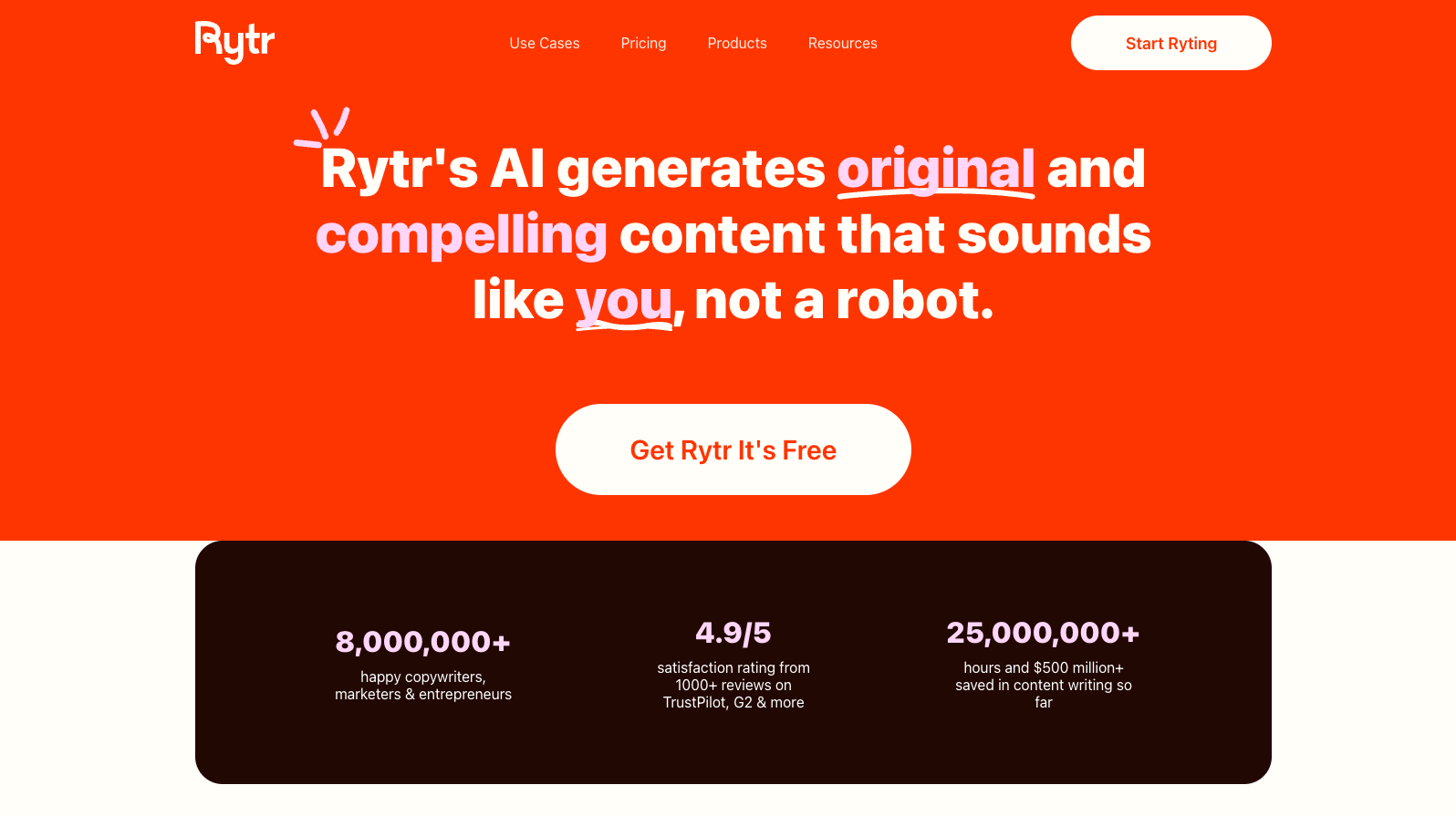
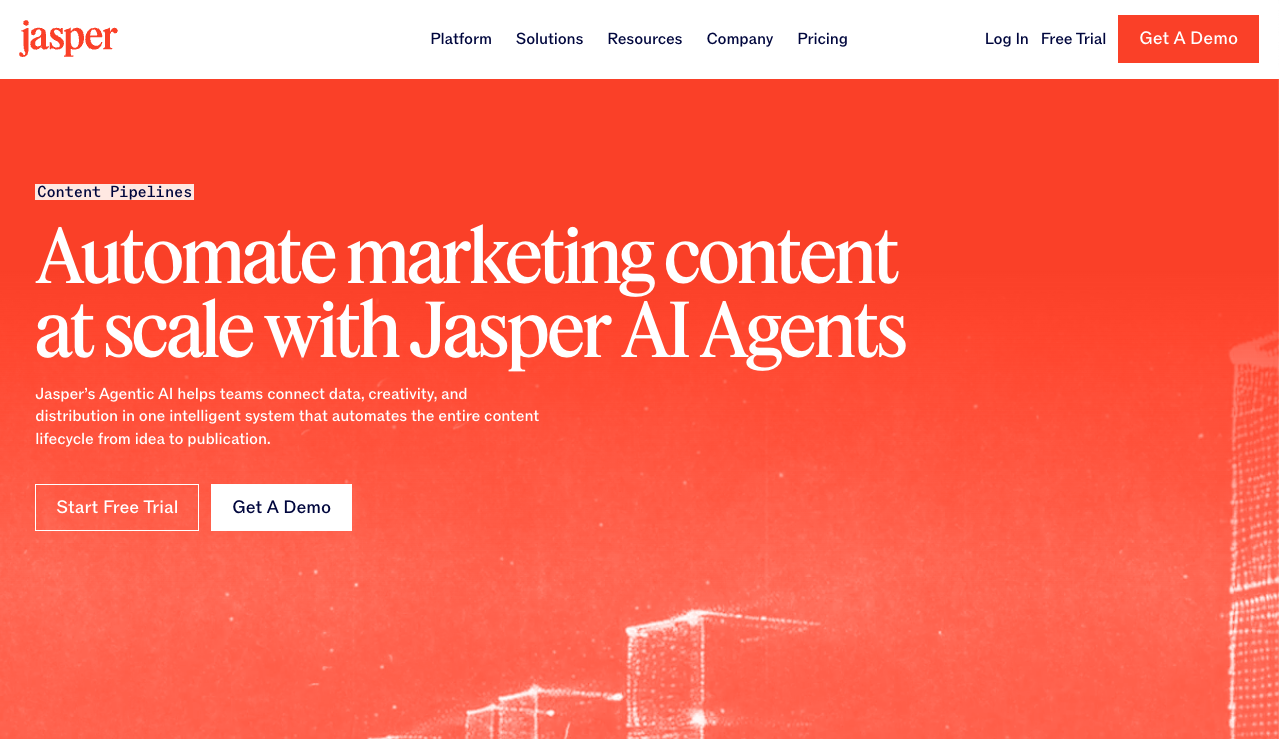
Jasper and Rytr are both AI writing assistants - but comparing them is less 'which is better' and more 'which league are you playing in.' Jasper at $69/month is a full marketing platform: brand voice enforcement, 100+ templates, team collaboration, Surfer SEO integration, and enterprise security. Rytr at $9/month is a lean individual writing companion: fast, easy, cheap, and excellent for short-form copy when you need a draft in under a minute. The buyer choosing between them is almost never a coin flip.

What is Jasper AI?
“On-brand AI content, everywhere you create”
Jasper is a general-purpose AI writing assistant built for any content type across any industry: ads, emails, social captions, blog posts, product descriptions, sales copy. It's a jack of all trades, and a capable one.
Visit Jasper AI
What is Rytr?
“Free AI Writer, Content Generator & Writing Assistant”
Rytr is a general-purpose AI writing assistant built for individuals and freelancers. It generates short-form copy - emails, social captions, CTAs, SEO meta titles, paragraph starters - across 40+ use case templates.
Visit RytrThe price difference between these tools is so large it almost defines the entire comparison. Rytr's Unlimited plan is $9/month for genuinely unlimited AI content generation. Jasper Pro is $69/month - nearly 8x more expensive - and requires a credit card even for the 7-day trial. Rytr also has a free forever plan with 10,000 characters per month, which is more than enough to evaluate whether the tool works for your use case before spending a cent.
For a freelance copywriter, a solo blogger, or a small business owner who primarily needs help with short-form tasks - email drafts, social captions, product descriptions - Rytr's price-to-utility ratio is difficult to argue against. The tool does its core job at a fraction of what Jasper costs. Users on Reddit and review platforms consistently flag Jasper's price as the primary friction point, particularly for individuals who don't use the full platform breadth.
Jasper's $69/month becomes defensible when you factor in what it bundles: brand voice configuration that learns from URLs and documents, 100+ marketing templates, an AI knowledge base, team collaboration, image generation, and Surfer SEO integration. For a small marketing team sharing an account and generating output across multiple content types, the per-seat cost amortizes quickly. For a single freelancer writing emails and captions, it doesn't.
Rytr wins on pricing and accessibility for any individual or budget-constrained buyer. Jasper is only defensible at team level where the platform breadth is actually used.
Long-form is where the tools genuinely diverge on capability, not just price. Jasper's long-form editor maintains context across thousands of words, supports structured document workflows, and applies brand voice configuration consistently throughout an extended draft. Users familiar with both tools consistently note that Jasper produces far more coherent long-form output - it's built around the document editing paradigm and handles complex content structures without the repetition and drift that shorter-window tools exhibit.
Rytr's long-form struggles are well-documented by users. Content loses coherence and begins repeating ideas beyond a few hundred words. The tool is architecturally designed for short outputs - paragraph starters, section copy, email bodies - not multi-section articles that need to maintain a logical thread across 2,000 words. Users on Reddit and review sites frequently describe Rytr as excellent for quick drafts but requiring heavy editing for anything resembling a complete article. The interface also separates the chat function from the main editor, which forces awkward copy-paste workflows when trying to build out longer pieces.
For blog content, white papers, case studies, or any content that requires narrative structure across multiple sections, Jasper is the materially better tool. Rytr is best treated as a draft accelerator for content fragments, not a long-form writing partner.
Jasper wins on long-form content quality. For a more SEO-specialized long-form option, see Frase, which builds structured briefs and optimization layers on top of article drafting.
Brand consistency is the dimension that most clearly separates a professional platform from a personal writing tool. Jasper's Brand Voice system learns from your website, style guide documents, and explicit tone instructions - then applies that voice across every template, every document, and every team member's output. On the Business plan, this extends to multiple brand profiles, role-based permissions, shared workspaces, and content governance workflows that ensure an agency's client content or an in-house team's output stays on-brand regardless of who generates it.
Rytr's 'My Voice' feature is a starting-point tone approximation: you paste in a writing sample, and Rytr attempts to mirror the style in subsequent outputs. It works at the paragraph level for short copy. It doesn't have a knowledge base, doesn't enforce terminology rules, and doesn't persist reliably across a long document. For a solo freelancer writing in their own voice, this is adequate. For a team that needs multiple writers producing consistent output for multiple brands, it's insufficient by a wide margin.
Rytr also has no collaborative infrastructure at all - it's a single-user tool. Jasper on Pro or Business supports shared folders, content permissions, and multi-seat generation from a shared brand context. For any workflow involving more than one person, this distinction matters immediately.
Jasper wins on brand voice and team workflow - it's not a close comparison for any team-level use case.
For the everyday short-form tasks that most content creators actually spend the majority of their time on - email drafts, social captions, product descriptions, CTAs, meta descriptions, reply copy - both tools perform the job adequately, and the quality difference doesn't justify an 8x price gap.
Jasper's 100+ marketing apps cover every imaginable short-form format: Facebook ad copy, Amazon product listings, LinkedIn thought leadership posts, YouTube descriptions, press releases, interview questions. The template depth is genuinely impressive. The Chrome Extension lets you access these templates directly inside Gmail, Google Docs, or LinkedIn without switching context.
Rytr's 40+ use case templates cover the core formats that most individual creators and small businesses actually use. Its Chrome Extension offers the same in-browser workflow. For the most common tasks - email subject lines, social captions, paragraph drafts, and product copy - Rytr produces usable output at a speed that matches Jasper.
The honest verdict for short-form is that Jasper is broader and Rytr is cheaper, but for most individual writing tasks, the difference in output quality is not 8x. If you're a freelancer handling client emails, social posts, and occasional blog sections, Rytr's $9/month Unlimited plan covers the job. Jasper's breadth earns its price when a marketing team is genuinely using 20+ template types across 5+ content channels.
This dimension is a tie for everyday short-form tasks. Jasper wins on breadth; Rytr wins on value per task.
Neither tool is an SEO platform, but Jasper has a meaningful structural advantage through its Surfer SEO integration on the Pro plan. When activated, Surfer's content scoring overlay sits inside Jasper's editor in real time - you can see keyword density, content score, semantic term coverage, and competitive gap analysis as you write. It's not a native feature of Jasper itself, and it requires a separate Surfer subscription to unlock, but the combined workflow is a legitimate on-page optimization tool.
Rytr's SEO capabilities are limited to a basic SERP analyzer and keyword generator bundled into the platform. Users who compare it to dedicated tools consistently describe the SEO features as "surface-level" - useful for identifying a keyword to target but lacking the search volume data, competitive difficulty scoring, and real-time content optimization that Surfer, Frase, or even Writesonic provide. Integrating keywords into the generated content is also largely a manual process.
For a content creator whose primary concern is search ranking, Jasper's Surfer integration makes it the better starting point - though it's worth noting you're paying for both tools to make that work. Rytr's SEO tooling is best treated as basic keyword prompting rather than any kind of optimization workflow.
Jasper wins on SEO capability - its Surfer SEO integration creates a genuine optimization workflow that Rytr has no equivalent for.
The pricing math is stark. Jasper Pro is $69/month for unlimited AI writing across 100+ templates, brand voice configuration, image generation, and a 7-day trial (credit card required). Rytr Unlimited is $9/month - nearly eight times cheaper - for unlimited content generation with one tone match and a Chrome Extension. Rytr also offers a free forever plan at $0 with 10,000 characters monthly, and a Premium plan at $29/month for multiple tone profiles, 35+ languages, and custom use cases.
The honest cost-per-use calculation depends on what you're generating. For a freelancer producing 50 short-form copy pieces a month, Rytr at $9 is $0.18 per piece. Jasper at $69 is $1.38 per piece - and you're using a fraction of the platform. For a marketing team of 3-4 people generating long-form articles, multi-format campaign content, and collaborative workflows, splitting Jasper at $69/month across the team brings it closer to $17-23 per seat - becoming genuinely competitive against Rytr. The tool's pricing only makes sense when the whole platform is being used.
Jasper's most persistent complaint is its price relative to output quality for individual users. On G2 and Reddit, the recurring pattern is clear: professionals who use the full platform across multiple content types and team members find it worth the price. Individual freelancers and solopreneurs who only need a drafting assistant feel they're overpaying for capabilities they never touch. The platform has evolved into an enterprise marketing tool, and the pricing reflects that trajectory more than the needs of a solo operator who wants to write faster.
The second limitation is output quality at the editing stage. Jasper's raw output - despite its brand voice features - can still read as generic, repetitive, or tonally flat, particularly on first-generation drafts without strong prompting. G2 reviewers consistently note that getting high-quality output requires mastering Jasper's prompting patterns, which creates a learning curve that takes days or weeks to move through. The platform's depth is also its complexity - the 100+ templates are powerful once you know which to use, but overwhelming when you're new.
There's no fact-checking layer. Jasper generates from its training data and your prompt context. For marketing copy with specific claims - competitor pricing, product specifications, statistics - every output requires human verification before publishing. This is not unique to Jasper, but it's worth naming: the research step remains entirely manual, and Jasper can and does hallucinate specifics when asked to generate factual content without explicit source material provided.
Rytr's fundamental limitation is long-form coherence. The tool was designed for short-form outputs, and it shows clearly when you try to produce anything requiring narrative structure across multiple sections. Users report that content becomes repetitive and shallow beyond a few hundred words - ideas start to loop, phrasing recycles, and the logical thread of an argument loses its way. For blog posts, case studies, or any article meant to genuinely inform a reader, Rytr produces adequate fragments that still require significant human work to assemble into something publishable.
The interface structure compounds this problem. The chat function and the main document editor are separate environments in Rytr, which means building out a long-form piece requires constant copy-pasting between contexts. It's a workflow friction that Jasper's unified long-form editor doesn't impose. For short-form tasks where you generate a caption and paste it directly into a social scheduler, this doesn't matter. For anything requiring iteration across a document, it adds real friction.
Output detectability is the third limitation. Rytr's content is frequently flagged by AI detection tools as machine-generated. There's no cleanup layer - no equivalent of a sub-editing pass to remove the characteristic AI phrases: the 'in today's fast-paced world' openers, the 'it's worth noting' transitions, the rhythmic patterns that immediately signal automated writing to any experienced reader or detection system. For brands building content credibility, this gap compounds over time. See Alfa for how a dedicated Sub-Editor Agent changes this calculus for SaaS content pipelines.
For most buyers, the decision is determined by budget and team size before any feature comparison happens. If you're a solo creator, freelancer, or small business owner who needs a capable writing tool for short-form tasks at a price that fits a bootstrap budget, Rytr at $9/month is the rational answer. Eight times the price does not deliver eight times the utility for an individual running through email drafts and social captions.
Jasper is the right answer for professional marketing teams that are actually going to use a broader feature set: multi-brand voice management, team collaboration, long-form document workflows, Surfer SEO integration, and an enterprise security posture. At the team level - three or more marketers sharing a Pro subscription and using it across multiple content types and channels - Jasper's per-seat cost becomes competitive and the platform depth earns its price. For a single individual only needing a drafting tool, it doesn't.
The scenario where Rytr beats Jasper even at a professional level: multilingual short-form content at scale. Rytr's Premium plan at $29/month supports 35+ languages and unlimited generation. For an e-commerce or local business brand producing social captions, product descriptions, and reply copy across multiple language markets, Rytr Premium delivers significantly more value per dollar than Jasper. Choose Jasper if you're a marketing team running content operations at scale. Choose Rytr if you're an individual needing affordable, accessible writing assistance. The tools aren't competing for the same buyer.
Both Jasper and Rytr share the same structural gap: neither was built to produce content autonomously. In both tools, a human is steering the output at every step - choosing the template, reviewing the draft, editing and expanding, adding research, and deciding when it's ready to publish. Jasper makes a skilled human faster. Rytr makes a budget-conscious human faster. Neither removes the human from the writing process.
For SaaS companies that need comparison pages, alternatives guides, and vs articles - the content that ranks for commercial-intent keywords and actually converts buyers into trial signups - this matters enormously. The articles that perform in SaaS search don't just need to be well-written; they need live competitor research baked in, claim-by-claim factual validation, and prose that reads like a practitioner wrote it, not a template. Producing that quality with Jasper requires a skilled writer who knows how to prompt well and still does significant editing. Producing it with Rytr requires even more manual work on top of shallower raw output.
Alfa's 8-agent pipeline removes the human from the writing step entirely for SaaS-specific content. The Research Agent builds a live competitor dossier from DataForSEO. The Strategy Agent prioritizes the highest-converting BOFU keywords. The Writer Agent drafts the article, the Fact-Checker Agent validates every pricing and feature claim, and the Sub-Editor Agent strips out the AI writing patterns that Jasper and Rytr both leave in the output. The Packager Agent delivers a CMS-ready article to WordPress.
If you're a SaaS company and your content bottleneck is comparison pages, alternatives guides, and vs articles, Alfa is built for that specific job. If you're a general content team needing drafting assistance across many formats, Jasper is the more powerful of these two tools. Alfa isn't the right tool for social captions or email copy - it's the specialist pipeline for the BOFU articles that move SaaS buyers from search to trial.