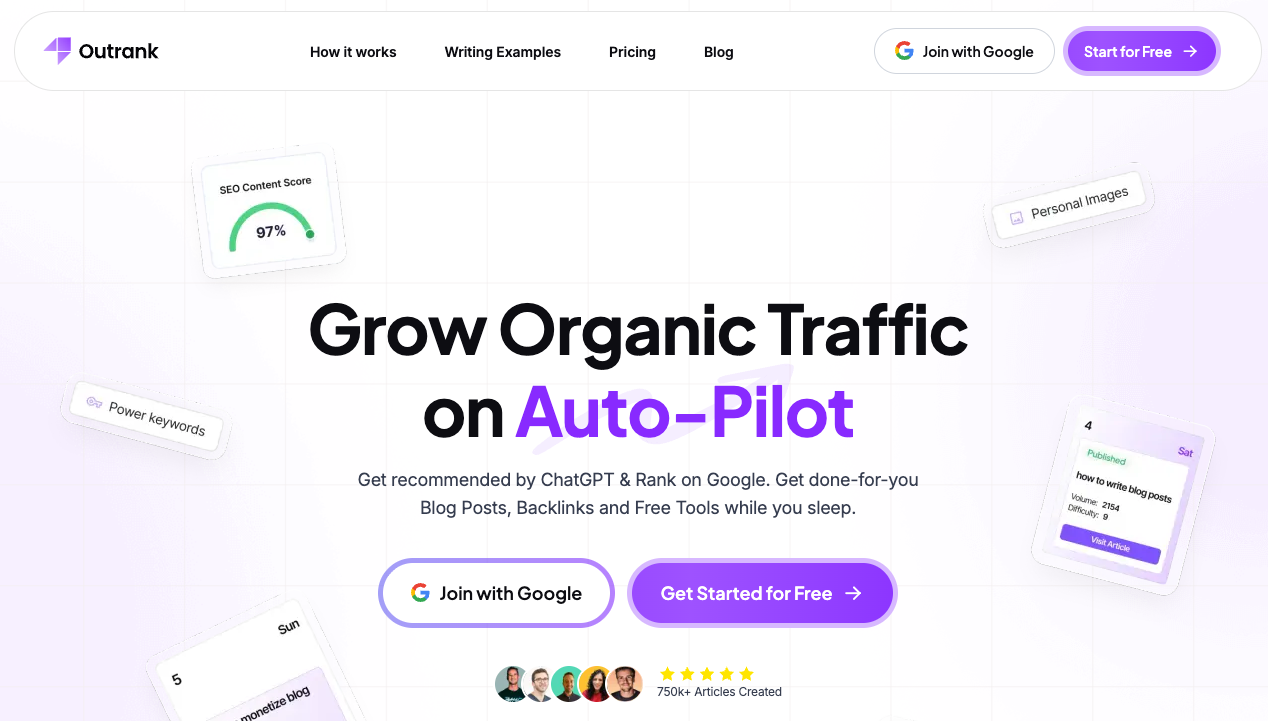
Outrank and Writer are almost never evaluated by the same buyer, and reading this comparison will clarify why. Outrank is a fully autonomous SEO content publisher: it discovers keywords, writes articles up to 4,000 words, builds backlinks, and publishes to six CMS platforms at 30 articles per month - with no human involved. Writer is an enterprise AI platform for Fortune 500 companies: Palmyra LLMs, Knowledge Graph infrastructure connecting agents to internal data systems, HIPAA-eligible compliance architecture, and multi-department AI orchestration. One eliminates the writer. The other governs how an entire organization uses AI safely.

What is Outrank?
“Grow organic traffic on auto-pilot with done-for-you blog posts”
Outrank and Alfa are both autonomous content systems. The difference is who they're designed for.
Visit Outrank
What is Writer?
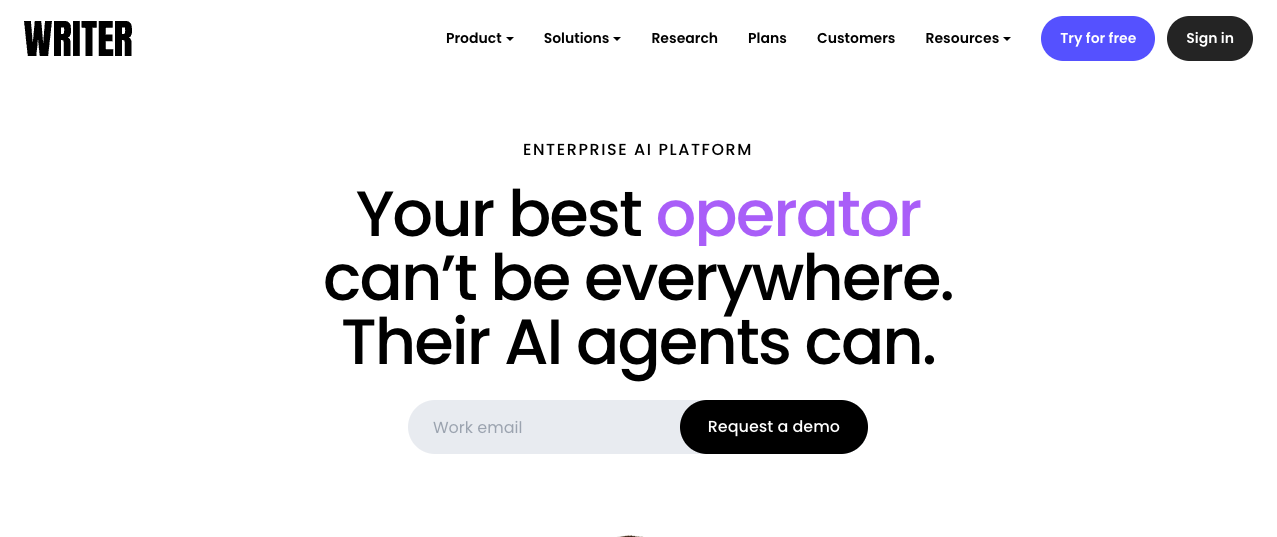
“The enterprise AI platform for agentic work”
Writer is a horizontal enterprise AI platform built for Fortune 500 companies - it handles marketing workflows, sales rep productivity, retail merchandising, and financial services research all from one interface. Content production is one of many use cases inside a platform designed for enterprise orchestration at scale.
Visit WriterOutrank is purpose-built for autonomous content publishing and is substantially more capable in this dimension than anything Writer provides. The $99/month plan delivers 30 articles per month - keyword research, generation, AI images, YouTube video embeds, internal and external linking, monthly re-linking, and publication to six CMS platforms - with no human writer at any stage. The Backlink Exchange builds link acquisition automatically in the background. Writer can generate content through its marketing Playbooks, but it is not designed as a hands-free publishing robot: it requires organizational context, Playbook configuration, and human review before content goes live. Writer is a platform for governing how humans and AI collaborate on content; Outrank is a platform for removing humans from the content production loop entirely. For businesses that want content published on autopilot without writing resources, Outrank is the only relevant tool between these two.
Writer leads every enterprise infrastructure dimension by a significant margin and this is precisely the use case it was built for. The Knowledge Graph connects Writer's AI agents to live internal data systems - Snowflake, Databricks, PitchBook, FactSet - through 15+ enterprise connectors, so outputs are grounded in the organization's actual proprietary data rather than general LLM training. The Palmyra LLM family provides proprietary model performance and BYO model flexibility on Enterprise. HIPAA-eligible infrastructure, SOC 2 certification, SSO/SCIM identity management, and the explicit commitment to not training on customer data are non-negotiable compliance requirements for healthcare, financial services, and regulated retail organizations. Outrank has none of this infrastructure. It is a marketing tool, not an enterprise platform, and its security posture reflects that scope. For organizations where IT, legal, and compliance teams are part of the tool approval process, Writer operates in a completely different category from Outrank.
On raw SEO content output per dollar, Outrank is among the most efficient tools available. 30 articles per month at $99 - a per-article cost of $3.30 with no writer required - creates topical authority at a pace that enterprise platform subscriptions are not designed to match. Writer's content generation Playbooks are capable for marketing copy production, but they don't deliver autonomous 30-articles-per-month SEO publishing in any pricing tier. Writer's enterprise cost structure also reflects multi-department organizational value, meaning the real investment per article of marketing content produced through Writer's Playbooks is substantially higher than Outrank's unit economics. For pure SEO content volume at low per-article cost, Outrank wins decisively. Writer is not competing in this use case and its pricing reflects that.
Writer was architecturally designed for multi-department enterprise AI deployment and Outrank was not designed for any version of this use case. Writer's platform orchestrates AI across marketing, sales development (BDR sequences), retail merchandising, and financial research report generation - all from the same Knowledge Graph and model layer, with consistent governance and compliance controls across every department's usage. A Chief Digital Officer evaluating AI infrastructure for an entire organization sees Writer as platform-level infrastructure that unifies AI governance across functions. Outrank is a single-purpose SEO content publisher. Its entire product surface is organized around generating and publishing blog articles for one domain. For any organization evaluating AI deployment beyond the marketing team's content calendar, Writer's multi-department capability is the only relevant option between these two.
Outrank delivers value faster with less organizational overhead than any enterprise platform can. The $99/month self-serve plan is available without a sales conversation, procurement approval, or IT involvement. A business can create an account, connect their CMS, and have the first articles generating within the hour. The refund guarantee if the first article doesn't meet expectations reduces financial risk to near zero for evaluation. Writer's real value is at the Enterprise tier - which requires a sales conversation, custom pricing, Knowledge Graph configuration, enterprise connector setup, and Playbook design. This deployment process commonly takes weeks from purchase decision to productive organizational use. For teams that need results quickly without internal coordination overhead, Outrank's self-serve model is the simpler path by a significant margin.
Outrank at $99/month: single all-in plan - 30 articles/month generated and auto-published, unlimited users, auto keyword research, Backlink Exchange, AI images, YouTube embeds, 6 CMS integrations, 150+ languages. Refund guarantee on first article.
Writer does not publish pricing for any paid plan beyond the Starter free trial (14 days, no credit card, up to 5 users). Enterprise pricing is contact-sales. Based on the platform's positioning for Fortune 500 multi-department deployments with proprietary LLMs and Knowledge Graph infrastructure, pricing reflects organizational platform investment rather than individual content tool budgets.
Outrank at $99/month is transparent and immediately accessible. Writer's pricing requires a sales conversation. The two tools are rarely in the same budget category - Outrank is a lean content marketing subscription; Writer is an enterprise AI infrastructure investment. Teams evaluating both should confirm which problem they're actually solving before comparing price.
Outrank's quality ceiling is the unavoidable limitation of its fully autonomous model. Articles published without writer review are structurally optimized for keyword coverage but may lack the nuanced editorial quality that builds reader trust over time. The Backlink Exchange carries recognized risk: links from a known mutual exchange network can be discounted by Google's algorithm over time, and the practice is technically within the category of link schemes that Google's guidelines discourage. SEO practitioners who are risk-averse about link tactics disable the Backlink Exchange and use Outrank purely for content generation.
Outrank's scope is also extremely narrow relative to an enterprise platform: it publishes SEO blog articles for one business domain with no capability for multi-department use, no enterprise data integration, and no workflow for sales sequences, internal documentation, or any content type beyond blog posts. For organizations evaluating AI as an organizational capability rather than a content marketing subscription, Outrank is fundamentally mismatched to that evaluation criteria - the product doesn't attempt to compete at that level.
Writer's limitation for content marketing teams specifically is that its genuine advantages are organizational-level features that individual marketing teams don't use. The Knowledge Graph, compliance infrastructure, and multi-department orchestration capability require IT involvement, enterprise procurement, and organizational change management to deploy - overhead that is justified at the enterprise scale but excessive for a marketing team that needs to publish blog articles. A marketing team at a mid-market SaaS company evaluating Writer and Outrank together will find that Writer's strengths don't address their publishing bottleneck and that its deployment complexity is disproportionate to the use case.
Writer's content generation Playbooks also lack the SEO-specific intelligence that drives ranking outcomes for organic search content. There is no built-in keyword research, no SERP analysis, and no content scoring against what's currently ranking. For teams where organic search performance is the primary content metric, Writer's content generation is useful but requires supplemental SEO tooling that narrows the practical cost advantage over content-specific platforms.
The verdict here is the clearest conditional split across the entire versus hub. Outrank is the right choice for businesses that need SEO content published consistently without writing resources - specifically e-commerce operators, content site publishers, local services businesses, and lean SaaS teams building topical authority in informational topics. The $99/month all-in plan with 30 autonomous articles, Backlink Exchange, and 6 CMS integrations solves a specific and common problem: how do I get content published without a writer.
Writer is the right choice for large enterprises deploying AI across multiple departments with regulatory requirements - healthcare organizations needing HIPAA eligibility, financial services firms requiring audit trails and no-training-on-customer-data guarantees, and multinational enterprises that need AI governance infrastructure spanning marketing, sales, and operations. The platform's enterprise infrastructure is justified at that organizational scale and genuinely differentiated.
These tools are not competitors. A business evaluating both is almost certainly asking the wrong comparative question. The buyer who needs Outrank is a lean team that needs content on autopilot. The buyer who needs Writer is an enterprise IT organization selecting AI infrastructure. If you find yourself evaluating both seriously, clarify whether you're solving a content production problem or an enterprise AI governance problem - because these are different problems with different tool requirements.
The gap both tools share, despite their very different scopes, is autonomous SaaS BOFU content with claim-level factual precision. Outrank publishes general informational articles for any business without a writer. Writer governs AI across enterprise departments with compliance infrastructure and internal knowledge grounding. Neither was designed to autonomously produce SaaS comparison pages, alternatives guides, and versus articles where each competitive claim is verified against live competitor data before publishing.
For SaaS companies, the articles that drive trial signups are not general blog posts - they are commercial-intent comparisons where a buyer evaluating two tools reads what you say about both and immediately checks it against their own research. A comparison page claiming a competitor's pricing is $X when it's actually $Y doesn't just fail to convert; it signals to the buyer that your marketing team hasn't done basic research, which is disqualifying at the moment they were considering a trial. Outrank's autonomous pipeline has no claim-verification step. Writer's Knowledge Graph grounds outputs in internal organizational data, not live external competitor intelligence.
Alfa's 9-agent pipeline was purpose-built for this verification requirement in the SaaS content context. The Research Agent builds a live competitor intelligence dossier from DataForSEO. The Fact-Checker Agent validates specific pricing and feature claims against that dossier before packaging. The Sub-Editor Agent removes the AI writing patterns - predictable phrasing, generic transitions - that appear in Outrank's autonomous output. The Strategy Agent and Outline Agent ensure each article is structured around the commercial intent signal that drove the search query that will find it, not around the general topic structure that LLMs default to.
Alfa is not a replacement for Outrank's 30-articles-per-month autonomous publishing for general informational topics. It is not a replacement for Writer's enterprise IT governance infrastructure. The buyer for Alfa is a SaaS company where the highest-leverage content investment is autonomous comparison content with claim accuracy - and where that specific requirement is worth prioritizing over volumetric publishing.