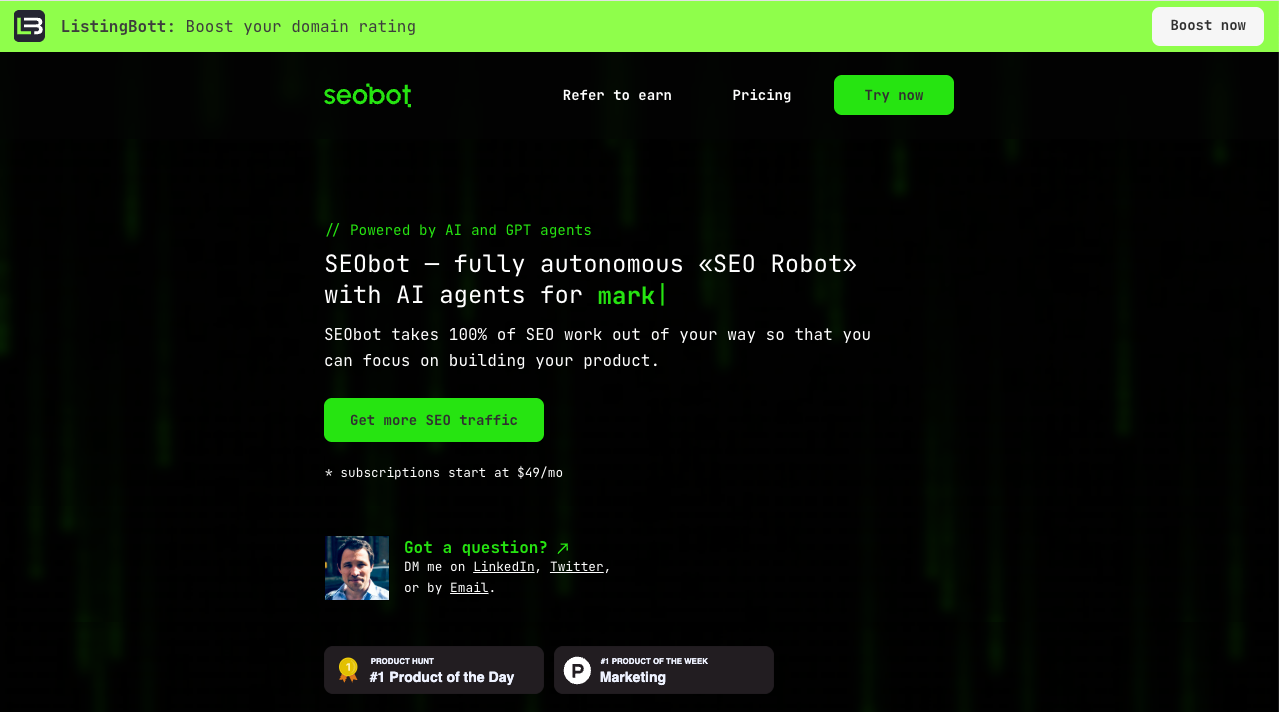
SEObot and Writer are both 'AI platforms' in the sense that they use AI to produce business outputs, but the similarity ends there. SEObot is a full-stack SEO robot: keyword research, article generation up to 4,000 words, fact-checking, AI backlink building, interactive mini-tools, YouTube-to-article conversion, and publication to nine different CMS platforms - all autonomous, all without a writer. Writer is a Fortune 500 enterprise AI platform: Palmyra proprietary LLMs, Knowledge Graph infrastructure connecting agents to internal data systems, HIPAA-eligible compliance, and multi-department orchestration. One is a $49/month subscription a solo founder deploys in an afternoon. The other is an enterprise IT procurement project.

What is SEObot?
“Fully autonomous SEO robot - takes 100% of SEO work out of your way”
SEObot and Alfa are both fully autonomous content agents. The fundamental difference is what they produce and for whom.
Visit SEObot
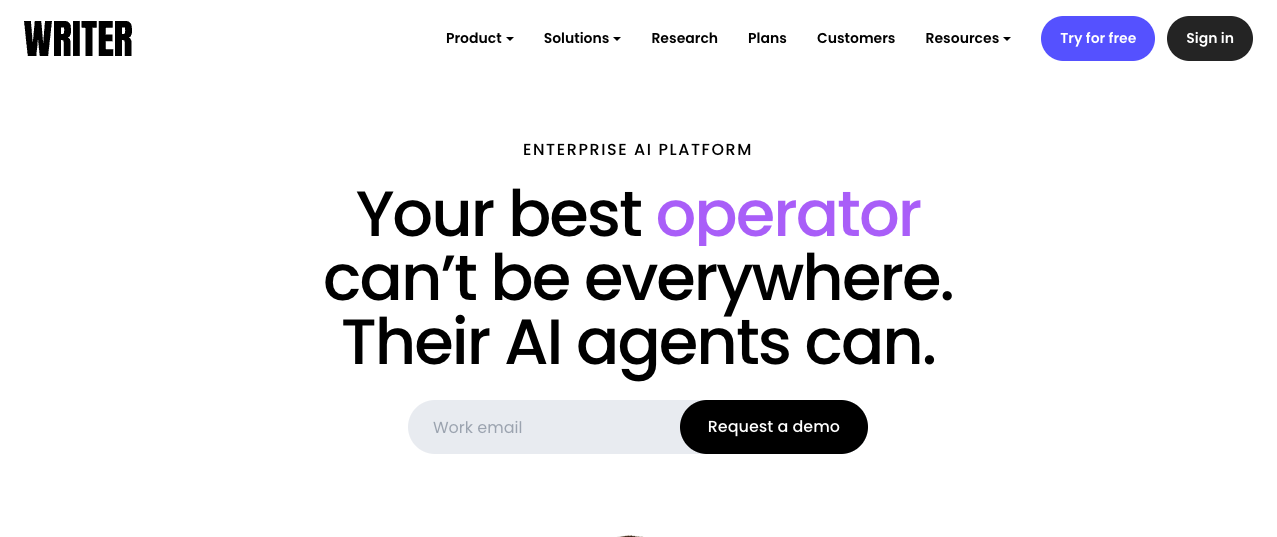
What is Writer?
“The enterprise AI platform for agentic work”
Writer is a horizontal enterprise AI platform built for Fortune 500 companies - it handles marketing workflows, sales rep productivity, retail merchandising, and financial services research all from one interface. Content production is one of many use cases inside a platform designed for enterprise orchestration at scale.
Visit WriterSEObot is purpose-built for end-to-end autonomous SEO content production and no feature in the Writer platform competes with this workflow. The $49/month Starter automates keyword research, article generation up to 4,000 words with fact-checking and source citations, AI image insertion in multiple styles, YouTube video embedding, internal and external linking automation, and publication to nine CMS platforms simultaneously. Higher tiers add YouTube-to-article conversion, AI news article generation, interactive SEO mini-tools deployed directly on your domain as link attractors, AI backlink building, programmatic SEO, and REST API access. Writer has content Playbooks that generate marketing copy, but no autonomous publishing pipeline, no keyword research automation, and no CMS push-to-publish integration. For any business that wants SEO content published without a writer, SEObot is architecturally designed for that use case and Writer is not.
Writer's Knowledge Graph is the most architecturally advanced internal data grounding system in this comparison, and SEObot has nothing comparable. Graph RAG connects Writer's agents to live enterprise data - Snowflake, Databricks, PitchBook, FactSet, and 15+ additional connectors - so outputs are grounded in the organization's actual proprietary knowledge rather than general LLM training data. The Palmyra LLM family provides model performance advantages and BYO model flexibility on Enterprise. HIPAA-eligible infrastructure, SOC 2 certification, explicit no-training-on-customer-data commitment, and SSO/SCIM governance make Writer the only viable choice for regulated industries. SEObot is a marketing tool with the security posture appropriate for its scope. For organizations where IT, legal, and compliance teams approve AI platform selection, Writer operates in a fundamentally different category.
Both tools market fact-checking features but approach the problem differently. SEObot claims fact-checking + anti-hallucination + source citations on its Starter plan - LLM-level validation that grounds generated content in real sources and flags obvious factual errors during generation. This is meaningful for autonomous publishing: content that cites sources and avoids basic hallucinations is more reliable than unchecked AI output. Writer's Knowledge Graph provides a different form of grounding: agents produce outputs based on your organization's actual internal data rather than general LLM knowledge. This reduces hallucinations on company-specific facts (financial figures, product details, internal processes) but doesn't apply to external competitive claims. Both approaches reduce error - different layers of error. SEObot's source-citation approach works for general informational content; Writer's Knowledge Graph approach works for internally-grounded content. Neither verifies external competitive claims at the claim-validation level a dedicated Fact-Checker Agent would provide.
Writer was designed for the organizational scale where AI deployment spans multiple departments simultaneously - marketing Playbooks, BDR sequence automation, retail merchandising workflows, and financial research report generation all running on the same Knowledge Graph and model infrastructure with consistent governance. A Chief Digital Officer evaluating AI infrastructure for an enterprise sees Writer as platform-level investment that unifies AI governance across functions. SEObot is a single-function SEO publishing robot. It publishes blog articles for one domain and does nothing outside that scope. As a tool for multi-department organizational AI strategy, SEObot is not in the category - it's a narrow but highly effective marketing automation tool. Writer's multi-department capability is in a different product category entirely.
SEObot at $49/month represents one of the fastest-to-value subscriptions in the content tool category. Create an account, connect your domain and CMS, and the autonomous pipeline publishes its first article within hours. No IT involvement, no procurement, no sales conversation, no Knowledge Graph configuration. The full refund guarantee on the first article makes evaluation risk near-zero. Writer's genuine value is locked behind an enterprise deployment process - sales conversation, custom pricing, Knowledge Graph connector configuration, Playbook design, and organizational change management for the user base that will access the platform. This process takes weeks from purchase decision to productive use. The Starter free trial gives basic access, but the differentiated features that justify Writer's enterprise investment aren't available until the full deployment completes. For teams that need results this week, SEObot's same-afternoon setup is the faster path by a substantial margin.
SEObot Starter at $49/month: fully autonomous pipeline - keyword research, articles up to 4,000 words, fact-checking + anti-hallucination + source citations, AI images, YouTube embeds, 9 CMS integrations, 50 languages, internal/external linking. Full refund if first article is unsatisfactory. Higher tiers from $49+/month add programmatic SEO, YouTube-to-article, news generation, interactive mini-tools, AI backlinking, and REST API/Webhook access.
Writer does not publish pricing for paid plans beyond the Starter free trial (14 days, no credit card, up to 5 users). Enterprise pricing is contact-sales. The investment reflects multi-department organizational value with proprietary LLMs, Knowledge Graph infrastructure, and compliance architecture.
SEObot's $49/month is transparent and immediately deployable. Writer's enterprise pricing requires a sales conversation and reflects an organizational-level investment. These tools are rarely in the same budget category for the same buyer.
SEObot's primary limitation is the quality ceiling of fully autonomous publishing without human editorial review. Articles that publish without review carry the risks inherent in AI generation: predictable phrasing patterns, content that covers a topic adequately without demonstrating genuine subject-matter expertise, and occasional factual errors that pass the LLM-level fact-checking but would be caught by a domain expert reviewing the draft. The claimed fact-checking and anti-hallucination features reduce obvious errors but don't substitute for editorial judgment at the claim level.
SEObot's AI backlink building, while an interesting automation feature, uses techniques that carry long-term SEO risk. Automated link-building through network schemes can be discounted by search algorithms over time and may conflict with Google's link scheme guidelines. Practitioners who are risk-averse about link acquisition typically disable this feature. The platform also lacks any GEO monitoring or AI citation tracking, meaning teams using SEObot have no visibility into how AI search platforms like ChatGPT or Perplexity represent their content - an increasingly important discovery channel for B2B audiences.
Writer's limitations in the context of content marketing teams stem from organizational scale mismatch. The platform's genuine advantages - Knowledge Graph, proprietary models, multi-department orchestration - are organizational infrastructure features that require IT and procurement involvement to deploy and that only deliver value at enterprise scale. For a marketing team that needs to publish SEO blog content, Writer's onboarding complexity and undisclosed enterprise pricing are disproportionate to the use case.
Writer's content generation capabilities, while solid for marketing copy Playbooks, lack the SEO-specific intelligence that drives organic search performance. There is no keyword research, no SERP analysis, no content scoring against ranking competitors, and no CMS push-to-publish integration. Teams using Writer for content marketing supplement it with Surfer SEO or Frase for optimization - adding cost and platform complexity that a purpose-built SEO tool like SEObot avoids entirely.
The buyer for each tool is almost categorically different. SEObot is the right choice for businesses that want autonomous SEO content published without writing resources - from solo founders to SMBs to growth-stage SaaS teams building topical authority. The $49/month Starter delivers the most complete autonomous SEO robot feature set at this price point: 9 CMS integrations, fact-checking, multilingual generation, and a roadmap of advanced features including AI backlinking and interactive mini-tools that no comparable autonomous publisher offers.
Writer is the right choice for large enterprises deploying AI across multiple departments with regulatory requirements - healthcare, financial services, and regulated retail where HIPAA eligibility, SOC 2 certification, audit trails, and no-training-on-customer-data commitments are organizational requirements before AI approval. The Knowledge Graph and Palmyra model family are genuine differentiated investments at the enterprise scale they're designed for.
These tools don't compete. The buyer that needs SEObot's $49/month autonomous SEO robot is a fundamentally different organizational context from the buyer that needs Writer's enterprise AI governance platform. If you're evaluating both tools simultaneously, clarify which problem you're solving first - autonomous content production at low cost, or enterprise AI governance at organizational scale - because the tools serve different answers to different questions.
The gap both tools share, despite their vast scope difference, is autonomous BOFU SaaS content with claim-level accuracy. SEObot publishes autonomous general-purpose SEO articles for any business with LLM-level fact-checking. Writer governs enterprise AI with Knowledge Graph-grounded outputs for internal organizational intelligence. Neither produces SaaS-specific comparison pages and alternatives guides where each competitive pricing tier, feature claim, and product assertion is validated against live competitor data before publishing.
For SaaS companies specifically, the comparison content category requires a different quality standard than general informational articles. A buyer who just finished a trial of your competitor knows whether your comparison page's pricing is accurate. They notice when your feature comparison shows a capability that was deprecated or updated since your article was written. SEObot's fact-checking validates LLM output at generation time - it doesn't cross-reference live competitor pricing. Writer's Knowledge Graph grounds outputs in internal company data, not external competitor intelligence.
Alfa's 9-agent pipeline was built for this specific requirement. The Research Agent pulls live competitor data from DataForSEO before writing begins. The Fact-Checker Agent validates each specific claim before packaging - not generic source citations, but claim-by-claim validation against current competitor intelligence. The Sub-Editor Agent removes the AI writing patterns that SEObot's autonomous output carries by design. The SEO Optimizer Agent handles keyword integration internally.
Alfa is not a replacement for SEObot's comprehensive autonomous SEO robot capability for general informational content. It is also not a replacement for Writer's enterprise Knowledge Graph and compliance infrastructure for organizational AI governance. The buyer Alfa serves is specifically the SaaS company where autonomous, factually verified BOFU comparison content with no writer in the loop is the primary content investment.