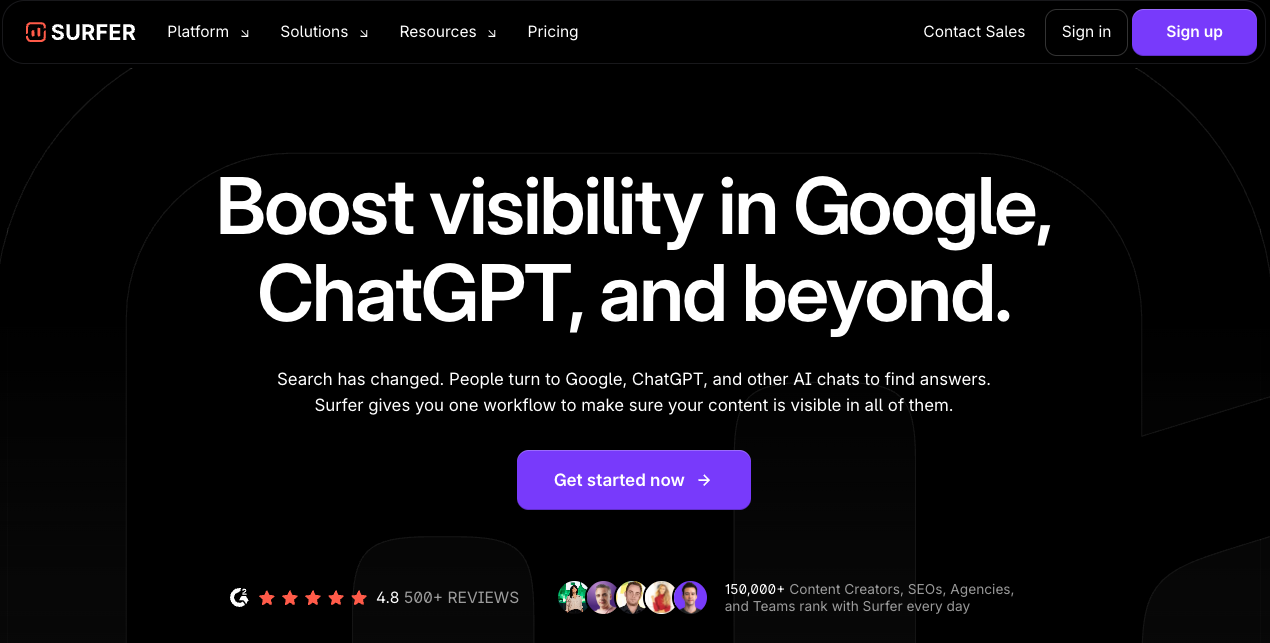
Surfer SEO and Writesonic are both used by content marketers who care about search traffic - but they've optimized in different directions. Surfer SEO is the SERP content optimization benchmark: granular NLP keyword analysis, real-time content scoring against ranking competitors, and coverage gap analysis that tells writers exactly what their articles are missing. Writesonic is a broader SEO + GEO platform: keyword research, AI citation monitoring across 10+ platforms, 120M+ real AI query data, Ahrefs integration, site audits, and an article writer with auto-citations - all in one subscription at a lower starting price. Both serve writers who need content to rank. The question is whether you want SERP optimization depth or a complete intelligence stack.

What is Surfer SEO?
“Create content that ranks with real-time SEO data”
Surfer is the industry standard for SEO content optimization - it tells you exactly what your article needs to rank. Alfa does all of that, plus researches, writes, fact-checks, and publishes the article autonomously.
Visit Surfer SEO
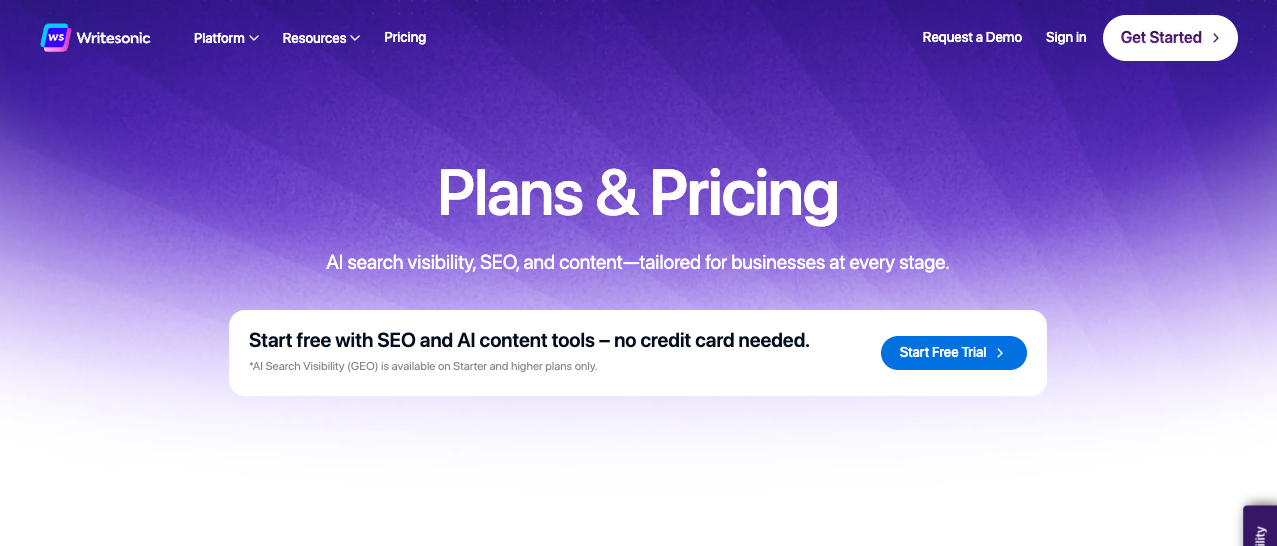
What is Writesonic?
“AI Search Visibility Tracking & Optimization — from $39/month”
Writesonic has made a clear strategic pivot: it's no longer primarily an AI writing tool — it's an AI Search Visibility platform. The homepage leads with brand monitoring across ChatGPT, Perplexity, Gemini, and 10+ AI platforms.
Visit WritesonicSurfer SEO is the category benchmark for SERP content scoring precision and nothing in Writesonic's platform matches it at this depth. The Content Editor analyzes the top-ranking results for any keyword and provides a live Content Score that updates in real time as the writer types - measuring keyword density, NLP entity coverage, semantic topical alignment, word count calibration, and heading structure against what's currently ranking. The granularity of Surfer's analysis - specific entity frequency targets, exact keyword placement recommendations, competitive content length based on SERP averages - is what makes it the default tool for SEO professionals who need to win competitive queries. Writesonic has content editing with SEO recommendations, but community reviewers who have used both consistently describe Writesonic's optimization layer as lighter than Surfer's SERP-grounded precision analysis. For competitive keyword battles where the content score determines whether you outrank entrenched competitors, Surfer's depth matters.
Writesonic is the substantially stronger GEO platform and Surfer SEO has no comparable infrastructure in this dimension. From the $39/month Starter, Writesonic tracks brand citations across 10+ AI platforms - measuring mention frequency, sentiment, and recommendation positioning across ChatGPT, Perplexity, Gemini, and other AI assistants that B2B buyers increasingly use during vendor research. The AI Search Volume Explorer with 120M+ real AI chatbot conversation data surfaces what people actually ask AI assistants - real natural language query volumes that no traditional search tool can replicate. The Reddit/community thread citation targeting identifies specific discussions where target buyers are asking questions, enabling participation strategies that serve AI citation objectives. Surfer SEO has invested in traditional search optimization for a decade and has no GEO monitoring, no AI citation tracking, and no AI search intelligence. For brands where AI search visibility is a growing acquisition channel alongside traditional SEO, Writesonic's GEO infrastructure fills a gap that Surfer doesn't acknowledge.
Writesonic's 80+ templates cover every marketing content format - ad copy, email sequences, social captions, product descriptions, landing page copy, YouTube scripts, and more. The Chatsonic AI assistant with real-time web access provides on-demand research within the same subscription. Ahrefs keyword data arrives at Basic ($99/month) without a separate subscription. AI image generation, content publishing integrations, and SEO auditing round out a genuinely comprehensive marketing content platform. Surfer SEO is a single-function optimization tool: it scores articles for SERP competitiveness and does nothing else. No ad templates, no email tools, no social captions, no AI research assistant, no image generation. For marketing teams producing across multiple content formats and channels simultaneously, Writesonic's breadth is a materially more useful daily-use platform than Surfer's narrow optimization focus.
The pricing comparison between these tools is one of the sharpest cost contrasts in the versus hub. Writesonic Starter at $39/month delivers: GEO monitoring across 10+ platforms, keyword research tools, 15 SEO audits/month, article writing with auto-citations, 80+ templates, AI image generation, and Chatsonic research assistant - no credit card for the free trial. Surfer SEO Standard at $119/month delivers: content scoring, SERP analysis, and content briefs for up to 30 articles. Three times the price for a narrower feature set. To get Ahrefs-equivalent keyword data alongside Surfer, teams typically add a separate subscription - pushing the combined stack further past $119. Writesonic's Basic plan at $99/month includes Ahrefs integration and reaches feature parity with Surfer Standard + a keyword research subscription at a lower combined cost. For budget-constrained teams managing the total cost of their content stack, the economics favor Writesonic.
Surfer's content briefs are among the most practically useful outputs in the SEO content category. The brief generated for any keyword includes: heading hierarchy derived from top-ranking pages, word count targets calibrated to competitive SERP content length, primary and secondary keyword targets with usage frequency, and NLP entity recommendations for semantic coverage. Writers who begin from a Surfer brief produce articles with a more competitive foundation than writers relying on general category knowledge. The AI Prompt Tracking feature also enables competitive content monitoring - setting alerts when competitors publish on tracked topics. Writesonic generates content briefs as part of its article writing workflow, but the depth of SERP-grounded brief analysis is less granular than what Surfer's dedicated SERP analysis infrastructure produces. For writing teams where the quality of each content brief directly affects article ranking probability, Surfer's brief depth is worth the price differential for that specific function.
Surfer SEO Standard at $119/month: Content Editor for 30 articles, AI Prompt Tracking (25 slots), 1-click optimization, brand knowledge, plagiarism checker. 7-day trial. Surfer Pro at $219/month: adds content ideas, coverage gap analysis, 5 brand workspaces, templates. Surfer Peace of Mind at $359/month: unlimited documents, 100 prompt tracking slots, API access.
Writesonic Starter at $39/month: GEO tracking (10+ AI platforms), AI Article Writer with auto-citations, 15 SEO audits/month, Chatsonic, Keyword Planner integration, Photosonic image generation, 80+ templates. Free trial, 2 free articles, no credit card. Writesonic Basic at $99/month: adds Ahrefs integration and higher volumes. 20% off annual billing.
At the $39 vs $119 entry comparison, Writesonic delivers three times more total platform features per dollar. At the $99 vs $119 comparison (Basic vs Standard), Writesonic includes Ahrefs data that Surfer doesn't, alongside everything else in Basic, at a $20/month discount. Surfer's competitive moat is SERP scoring precision - teams for whom that specific depth is the primary value will pay the premium. Teams that want the broadest content intelligence platform at lower cost should start with Writesonic.
Surfer SEO's community criticism is consistent and falls into two themes. First: the $119/month Standard entry price is widely described as steep for what is effectively a single-layer optimization tool without writing assistance, keyword research, or GEO monitoring. Competitors like Frase at $49/month and Writesonic at $39/month include comparable content scoring alongside complete writing and research platforms. Surfer's defenders argue that no competitor's scoring is as granular - and that's true - but teams without the budget for both Surfer and a writing tool often land on a single-platform alternative.
Second: the jump to Pro at $219/month for coverage gap analysis is a meaningful price cliff for a feature many content strategists consider standard for planning. Teams that need both content scoring and competitive topic intelligence pay $219/month minimum - at which point the combined value of Writesonic Basic at $99/month plus a specialist keyword research tool starts to look competitive.
Writesonic's limitation relative to Surfer SEO is the depth of its content optimization scoring. Community reviewers who have used both consistently describe Surfer's real-time Content Score as more granular and more actionable than Writesonic's SEO recommendations: Surfer provides specific NLP entity targets with frequency counts; Writesonic provides keyword suggestions without the same statistical grounding in SERP competitor analysis. For teams competing for high-opposition keywords in established niches, this precision gap matters - content optimized with Surfer's scoring tends to perform better per article at the competitive query level than content optimized with Writesonic's lighter recommendations.
Writesonic's AI article output quality also draws consistent community feedback: the prose is well-structured and SEO-ready but carries the generic phrasing and transitional patterns that experienced readers associate with machine-generated content. Editorial refinement before publication is the expected workflow, not an exception. Teams that use Writesonic as a first-draft accelerator for human editors get strong value; teams expecting publish-ready output regularly need more editing time than the tool's speed advantage saves.
The split is between optimization precision and platform breadth, and both are legitimate priorities. Surfer SEO is the right choice for content teams whose primary metric is ranking performance on competitive keywords and whose workflow centers on high-quality writer-produced articles. The SERP analysis depth, NLP keyword recommendations, and content brief quality produce measurably better-positioned articles than lighter optimization tools. For agences and in-house SEO teams managing competitive content at volume, Surfer's precision is what justifies the price premium.
Writesonic is the right choice for marketing teams that need a complete content intelligence platform across SEO and GEO - keyword research, AI citation monitoring, site auditing, article writing, and 80+ short-form templates in one subscription at entry prices starting at $39/month. The GEO monitoring across 10+ AI platforms fills a visibility gap that Surfer doesn't address. The Ahrefs integration at $99/month provides authoritative keyword data without a separate subscription. For budget-conscious teams or teams where multi-channel content breadth matters alongside search optimization, Writesonic's platform value per dollar is substantially higher.
Teams that use both exist and the combination is logical: Surfer for SERP-grounded scoring of strategic long-form pillar content; Writesonic's $39/month Starter for GEO monitoring and short-form marketing content. The combined $158/month covers both the optimization precision and the search intelligence monitoring that the two tools respectively deliver.
Both tools leave the same gap: neither produces SaaS-specific BOFU comparison content where competitive claims are verified before publishing. Surfer SEO optimizes articles with SERP-grounded scoring - ensuring topical coverage and keyword density match what's ranking. Writesonic adds GEO monitoring, AI query intelligence, and a broader content platform. What neither provides is a pipeline that produces a comparison page where each pricing tier, feature claim, and plan limitation is cross-referenced against live competitor data before the article goes live.
For SaaS companies, this verification requirement is specific to commercial-intent content. A buyer evaluating your product against a competitor who lands on your comparison page is simultaneously browsing the competitor's site. When the comparison article quotes an outdated pricing tier or attributes a feature that was removed in the last product update, the credibility damage is immediate and consequential. Surfer's content scoring ensures the article is structurally competitive against SERP. Writesonic's auto-citations ground the writing in real sources. Neither validates the specific competitive claims against live current data.
Alfa's 9-agent pipeline was built for this verification requirement. The Research Agent builds a live competitor intelligence dossier from DataForSEO before writing begins. The Fact-Checker Agent validates each specific pricing and feature claim against that dossier. The Sub-Editor Agent removes the AI writing patterns that Writesonic's output carries and that human-written Surfer-optimized drafts can also contain without a dedicated cleanup step. The SEO Optimizer Agent handles keyword integration internally, eliminating the need for a Surfer subscription alongside Alfa.
Alfa is not a replacement for Surfer's SERP precision for teams optimizing competitive general-purpose content with dedicated writers. It is not a replacement for Writesonic's GEO monitoring infrastructure or multi-format template breadth. The buyer who needs Alfa is the SaaS company where autonomous, verified BOFU comparison pages are the primary content investment - and where the additional tool subscriptions and writer coordination overhead that Surfer and Writesonic require are the bottleneck.