Writer and Writesonic represent two philosophically different answers to the question of what enterprise AI for content should look like. Writer's answer: governance, compliance, and Knowledge Graph-grounded intelligence for Fortune 500 organizations deploying AI across departments. Writesonic's answer: a complete SEO + GEO content platform with built-in Ahrefs data, 120M+ AI query intelligence, and monitoring across 10+ AI platforms - for any marketing team, starting at $39/month with no credit card required. One is organizational infrastructure for large enterprises. The other is a power tool for lean marketing teams that want the maximum content and search intelligence stack at an accessible price.

What is Writer?
“The enterprise AI platform for agentic work”
Writer is a horizontal enterprise AI platform built for Fortune 500 companies - it handles marketing workflows, sales rep productivity, retail merchandising, and financial services research all from one interface. Content production is one of many use cases inside a platform designed for enterprise orchestration at scale.
Visit Writer
What is Writesonic?
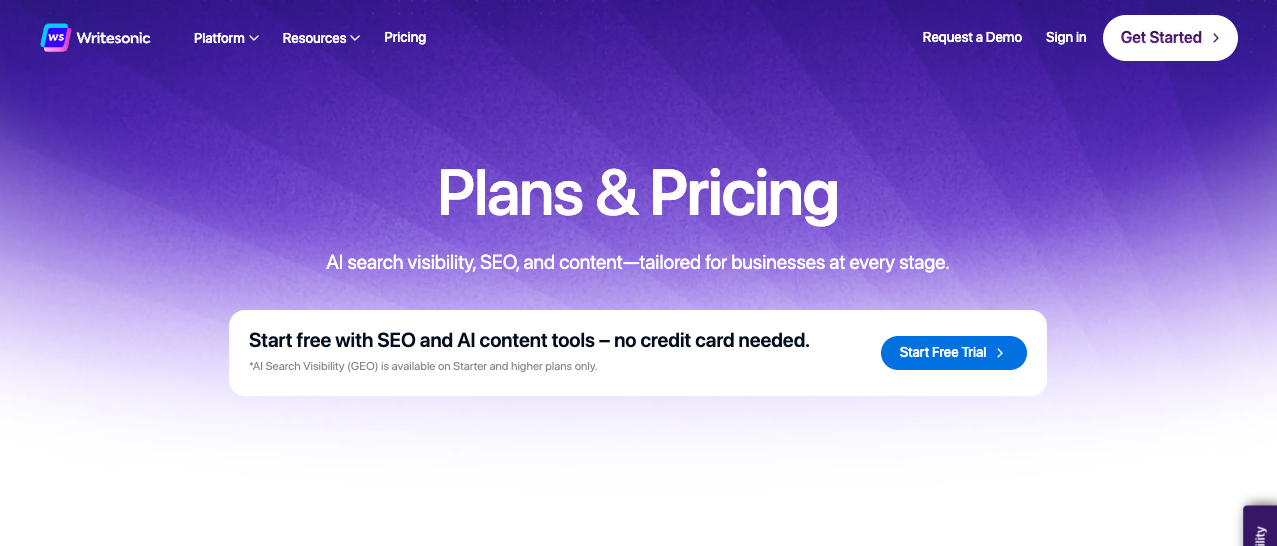
“AI Search Visibility Tracking & Optimization — from $39/month”
Writesonic has made a clear strategic pivot: it's no longer primarily an AI writing tool — it's an AI Search Visibility platform. The homepage leads with brand monitoring across ChatGPT, Perplexity, Gemini, and 10+ AI platforms.
Visit WritesonicWriter has the most advanced enterprise compliance infrastructure in this comparison and no feature of Writesonic competes with it at this depth. The Knowledge Graph connects Writer's AI agents to live internal data systems - Snowflake, Databricks, PitchBook, FactSet - through 15+ enterprise connectors, grounding agent outputs in actual organizational intelligence rather than general training data. The Palmyra LLM family and BYO model option give large enterprises control over the model layer. HIPAA-eligible architecture, SOC 2 certification, explicit no-training-on-customer-data commitment, and SSO/SCIM identity governance satisfy the compliance requirements that regulated industries impose before approving any AI platform for production use. Writesonic is a marketing content platform with data handling policies appropriate to its scale, but it doesn't attempt to compete with Writer's enterprise infrastructure. For organizations where Writer's compliance and Knowledge Graph features are the selection criteria, Writesonic is in a different product category.
Writesonic wins the search intelligence dimension comprehensively and at every price point. Its $39/month Starter tracks brand citations across 10+ AI platforms - giving marketing teams visibility into how ChatGPT, Perplexity, Gemini, and other AI assistants represent their brand in generated answers. The AI Search Volume Explorer with 120M+ real AI chatbot conversation data surfaces what buyers actually type into AI assistants - real natural language query volumes from a proprietary dataset no traditional keyword tool provides. The Ahrefs integration on Basic ($99/month) delivers authoritative keyword volume and competitive difficulty without a separate Ahrefs subscription. SEO site auditing at 15-40 audits/month provides diagnostic intelligence alongside content production. Writer has none of these SEO or GEO features. It generates content grounded in internal organizational data but has no external search intelligence layer. For marketing teams where organic and AI search performance are the primary content KPIs, Writesonic delivers infrastructure that Writer doesn't offer.
Writesonic's 80+ marketing templates cover every format a marketing team produces daily: ad headlines, email sequences, social captions formatted for each platform, product descriptions, landing page copy, YouTube scripts, press releases, and blog articles. The Chatsonic AI research assistant with real-time web access provides within-subscription research capability. AI image generation through Photosonic and content publishing integrations complete a marketing team's daily content workflow without leaving the platform. Writer has marketing Playbooks that generate content - capable for organized workflows - but the template breadth and creator-first UX don't match Writesonic's marketing-first design. For a marketing manager evaluating a daily-use content platform, Writesonic's breadth and creator-centered interface deliver more practical workflow coverage per subscription dollar.
Writer is the only tool of the two designed for multi-department enterprise AI deployment. Its use cases span marketing Playbooks, BDR outreach automation, retail merchandising content, and financial research report generation - all running on the same Knowledge Graph and Palmyra model infrastructure with consistent compliance governance and audit trails. A CDO evaluating AI infrastructure for an entire organization sees Writer as the platform that unifies AI access across functions with the governance required for organizational approval. Writesonic is a marketing content platform that does not extend into sales sequences, financial reporting, or compliance-sensitive internal communication workflows. For executives evaluating organizational AI strategy rather than a marketing team content tool, Writer's multi-department scope is the only relevant option between these two.
Writesonic wins accessibility with no friction: a free trial with 2 free articles and no credit card means any marketing professional can evaluate the full Starter feature set immediately. The $39/month Starter price point is self-serve, available today without a sales conversation, and delivers GEO monitoring, keyword research, SEO auditing, article writing, and 80+ templates from day one. Writer's genuine value is at the Enterprise tier - which requires a sales call, custom pricing, Knowledge Graph configuration, enterprise connector setup, and organizational deployment planning. The Starter free trial (14 days, no credit card, up to 5 users) is accessible for basic evaluation, but the differentiated features - Knowledge Graph, Palmyra models, compliance infrastructure - require the enterprise deployment process to unlock. For teams that need to be productive this week, Writesonic is operational in minutes and Writer's enterprise features take weeks to deploy.
Writer does not publish pricing for paid plans beyond the Starter free trial (14 days, no credit card, up to 5 users). Enterprise plan pricing is contact-sales. The investment reflects multi-department organizational AI value with proprietary LLMs, Knowledge Graph, and compliance infrastructure.
Writesonic Starter at $39/month: GEO tracking across 10+ AI platforms, AI Article Writer with auto-citations, 15 SEO audits/month (750 pages), Chatsonic research assistant, Google Keyword Planner, Photosonic image generation, 80+ templates. Free trial, 2 free articles, no credit card. Writesonic Basic at $99/month: adds Ahrefs integration and higher article volumes. Writesonic Growth at $249/month: scales audit and article capacity for larger teams. 20% off annual billing.
The pricing visibility gap is stark: Writesonic's full pricing menu is public and immediately accessible. Writer's enterprise pricing requires a sales conversation. Most marketing teams comparing these tools are evaluating different problems - if you need a complete SEO and GEO content platform today, Writesonic's $39-$99/month tiers are deployable immediately. If you need enterprise AI governance across your organization, Writer's sales process is the starting point.
Writer's limitation for standalone content marketing teams is that its genuine advantages - Knowledge Graph, multi-department orchestration, HIPAA compliance - are organizational infrastructure features that require IT involvement, procurement, and Playbook deployment to access. A marketing team that subscribes expecting Writer to immediately improve their content production workflow will spend weeks in configuration before the platform delivers its distinctive value. The Starter free trial provides basic content generation, but the differentiated capabilities that justify Writer's enterprise investment are not accessible until the full deployment completes.
Writer also lacks the SEO-specific intelligence that marketing teams making content decisions need. There is no keyword research, no SERP analysis, no content scoring, no GEO monitoring, and no AI citation tracking. Teams using Writer for marketing blog production typically add Surfer SEO, Writesonic, or Frase to the marketing content stack - increasing both cost and platform complexity that a purpose-built content intelligence tool would cover in a single subscription.
Writesonic's persistent limitation is AI article prose quality. The AI Article Writer produces well-structured first drafts with SEO-relevant organization and auto-citations, but the output carries the generic writing patterns - predictable transitions, hedged qualifications, repetitive paragraph openings - that experienced readers associate with machine-generated content. Teams that use Writesonic as a first-draft accelerator for human editors get meaningful time savings. Teams that expect minimal editing before publishing are regularly surprised by the cleanup required to reach brand-credible quality.
Writesonic's brand voice and style enforcement is also less sophisticated than enterprise-grade systems like Writer's Knowledge Graph-grounded model and Jasper's Brand IQ system. For organizations where multiple writers must produce content that sounds like a unified editorial voice, Writesonic's tone settings provide basic consistency but not compliance-level enforcement. This is primarily a concern for larger marketing teams or those with strict brand identity standards, not for solo marketers or lean teams where one writer is setting the tone.
The verdict here follows organizational context with unusual clarity. Writer is the right choice for large enterprises deploying AI across departments with regulatory requirements - healthcare, financial services, regulated retail, and multinational organizations where compliance infrastructure, audit trails, no-training-on-customer-data guarantees, and the Knowledge Graph's ability to ground AI outputs in proprietary internal data are organizational requirements. The platform is designed for IT-led deployment at a scale that most individual marketing teams don't represent.
Writesonic is the right choice for marketing teams - from solo founders to growth-stage companies to enterprise marketing departments - who need a complete SEO and GEO content intelligence platform at an accessible, transparent price. The $39/month Starter delivers more total marketing intelligence features than almost any platform in the content marketing category at its price point: GEO monitoring, keyword research, AI query data, SEO auditing, article writing, image generation, and 80+ templates from day one without a sales conversation.
The coexistence scenario: Enterprises can run Writer for organizational AI governance across departments while the marketing team uses Writesonic for SEO content production and GEO monitoring. Writer governs access and compliance; Writesonic optimizes marketing output. The combination makes sense at the enterprise scale that justifies Writer's organizational investment alongside Writesonic's $39-$99/month content intelligence subscription.
Both tools leave the same gap despite serving radically different organizational contexts: neither produces SaaS-specific BOFU comparison content where competitive claims are verified against live data before publishing. Writer's Knowledge Graph grounds outputs in internal organizational intelligence. Writesonic's GEO monitoring tracks AI search visibility and its article writer accelerates human content production. Neither provides an autonomous pipeline that produces a comparison page where each specific pricing tier, feature claim, and plan limitation is cross-referenced against live external competitor data before the article publishes.
For SaaS companies, this verification layer is most important for the content category that directly converts buyers. A buyer who has spent a week evaluating SaaS tools and lands on your comparison page is simultaneously fact-checking what you say about competitors against their own research. Writer's Knowledge Graph won't help here - it connects to internal data, not external live competitor intelligence. Writesonic's auto-citations ground articles in real sources but don't validate specific competitive product claims at the claim level. Both tools require a human to verify or accept the risk that competitive claims may be outdated or inaccurate.
Alfa's 9-agent pipeline was built specifically for this verification requirement. The Research Agent builds a live competitor intelligence dossier from DataForSEO before writing begins. The Fact-Checker Agent validates each specific pricing and feature claim against that dossier. The Sub-Editor Agent removes the AI writing patterns - generic transitions, hedged phrasing - that Writesonic-directed output carries and that Writer-generated Playbook content can also contain without a dedicated cleanup step. The SEO Optimizer Agent handles keyword integration internally.
Alfa is not a replacement for Writer's enterprise Knowledge Graph infrastructure or multi-department compliance governance. It is not a replacement for Writesonic's GEO monitoring platform, AI query intelligence, or marketing template breadth. Alfa serves the SaaS company whose highest-value content investment is autonomous comparison pages and alternatives guides - produced without a writer, with claim-level accuracy, and as a complement to whichever broader platform the organization runs for governance or marketing content production.