AirOps vs Frase

AirOps vs Frase

AirOps and Frase both sit inside a content team's stack - but they solve opposite problems. Frase is a document-level tool: it makes writing one article faster by pulling SERP data, building outlines, and scoring content in real time. AirOps is an operations platform: it replaces the document-by-document approach with automated, multi-step workflows that connect data sources, enforce brand controls, and publish at volume. The buyer evaluating both is usually a content manager who has outgrown simple writing tools but isn't sure yet whether their operation actually needs infrastructure - or just a better editor.

Last updated: April 2026Honest comparison — no affiliate bias
The Tools

What are AirOps & Frase?

AirOps screenshot

What is AirOps?

AirOps

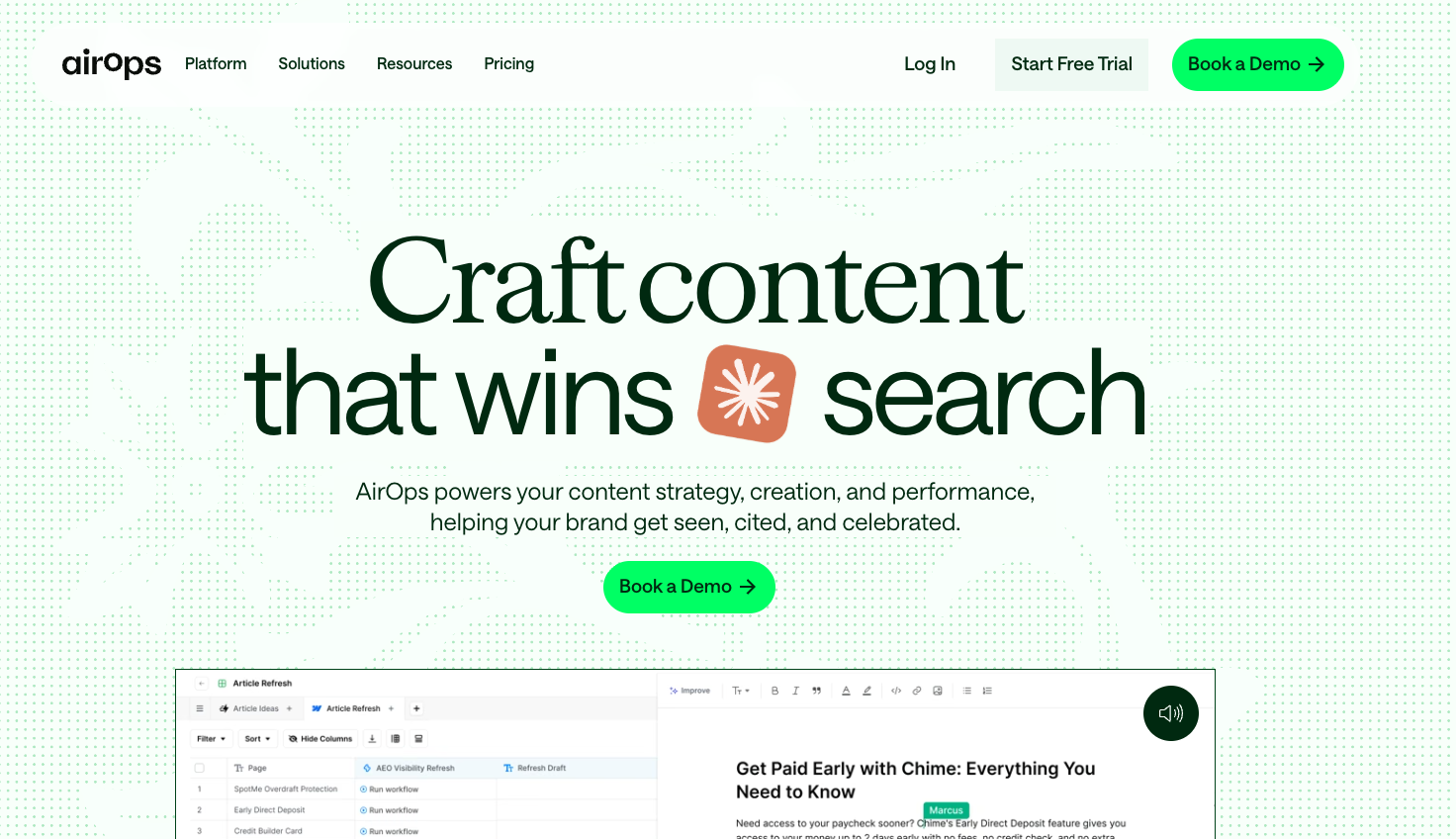
Craft content that wins AI search

AirOps positions itself as the first end-to-end content engineering platform - giving content and SEO teams visibility into what to create, workflows to create it, and human-review checkpoints to ensure quality before publishing. Its primary differentiator is AI search visibility tracking: surfacing where your brand appears (or doesn't) across ChatGPT, Perplexity, Google AI Overviews, and other LLMs, then feeding that data into configurable content workflows.

Visit AirOps
Frase screenshot

What is Frase?

Frase

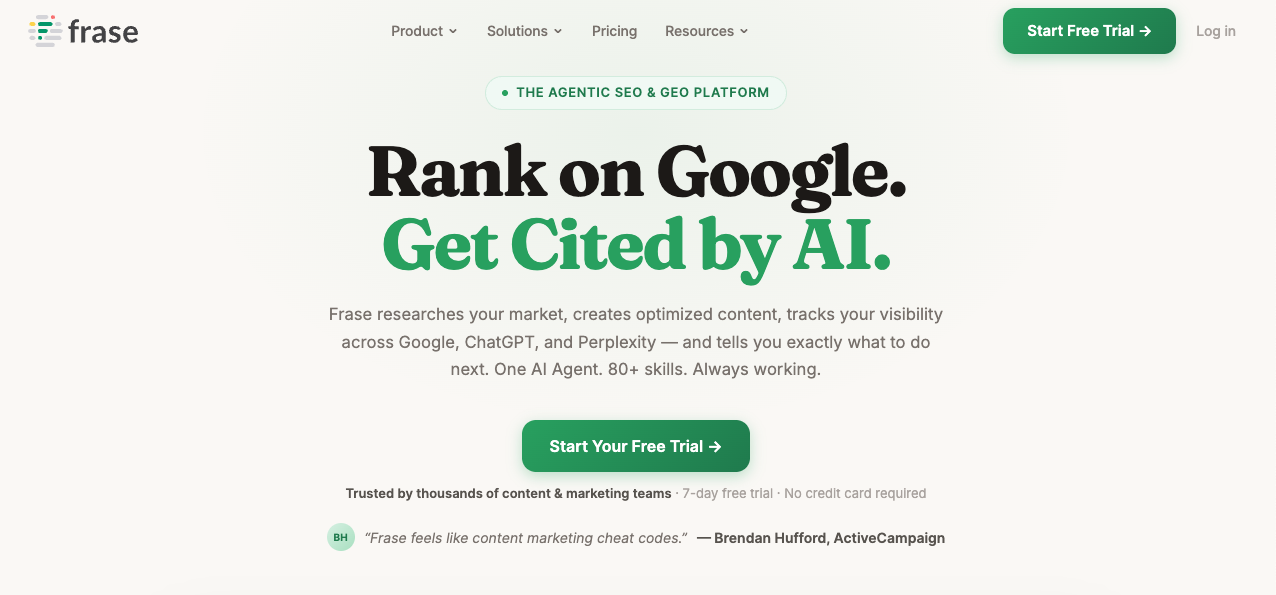
Rank on Google. Get cited by AI.

Frase and Alfa are both AI-powered content tools - and that's where the similarity ends. Frase is a full-stack SEO and GEO platform built for content marketing teams.

Visit Frase
Feature Comparison

AirOps vs Frase — Feature by Feature

Feature
AirOps
Frase
Content Pipeline
Autonomous end-to-end pipeline (no writer required)
Human-in-the-loop by design - writers and editors are required participants
AI Agent drafts articles; human reviews, scores, edits, and publishes
SERP research and content brief generation
Supported via workflow inputs and Insights data - not one-click per article
Core feature - competitor SERP analysis and structured brief in 30 seconds
Multi-step configurable workflow builder
No-code drag-and-drop workflow builder - the platform's core capability
Linear document editor - no workflow builder or multi-step orchestration
Bulk content actions (refresh, optimize, publish at scale)
Grids and Workflows handle hundreds of pages simultaneously
Article-by-article editor - no bulk processing capability
Content refresh (update existing pages)
Dedicated Content Refresh module - identifies declining pages and triggers updates
Import any page, score against current competitors, get specific fix recommendations
Programmatic SEO (data-driven pages at scale)
Supported through Grids + workflow pipelines at enterprise tier
Scale plan - 1,000+ templated pages from structured data
Content repurposing (blog to social formats)
Supported as a configurable workflow - requires setup
Professional plan - 1 post automatically becomes LinkedIn, Twitter, newsletter
SEO & GEO Capabilities
Real-time content optimization scoring
No live editor with SEO scoring - optimization applied through workflow steps
Core feature - real-time SEO and GEO topic scores as you write
AI citation tracking (brand visibility in AI search)
Insights layer - tracks brand across ChatGPT, Perplexity, AI Overviews; flags competitor citations
Tracks brand across 8 AI platforms - ChatGPT, Perplexity, Gemini, Claude, and others
GEO optimization (structure content for AI search engines)
AI search visibility data informs content strategy; no inline GEO scoring
Real-time GEO scoring built into the editor alongside standard SEO scoring
Offsite monitoring (Reddit, 3rd-party mentions)
Dedicated Offsite module - find, secure, and measure 3rd-party brand mentions
Not a feature - focused on owned content production and optimization
Output Quality
Human review and approval workflow
Configurable review gates built into every workflow - core differentiator
Editor-based review; no structured approval pipeline or multi-stakeholder gates
Brand voice configuration
Brand Kit and Knowledge Base - applied to all workflows; unlimited on Enterprise
Brand governance features (terminology, reference docs); less structured than AirOps
AI image generation
Supported through workflow integrations - not a built-in generation step
Not included
Integrations & Publishing
CMS direct publish (WordPress, Webflow, Contentful)
Full CMS publishing suite on Pro - direct connect to 10+ major CMSs
WordPress publishing on Starter; API access for additional CMS connections
External data source connections (Semrush, GSC, Ahrefs)
Pro plan supports pulling data directly from SEO tools into workflows
SERP data pulled from Frase's own research engine - no 3rd-party data connections
Multi-language content production
Enterprise plan supports multiple regions, personas, and languages
Supports international content; no dedicated multi-language enterprise tier
Pricing & Plans
Entry price
Free Solo tier ($0), then $199/month - significant jump for paid access
$49/month Starter - lowest entry price in this comparison
Predictable monthly cost (no usage metering)
Task-metered pricing - actual bill varies by workflow complexity and volume
Flat monthly tiers - no per-task charges or overage model
Free trial (no credit card required)
14-day free trial with Scale-level feature access, no credit card
7-day free trial, no credit card required
Full support
Partial / limited
Not available
Feature Analysis

Where each tool actually wins

Workflow Architecture

This is the defining structural difference between the two tools. Frase is a document editor - you open it for one article, run SERP research, generate an outline, draft, score, and close. The workflow lives entirely in a single document session. Efficient for writers who work article by article. Brittle when you need consistency across dozens of articles per month.

AirOps is a workflow engine. You design the process once - research step, draft step, brand-check step, human review gate, CMS publish step - and run it as many times as needed. Teams at Ramp and Webflow have built proprietary content systems on top of AirOps's no-code builder, connecting external data sources like Semrush and Google Search Console into the pipeline. The process is repeatable, documented, and auditable.

The tradeoff is setup cost. Reviewers on G2 consistently cite a steep learning curve - users report needing significant time to understand AirOps's data mapping and workflow logic before seeing any output. Frase is plug-and-play in comparison: sign up, paste a keyword, start writing in minutes. For a content manager trying to choose, the honest question is whether their team's bottleneck is individual article quality (Frase wins) or operational scale and repeatability (AirOps wins).

AirOps wins on workflow architecture for teams that have outgrown document-by-document content production and need repeatable, auditable content systems. See more on AirOps vs Jasper for how this plays out against a writing-assistant tool.

AirOps has the edge

AI Search Visibility Tracking

Both tools now include AI citation tracking as a first-class feature, which is unusual in this space - most content tools have not yet built this capability. But the depth and framing differ meaningfully.

Frase integrates AI citation tracking directly into its content scoring workflow. As you're editing an article, Frase shows you a live GEO score alongside the traditional SEO topic score - you can see in real time whether your content is structured to be cited by ChatGPT or Perplexity. The monitoring layer tracks your brand across 8 AI platforms on the Professional tier. For a writer who wants GEO guidance baked into their editing experience, this is the more frictionless implementation.

AirOps's Insights layer goes deeper on the monitoring and intelligence side. It tracks brand citation rates across AI search engines, identifies which specific prompts surface competitors instead of your brand, and surfaces those gaps as content workflow triggers. Carta increased its citation rate by 75% on new pages using this data loop. The AirOps approach treats AI search visibility as a strategic intelligence input that drives workflow decisions - not as an editor-level score.

Frase's implementation is more accessible and integrated into day-to-day writing. AirOps's approach is more strategic and actionable at scale. For a team that wants to do something with the visibility data programmatically, AirOps has the advantage. For a writer who wants guidance while drafting, Frase's inline GEO scoring is the better daily experience.

Tie - both tools cover AI citation tracking, but serve different workflow contexts.

Roughly equal

Pricing and Entry Risk

Frase's pricing structure is simpler and considerably lower-risk to trial. The $49/month Starter covers one user, one domain, 10 AI-optimized articles per month, full GEO scoring, AI citation tracking, and WordPress publishing. The per-feature value at entry is high for a small team. Scaling to the Professional tier at $129/month adds 3 seats, 5 domains, 40 articles, and content repurposing. Pricing is flat, public, and predictable.

AirOps's entry math is more complicated. There is a free Solo tier at $0 capped at 1,000 tasks per month with no overages - useful for evaluation but limited in output. The first paid tier is $199/month (Solo Plan), a meaningful jump from free. The Pro Plan is $1,999/month - and additional tasks cost $9 per 1,000 on Solo and $6 per 1,000 on Pro above the monthly allotment. Teams running complex, multi-step workflows at volume have reported actual bills exceeding the plan rate in busy months. G2 reviewers have specifically flagged the opaque pricing for Scale and Agency plans requiring sales calls as a recurring frustration.

For a team evaluating both tools for the first time, Frase removes the financial risk of a wrong-fit purchase. AirOps's value justifies its price at sufficient scale, but reaching that justification point first requires time and configuration investment that itself costs money. At small team sizes - one to two content people - the ROI case for AirOps's paid tier requires careful math.

Frase wins on pricing transparency and entry-level value for teams not yet at enterprise content operations scale.

Frase has the edge

Research and Writing Quality

Frase's strongest capability is SERP-grounded research. The tool pulls the top-ranking pages for any keyword, analyzes their heading structure, identifies the topics and entities they cover, and surfaces a structured outline in under 30 seconds. Writers using Frase consistently report that this brief-generation step alone saves 1-2 hours per article. The real-time topic score - where you see your content coverage percentage climb as you add sections - keeps the writing anchored to what's actually ranking.

The AI writing quality, however, is a more modest story. Community reviews across Reddit and G2 are consistent: Frase's AI-drafted content is described as a useful structural scaffold that requires significant human editing before publication. Generic phrasing, logic gaps, and thin introductions are the patterns most frequently reported. Frase works best as a research and outlining layer around human-written content - not as a draft-to-publish pipeline.

AirOps is not a writing tool in the Frase sense. There is no inline editor, no live scoring, no real-time topic coverage feedback. Writing happens inside the broader workflow system. The quality ceiling depends entirely on how well the workflow is configured and what models are invoked at each step. Human review gates are a built-in structural expectation.

For practical writing quality of individual articles, Frase's integrated research-to-editor experience is meaningfully better designed. AirOps's quality controls operate at the system level - brand kits, review checkpoints, approval gates - rather than in the writing moment itself.

Frase wins on research and individual writing quality - it is a specialist research-and-edit tool in a way AirOps is not built to be. See also Frase vs Surfer for how Frase compares to the other leading scoring-based writing tool.

Frase has the edge

Team Scale and Organizational Fit

The audience gap between these tools is larger than most comparison articles acknowledge. Frase is designed for individual contributors and small content teams: one writer researches, drafts, optimizes, and publishes one article at a time. The tool's design language - a single-document editor with nested research panels - reflects a one-person or two-person workflow. The Professional tier adds 3 seats; the Scale tier adds agency-level volume. Frase is not built to coordinate content operations across multiple business units, markets, or stakeholder groups.

AirOps is explicitly enterprise infrastructure. Case studies from Ramp, Carta, Chime, Apollo, Docebo, and Webflow are not coincidences - they are the archetype of the buyer AirOps is designed for: an established company with a content team, defined brand standards, compliance requirements, and a need for consistent output at high volume. The approval gate system, multi-Brand-Kit support, unlimited user seats on Pro, and dedicated account management at Enterprise are markers of a platform designed for organizational content operations, not individual article production.

G2 reviewers consistently flag that AirOps is "overkill" for smaller teams and that the ROI doesn't materialize until the team is large enough and the content volume is high enough to absorb the setup and configuration overhead. For a 2-person content team producing 10-20 articles per month, that overhead is real friction with marginal payoff. For a 10-person content operation managing 500+ pages, AirOps's systems-orientation becomes the primary advantage.

AirOps wins at organizational scale - it is the right choice for teams that have operationalized content production and need infrastructure to match.
AirOps has the edge
Pricing

What you get at each price point

AirOps
Solo (Free)
$0month
  • 1 user
  • 1,000 tasks/month included
  • No overages — tasks capped at allotment
  • Basic templates
  • Live chat support
Solo Plan
$199month
  • All Solo (Free) features
  • Expanded template library
  • $9 per 1,000 tasks overage (above monthly allotment)
  • Community and live chat support
Pro Plan
$1,999month
  • Unlimited users
  • Advanced workflows
  • $6 per 1,000 tasks overage (above monthly allotment)
  • Priority support
Scale / Enterprise
Custom
  • Unlimited tasks
  • Brand kits, SSO, and enterprise integrations
  • Multiple regions, personas, and languages
  • Dedicated Account Manager and 1:1 expert onboarding
  • Contact sales for pricing
Frase
Starter
$49/month
  • 1 user, 1 domain
  • 10 AI-optimized articles/month
  • 50 audit pages/month
  • Full Frase AI Agent (80+ skills)
  • SEO + GEO content optimization
  • AI search tracking (ChatGPT, Perplexity, etc.)
  • WordPress publishing
  • 7-day free trial, no credit card
Professional
$129/month
  • 3 user seats, 5 domains
  • 40 AI-optimized articles/month
  • 250 audit pages/month
  • AI visibility tracking across 8 AI platforms
  • Site audit tools
  • Content repurposing (1 post → LinkedIn, Twitter, newsletter)
  • API access
Scale
$299/month
  • High-volume article production
  • Programmatic SEO (1,000+ pages from data)
  • Agency/multi-client workflows
  • Performance tracking at scale
  • Priority support

Frase pricing is flat and fully public. Starter at $49/month gives 10 articles per month to one user - roughly $4.90 per article if you use the full allotment. Professional at $129/month covers 3 users and 40 articles, dropping the per-article cost to $3.23. Scale at $299/month unlocks full programmatic volume. Every tier is predictable month to month with no usage-based variables.

AirOps pricing is metered and significantly more expensive at scale. The free Solo tier is capped at 1,000 tasks with no overages - useful for evaluation. The Solo paid plan is $199/month, and the Pro Plan is $1,999/month, with overage charges of $9 per 1,000 tasks (Solo) and $6 per 1,000 tasks (Pro) above the included allotment. What constitutes a 'task' varies with workflow complexity - a single multi-step article workflow can consume hundreds of tasks. Teams evaluating AirOps's Pro tier should budget for realistic overage scenarios before comparing list prices to Frase's flat structure. Scale and Enterprise pricing requires a sales call, adding further friction for teams trying to plan budgets in advance.

Honest Assessment

Where each tool falls short

Where AirOps falls short

AirOps's primary limitation is the cost of entry for smaller teams. The free tier is functional but capped at 1,000 tasks - which evaporates quickly once multi-step workflows start running. The jump from free to the first paid Solo Plan at $199/month is steep for a team that isn't already producing content at volume. G2 reviewers who churned from AirOps consistently describe the same scenario: they signed up, found the platform powerful in principle, spent significant time configuring workflows, and then couldn't justify the ongoing cost once they calculated the per-article economics at their actual volume.

The learning curve is the second significant friction point. AirOps is workflow infrastructure, not a writing interface. It requires users to understand concepts like data mapping, workflow step connections, and Grid configuration before they can produce anything. Reviewers note needing weeks of onboarding time before the platform became net productive. For a content manager coming from Frase or Surfer, the mental model shift is substantial. The platform is designed for 'systems-minded' operators - which is accurate product positioning, but it also means that teams who lack that systems orientation will struggle.

AirOps also has no native inline writing experience. There is no editor where a writer opens a document, sees research, and produces content in one place. Writing happens inside workflows, which is efficient for repeatable processes but less intuitive for ad-hoc article creation. Teams that mix high-volume workflow production with one-off research tasks often end up running both AirOps and a writing tool concurrently - a cost and workflow overlap that defeats part of the platform's value proposition.

Where Frase falls short

Frase's biggest limitation is AI writing quality. The platform's research and briefing capabilities are genuinely excellent - consistent praise across Reddit and G2 reviews. But the AI-generated drafts consistently require significant human editing before publication. Users describe the output as generic in introductions and conclusions, prone to logic gaps mid-article, and rhythmically flat in ways that signal AI authorship to readers. The community consensus is clear: Frase works best as a research-and-scaffold layer around human-written content, not as a draft-to-publish pipeline. Teams that buy Frase expecting to reduce writing labor are frequently disappointed at how much editing work remains.

The tiered pricing structure has its own gotchas. The base Starter plan offers 10 articles per month - workable for a solo writer, but limiting for an agency or content team. Reaching 'unlimited' AI generation capacity has historically required additional paid add-ons beyond the base plan price, and reviewers have flagged a lack of transparency around what 'unlimited' means in practice. The per-feature cost rises faster than the headline tier prices suggest as volume increases.

Frase also lacks enterprise-grade workflow controls. There are no configurable approval gates or multi-stakeholder review pipelines. For organizations where legal, compliance, or brand-risk review is required before publication, Frase's editor-based workflow doesn't provide the structural safeguards that AirOps or Writer offer. It is a document-level tool, and that constraint becomes a ceiling for larger content operations.

Our Verdict

The honest answer

The most likely buyer searching 'AirOps vs Frase' is a content manager who has been using Frase and is wondering whether to upgrade to AirOps as their team scales. The honest answer is: upgrade only if your bottleneck has shifted from article quality to operational systemization. If you're still producing content article by article and your team needs better research, scoring, and AI citation guidance, stay with Frase. It does that job at a lower price with a fraction of the setup friction.

Switch to AirOps when the content team is large enough that consistent brand enforcement across hundreds of articles is more valuable than any individual article's quality score. When compliance review gates are a non-negotiable part of the publishing process. When you're maintaining a content library of 200+ pages that need coordinated refresh cycles, not just new article production. AirOps at $1,999/month is only rational when the content operation is running at a rate where that infrastructure pays for itself in time savings and error prevention.

The scenario where Frase wins outright: any team under five content people producing fewer than 40 articles per month. Frase's research quality, real-time GEO scoring, and predictable flat pricing make it the obviously correct choice at that scale. AirOps isn't wrong - it's simply over-engineered and over-priced for that operation size, and G2 feedback confirms this consistently.

A third option worth considering

Consider Alfa instead

Both AirOps and Frase share a structural requirement: a human writer stays in the loop. Frase gives that writer better research and scoring tools. AirOps gives a content team better workflow controls and brand governance. Neither tool removes the dependency on having someone to write, review, and ship the content. For a SaaS company with no content person - or a founder who is the content person alongside everything else - this shared assumption is the gap neither tool addresses.

Alfa's pipeline is built around the opposite premise. There is no writer in the loop because the pipeline is the writer. The Research Agent builds a live competitor dossier per keyword. The Strategy Agent maps BOFU keyword clusters using DataForSEO live SERP data. The Writer Agent produces a full article. The Fact-Checker Agent cross-validates every pricing claim, feature claim, and integration detail before packaging. The Sub-Editor Agent removes AI writing patterns on every run as a non-negotiable step. The Art Director Agent generates brand-aligned images. The SEO Optimizer Agent handles internal linking and metadata. The Packager Agent delivers a CMS-ready output. No brief to write. No draft to review. No approval gate because no human wrote anything that needs catching.

Alfa also specializes in the content types that AirOps and Frase treat as just another article format: comparison pages, alternatives guides, vs articles, and product reviews. These are the articles SaaS buyers read right before they sign up for a trial. Getting a competitor's pricing wrong by $10/month in a comparison page costs you that buyer's trust permanently. Alfa's Fact-Checker Agent was built for exactly this: verifiable claims on SaaS products where accuracy is not optional.

Who should not use Alfa: teams that already have a content person who needs better research tools (Frase is the answer), and enterprise organizations that need human review gates and compliance workflows baked into every piece of content (AirOps is the answer). Alfa serves one specific buyer: a SaaS company where zero-labor content production is the goal and BOFU article quality is the standard.

FAQ

Common questions

Continue reading

Alfa vs AirOps

See how Alfa compares directly to AirOps

Alfa vs Frase

See how Alfa compares directly to Frase

All Alfa comparisons

Browse all Alfa vs competitor pages

More head-to-head comparisons

See all tool vs tool comparisons