AirOps and Writesonic are both in the AI content space, but they've staked out positions at opposite ends of the operational spectrum. AirOps is infrastructure: a no-code workflow builder that lets content teams design, automate, and govern complex content pipelines with human review checkpoints at every stage. Writesonic is throughput: an accessible, all-in-one platform that gets blog posts, GEO tracking, and SEO audits out the door fast with minimal setup. The buyer who ends up switching from one to the other usually does so because they either outgrew Writesonic's generalist output quality, or found that AirOps's workflow overhead stopped being worth the return.

What is AirOps?
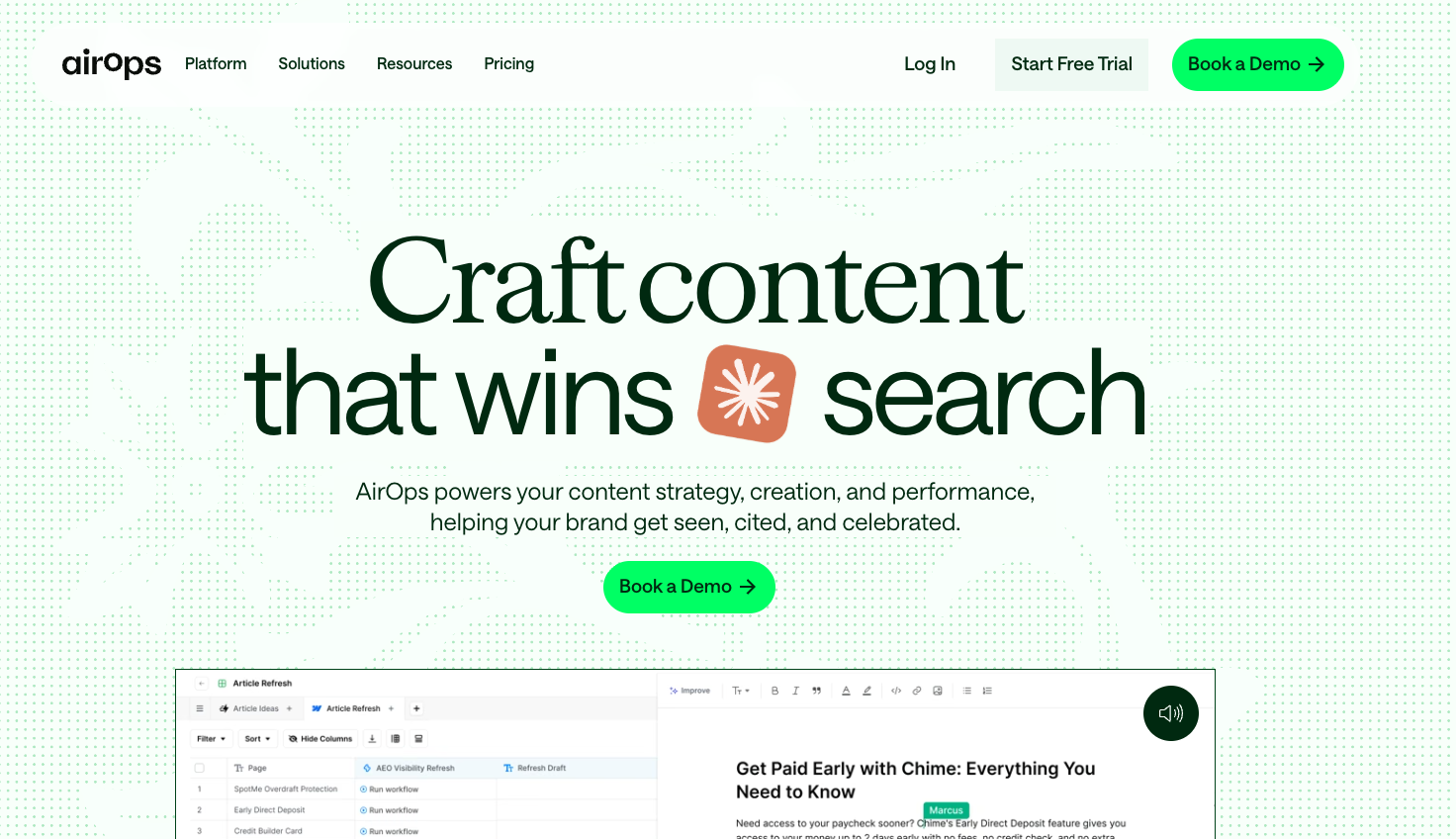
“Craft content that wins AI search”
AirOps positions itself as the first end-to-end content engineering platform - giving content and SEO teams visibility into what to create, workflows to create it, and human-review checkpoints to ensure quality before publishing. Its primary differentiator is AI search visibility tracking: surfacing where your brand appears (or doesn't) across ChatGPT, Perplexity, Google AI Overviews, and other LLMs, then feeding that data into configurable content workflows.
Visit AirOps
What is Writesonic?
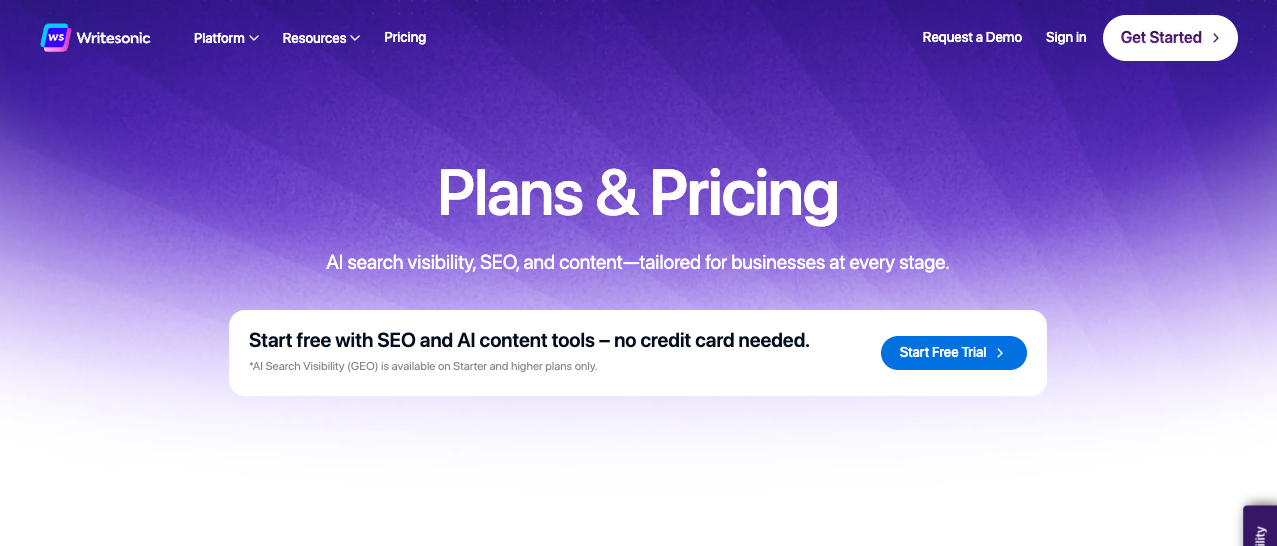
“AI Search Visibility Tracking & Optimization — from $39/month”
Writesonic has made a clear strategic pivot: it's no longer primarily an AI writing tool — it's an AI Search Visibility platform. The homepage leads with brand monitoring across ChatGPT, Perplexity, Gemini, and 10+ AI platforms.
Visit WritesonicThis is the clearest structural difference between the two tools. AirOps is built for content teams, not individual marketers. The platform requires workflow design, prompt engineering, data source configuration, and ongoing maintenance. G2 reviewers consistently report an average time-to-implement of around one month and an average of eight months before meaningful ROI. For an agency or enterprise content operation with dedicated operations staff, that setup investment pays off. For a solo growth marketer or a lean SaaS team, it's a different equation entirely.
Writesonic requires almost no setup. You pick a template, enter a topic, configure your brand voice once, and the article writer runs. The GEO dashboard connects to your domain in minutes. SEO audits run automatically. There's no workflow to design, no logic to debug, no ongoing maintenance cadence required.
Some users on Reddit have described AirOps as "thinking in systems" - which is accurate, and also a disqualifier for most teams that don't want to become workflow engineers. Writesonic's lower operational floor makes it the stronger choice for any team that doesn't already have a dedicated content operations function.
Writesonic wins for operational simplicity - the gap between who can productively use each tool on day one is large, and most teams evaluating this comparison sit closer to Writesonic's intended buyer profile.
Both tools have made AI search visibility central to their 2025-2026 product identity, and both are genuinely strong here - though they approach it differently.
AirOps's Insights layer tracks where your brand appears across ChatGPT, Perplexity, Google AI Overviews, and other LLMs. The data feeds directly into AirOps workflows, so when you identify a citation gap, you can immediately trigger a content creation or refresh workflow to close it. The connection between intelligence and action is tighter than in any competing tool. Case studies from Carta (75% citation rate increase) and Chime (24 to 68 priority question citations) illustrate this compounding effect.
Writesonic's GEO dashboard monitors 10+ AI platforms and provides share of voice, sentiment analysis, and competitor citation comparisons. Its proprietary AI Search Volume Explorer - built on 120M+ real AI chatbot prompts - is a data asset AirOps cannot match. Understanding what people actually ask AI engines, not just what they type into Google, is a meaningfully different research layer that Writesonic owns outright.
The tie verdict is earned: AirOps converts visibility data into operational action better; Writesonic has deeper raw AI query intelligence. Which wins depends on your bottleneck - if you need to understand AI search behavior, Writesonic's data advantage matters. If you need to close known gaps at scale, AirOps's workflow integration is the better lever. For teams with both needs, see how Jasper approaches AI-era content teams for additional context.
AirOps wins this dimension, but not for the reason most comparisons cite. It's not that AirOps's AI models are inherently better - both tools use capable LLMs. The quality advantage comes from governance architecture.
AirOps's Brand Kit and Knowledge Base inject brand context into workflow steps systematically. Human review checkpoints catch content that doesn't meet standard before it ever reaches a CMS. For organizations where published content carries brand, legal, or compliance weight - a public SaaS company, an enterprise brand - this governance layer is not optional. Webflow credits AirOps for 'sharper workflows' specifically because their content passes through defined approval gates before it goes live.
Writesonic's brand voice setup is capable for the category - you configure your writing style, and the article writer applies it. But there's no approval gate between generation and publication. The human reviewer catches issues in their own workflow if they're diligent, not because the platform enforces it. Some users on Reddit have noted that Writesonic output frequently requires significant manual editing before it reads like the brand: generic AI phrases, inconsistent tone, and the rhythmic cadence that editors flag.
For high-stakes content where a substandard article harms the brand, AirOps's governance structure is a genuine structural advantage. For teams producing volume where quality is "good enough" rather than "exceptionally controlled," that overhead becomes friction rather than value.
AirOps wins on brand governance - the combination of Brand Kit, human review gates, and workflow-level configuration provides a quality floor that Writesonic's self-directed workflow doesn't enforce structurally.
The pricing gap between these two tools is significant enough to determine which one most buyers should start with. Writesonic Starter is $39/month - GEO tracking, AI article writer, SEO audit, Chatsonic AI chat, and Google Keyword Planner integration included. That's a genuinely broad platform for the price, and the $99/month Basic tier adds Ahrefs data integration and higher article volume. Annual billing cuts 20% off across all plans.
AirOps's paid entry point is $199/month for the Solo Plan, which is where meaningful features actually unlock. The Pro Plan is $1,999/month. Both tiers use a task-metered overage model: Solo charges $9 per 1,000 tasks above allotment, Pro charges $6 per 1,000. G2 reviewers consistently flag the task-consumption model as difficult to predict - complex workflows burn tasks faster than expected, and a busy month at Pro can run closer to $2,500 than $1,999.
Beyond list price, AirOps carries a hidden cost: the time to implement. Reviews report an average setup phase of one month before the platform is productive. That operational investment is real overhead that Writesonic doesn't impose.
Writesonic wins on pricing by a wide margin at every tier. The $160/month gap between AirOps Solo ($199) and Writesonic Basic ($99) represents significant buying power for a small team. Unless you specifically need AirOps's workflow infrastructure and can absorb the setup cost, the entry-level math strongly favors Writesonic.
Here, the verdict flips emphatically. AirOps was designed from the ground up for the scale and complexity of enterprise content operations, and Writesonic was not. AirOps Enterprise supports unlimited users, unlimited Brand Kits, multiple regions, personas, and languages simultaneously - alongside SSO, dedicated account management, and custom agent builds. Apollo, Ramp, Docebo, and Carta have built proprietary content workflows inside AirOps, treating it as an internal content operating system rather than a SaaS tool.
For that type of deployment - a content team of 15+ people producing thousands of articles per month across multiple markets, with compliance requirements and brand governance as non-negotiables - Writesonic doesn't scale to the same architectural requirements. The template-based, human-driven workflow that makes Writesonic easy to use at the individual level becomes a bottleneck at the team level.
Some users evaluating AirOps on Reddit have described it as "overkill for small teams" - which is accurate, and also the clearest possible signal that it's purpose-built for larger content operations. If your content program has reached the point where individual article production is no longer the bottleneck and operational infrastructure is, AirOps's architecture becomes the right answer. Comparable enterprise-grade tools like Writer compete in this same quadrant, but AirOps's content-engineering-specific focus gives it a distinct advantage for marketing organizations specifically.
AirOps wins on enterprise scalability - for large-scale operations, it's in a different class from Writesonic's template-based model.
The pricing story here is one of the sharpest divergences in the AI content tool market. Writesonic Starter at $39/month delivers a genuinely multi-featured platform - GEO monitoring, AI article writer, SEO audits, and Chatsonic - for a price that any early-stage team can absorb. The $99/month Basic tier adds Ahrefs integration, making it one of the more cost-efficient SEO stacks available. Annual billing cuts 20% off.
AirOps's paid plan starts at $199/month for the Solo Plan, with the Pro Plan at $1,999/month. Both plans use task-based overage pricing: once you exceed your monthly task allotment, Solo bills at $9 per 1,000 additional tasks and Pro at $6 per 1,000. A Pro user running significant workflow volume in a busy month should budget above the $1,999 baseline - the metered model means your bill scales with usage. For the typical SaaS team evaluating both tools, the honest starting point is Writesonic: the lower financial risk means you learn what you actually need before committing to AirOps's infrastructure investment.
AirOps's primary limitation is that it is infrastructure, not a tool. This distinction matters more than any feature gap. Building an effective AirOps workflow requires you to understand your content process well enough to systematize it - which means you need a mature editorial operation before AirOps can make it faster. Users who come in without a defined workflow and immediately try to build one inside AirOps consistently report frustration. G2 reviewers document an average time-to-implement of one month and an average eight months to measurable ROI - numbers that should make any small team pause before committing.
The pricing model adds compounding uncertainty. At $199/month Solo and $1,999/month Pro, AirOps is already more expensive than the entry point of most alternatives. Add task-based overages - $9 per 1,000 tasks on Solo, $6 per 1,000 on Pro - and teams that don't carefully manage workflow complexity can find their monthly bill growing faster than their content output. Reviewers on Reddit have described the credit model as difficult to predict, especially when scaling workflows that chain multiple AI steps.
The platform is desktop-only, which is a practical constraint for any team member who manages content workflows while away from a desk. And AirOps has no AI Search Volume Explorer equivalent - it tracks where you appear in AI answers, but it doesn't have the proprietary query-level data that Writesonic built from 120M+ real AI chatbot conversations. If understanding what AI users actually search for is a research priority, AirOps lacks that data layer entirely.
Writesonic's primary limitation is depth of output quality. The all-in-one positioning is a genuine strength in breadth, but reviewers consistently find that articles require significant manual editing before they're ready to publish under a real brand name. Common complaints include content that feels 'robotic or flat,' inconsistent tone between sections, overuse of generic AI phrasing that any editor or AI detector would flag, and articles that read identically to what dozens of other Writesonic users in the same niche are publishing. For a SaaS company where content credibility is a proxy for product credibility, 'good enough for volume' is not a usable quality bar.
The credit and quota system is a recurring friction point. Monthly article allowances reset without rollover. Heavy users report that credits deplete faster than expected, and the step-up from Starter ($39) to Basic ($99) to Growth ($249) escalates faster than article volume alone might justify. Long-term users who purchased Lifetime Deals have expressed frustration when new features required additional spend not covered by their original purchase.
Writesonic lacks the workflow governance that enterprise or compliance-sensitive content operations require. There's no approval gate between generation and publication, no configurable human review checkpoint, and no structured governance layer enforcing brand standards before content goes live. For teams where a single off-brand article creates reputational or legal exposure, that gap is material. Unlike AirOps, which treats human review as a structural feature, Writesonic's quality control depends entirely on the individual user being thorough.
The most likely buyer searching this comparison is a SaaS marketer or content lead who wants AI-assisted content creation and AI search visibility without building a content engineering department from scratch. For that buyer, Writesonic is the call. The lower entry price ($39/month), the immediate usability, and the combination of GEO tracking plus article creation in one platform covers the most common bottleneck: producing more content and understanding whether AI search surfaces your brand.
AirOps is the right answer in a specific, different scenario: you have a mature content team that already understands its editorial process, produces content at high volume, and is hitting quality or consistency limits that require systematic workflow governance rather than faster individual output. The one-month implementation timeline and eight-month average ROI are not failure statistics - they describe the legitimate investment required to get infrastructure-level returns. Apollo, Ramp, and Carta didn't build content engineering operations on AirOps to get blog posts faster. They did it to systematize content production at a scale where manual processes fail.
The split verdict: Use Writesonic if content volume and AI visibility monitoring are your primary needs and you want something running today. Use AirOps if you have an existing content team, need human review governance, and are prepared to invest in setup before seeing returns. The two tools are rarely in direct competition for the same buyer - if you find yourself genuinely uncertain between them, you almost certainly belong in the Writesonic camp for now.
The limitation both AirOps and Writesonic share is one that neither addresses head-on: neither was built to produce the specific SaaS content that closes deals. AirOps is a workflow platform for any content type a team can systematize - it does not specialize in the article formats that move SaaS buyers from evaluation to signup. Writesonic's AI Article Writer is a general-purpose tool; it produces blog articles, ad copy, emails, and product descriptions with equal priority, which is another way of saying it has no priority at all. A 'best CRM software alternatives' guide and a 'Notion vs Coda' comparison require completely different research depth, factual verification standards, and competitive positioning than a travel blog post. General-purpose pipelines don't consistently deliver the former at the standard SaaS buyers require.
Alfa's pipeline was built for exactly these article types and nothing else. The Research Agent assembles a full competitor dossier - live SERP data via DataForSEO, pricing verification, feature claims, positioning signals. The Fact-Checker Agent cross-validates every pricing figure, feature claim, and integration statement against that dossier before the article leaves the pipeline. The Sub-Editor Agent runs a dedicated pass to remove the AI writing patterns that Writesonic output consistently triggers - the generic phrasing, the rhythmic cadence, the phrases that signal 'machine-generated' to any sophisticated reader. The SEO Optimizer Agent and Packager Agent delivers a CMS-ready article, formatted and internally linked, without any human editing step required.
If your content gap consists of comparison pages, alternatives guides, vs articles, and product reviews - the pieces that rank for commercial-intent keywords and convert SaaS buyers already in evaluation mode - Alfa is the specialist tool for that job. The output is narrower than Writesonic's template library and requires no workflow design like AirOps demands. You input a keyword; the pipeline delivers a publication-ready BOFU article.
Alfa is not the right choice if you need AI search citation monitoring (Writesonic and AirOps both cover that), workflow governance for a content team (AirOps owns that), or general-purpose blog content across any industry (Writesonic handles that better). Alfa is the right choice if SaaS conversion content is your primary organic acquisition lever and 'autonomous article production' means what it says.