Frase vs Rytr

Frase vs Rytr

Frase and Rytr both generate AI text - that's the end of the similarity. Frase is a full-stack SEO and GEO research platform built for content teams: it analyzes SERPs, generates detailed content briefs, scores articles against top-ranking competitors in real time, tracks where your brand appears in ChatGPT and Perplexity, and audits declining pages before they tank. Rytr at $9/month is a lean personal writing assistant: formy short-form copy - emails, captions, CTAs, paragraph starters - with 40+ use case templates and a Chrome Extension to use it anywhere. Comparing them is less a feature competition and more a question of which job you're actually hiring for.

Last updated: April 2026Honest comparison — no affiliate bias
The Tools

What are Frase & Rytr?

Frase screenshot

What is Frase?

Frase

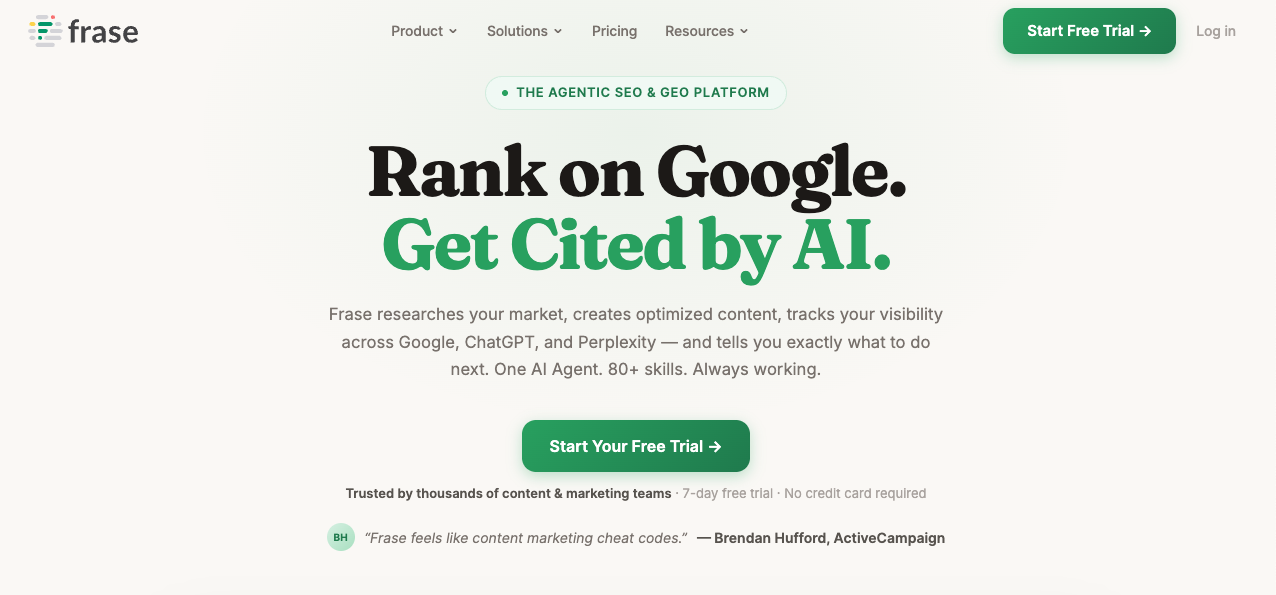
Rank on Google. Get cited by AI.

Frase and Alfa are both AI-powered content tools - and that's where the similarity ends. Frase is a full-stack SEO and GEO platform built for content marketing teams.

Visit Frase
Rytr screenshot

What is Rytr?

Rytr

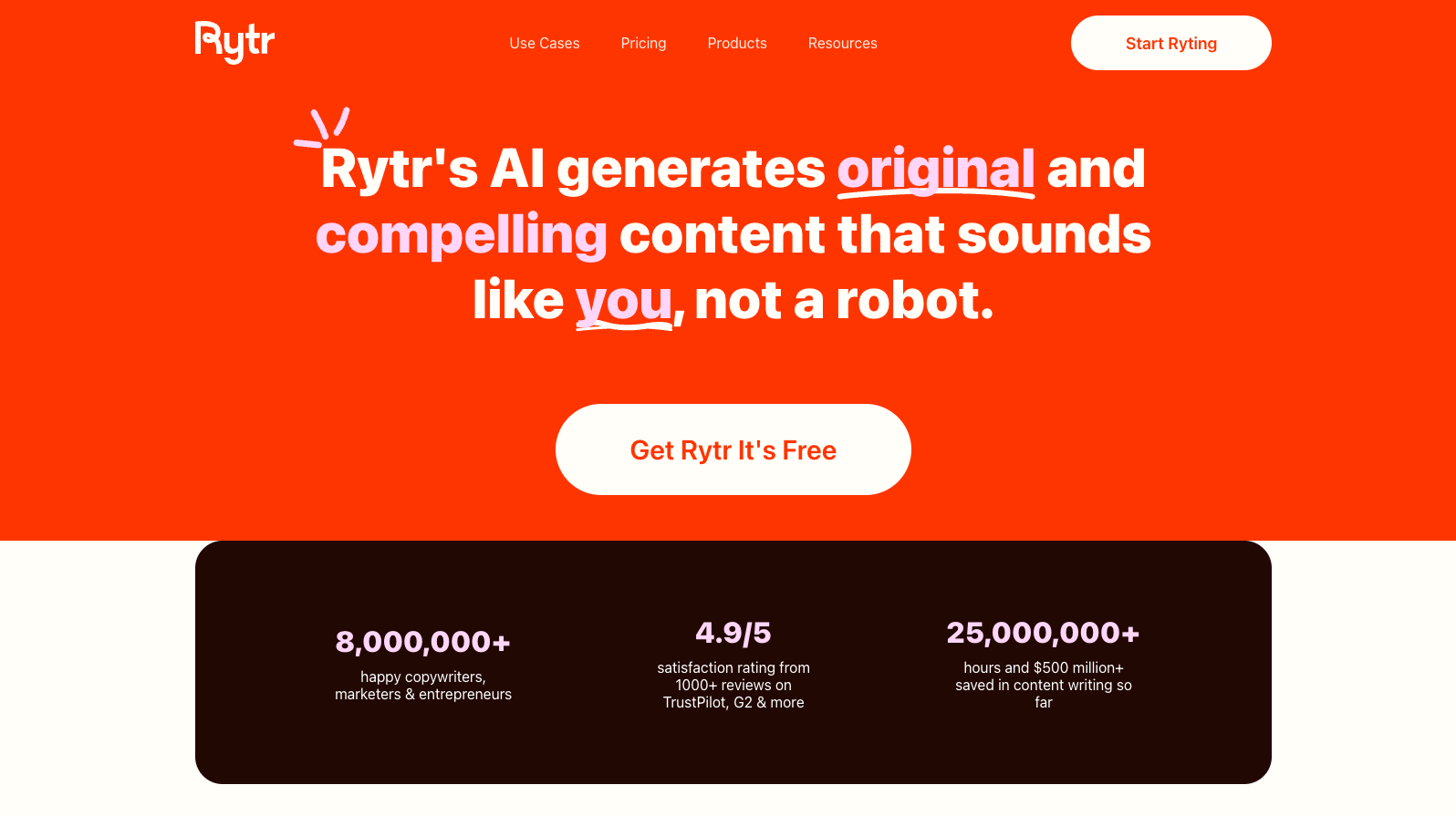
Free AI Writer, Content Generator & Writing Assistant

Rytr is a general-purpose AI writing assistant built for individuals and freelancers. It generates short-form copy - emails, social captions, CTAs, SEO meta titles, paragraph starters - across 40+ use case templates.

Visit Rytr
Feature Comparison

Frase vs Rytr — Feature by Feature

Feature
Frase
Rytr
Content Pipeline
SEO content brief and SERP research
Core feature - competitor gap analysis in 30 seconds with topic scores
No research layer; generates from user prompt and training data only
Long-form article drafting
AI Agent (80+ skills) drafts - human reviews, edits, and optimizes
Paragraph and section generation; loses coherence and structure past ~500 words
Short-form copy templates (email, captions, CTAs, descriptions)
Not a focus - Frase is a research and optimization platform
40+ use case templates - the core product experience
Autonomous end-to-end article production (no writer)
AI Agent can draft; human review and publishing decision required
Writing assistant - human selects template, reviews output, and publishes
Content repurposing (blog to social formats)
Professional plan - 1 post to LinkedIn, Twitter, newsletter automatically
Social media copy templates available; no structured repurposing workflow
Programmatic SEO (data-driven pages at scale)
Scale plan - 1,000+ templated pages from structured data
Not a feature; individual copy fragments only
SEO & GEO Capabilities
Real-time content optimization scoring
Core feature - SEO and GEO scores update as you write
No optimization scoring; basic SEO meta description and title templates only
GEO optimization (optimize for AI search engines)
Real-time GEO scoring so ChatGPT and Perplexity choose your content
Not a feature
AI citation tracking (brand visibility in ChatGPT, Perplexity, etc.)
Tracks brand across 8 AI platforms including ChatGPT, Gemini, Claude
Not a feature
Existing page audit and optimization
Import any page, score against competitors, surface fix recommendations
Not a feature; generates new copy only
Internal link injection
Included in optimization workflow
Manual; no link automation
Output Quality
Brand voice configuration
Brand governance features - terminology and reference docs; less structured
My Voice tone matching on Unlimited/Premium plans; paragraph-level, not pipeline-wide
Dedicated fact-checking step
AI output; human review for factual accuracy expected
No fact-checking; generates from training data and user inputs
AI-isms removal (zero-detectable-AI policy)
Not a documented pipeline step
No cleanup step; output retains AI writing patterns
Plagiarism check
Not included
50 checks/month on Unlimited; 100 checks/month on Premium
Multilingual content generation
Multiple languages supported; not a primary feature
35+ languages on Premium ($29/mo); 1 language on Free and Unlimited
Platform & Access
Chrome Extension (write directly in browser)
Web platform only
Chrome Extension works in Gmail, Google Docs, LinkedIn, and any web editor
WordPress direct publishing
Starter plan and above
No CMS publishing integration
Multi-seat team collaboration
Professional plan includes 3 seats and 5 domains
Solo tool only; no team or collaboration features
Pricing & Plans
Entry price
$49/month Starter - 10 AI-optimized articles, 50 page audits, 1 user
$0/month free plan (10K chars); $9/month unlimited content generation
Free plan (no credit card)
7-day free trial, no credit card required
Free forever plan with 10,000 characters/month, no credit card required
Agency / multi-client tier
$299/month Scale plan - programmatic SEO, multi-client, high-volume production
No agency or multi-client tier; individual tool only
Full support
Partial / limited
Not available
Feature Analysis

Where each tool actually wins

Pricing and Accessibility

This is the most lopsided dimension between the two tools. Rytr's free plan delivers 10,000 characters per month with no credit card - a genuinely usable amount of content for someone evaluating AI writing assistance before spending anything. The $9/month Unlimited plan removes the character cap entirely, making it one of the most affordable unlimited-generation tiers in the entire AI writing market. Even at the top of Rytr's pricing, the $29/month Premium plan adds 35+ languages and multiple tone profiles.

Frase's entry price is $49/month - more than five times Rytr's paid tier - for a 7-day trial period with no credit card. The Starter plan delivers meaningful platform value: 10 assisted articles, 50 page audits, the full AI Agent with 80+ skills, and AI search tracking. But the price comparison tells a story about who each tool is built for. Frase is a professional SEO and GEO platform priced for content teams that need research infrastructure. Rytr is a productivity add-on priced for individuals who want to draft copy faster.

For a freelancer, solo blogger, or small business owner who primarily needs help with short-form tasks at a minimal budget, Rytr's price-to-utility ratio is genuinely difficult to compete with. For a content team that needs SERP research, content scoring, and AI citation tracking, Frase's $49/month is reasonable for the platform breadth - the per-session value of good content briefs alone typically offsets the cost.

Rytr wins on pricing and accessibility - its free forever plan and $9/month unlimited tier are unmatched for cost-conscious individual users.

Rytr has the edge

SEO Research and Content Intelligence

Frase's core value proposition is the quality of its SEO research layer, and this is the dimension where the tools are furthest apart. Frase analyzes the top-ranking pages for any target keyword in real time - pulling competitor headings, word counts, semantic topic coverage, and linking patterns - then auto-generates a content brief that maps the gaps between your current article and what ranks best. Experienced SEO professionals on Reddit and G2 consistently describe Frase's brief generation as one of the fastest in the space, compressing 30-45 minutes of manual SERP analysis into under a minute.

Beyond brief generation, Frase adds GEO scoring - real-time feedback on how well your content is structured to be cited by ChatGPT, Perplexity, and Gemini - plus AI citation tracking across 8 AI platforms including Claude. As AI search cannibalizes traditional Google traffic, this GEO intelligence layer has become increasingly central to Frase's product identity. See Frase vs Writesonic for how Frase's GEO features compare against another platform making a similar pivot.

Rytr has none of this research infrastructure. You bring the strategic direction; Rytr helps you write faster within whatever direction you've already established. There is no keyword research, no SERP analysis, no SEO or GEO scoring, and no AI citation monitoring. Rytr is a drafting accelerator, not an intelligence platform.

Frase wins on SEO research and content intelligence - it's not a close comparison in this category.

Frase has the edge

Short-Form Copy and Everyday Writing Tasks

This is the dimension where Rytr earns its large user base. The platform was purpose-built for everyday copy tasks: email subject lines, product descriptions, reply-to-reviews, job descriptions, interview questions, social captions, CTA copy, cover letters, and paragraph starters across 40+ use case templates. None of these require research infrastructure or SEO scoring - they require speed, variety, and a low barrier to entry. Rytr delivers all three, and its Chrome Extension brings the entire template library directly into Gmail, Google Docs, LinkedIn, and Twitter without switching applications.

Frase is not designed for this use case. Its marketing positions it as a research and optimization platform, not a short-copy tool. There are no email templates, no caption generators, no CTA helpers, and no Chrome Extension for in-context writing. If you need to draft a batch of email subject lines, generate product descriptions, or write a social caption while inside LinkedIn, Frase is simply not the tool for that job.

Users who describe themselves as primarily handling short-form copy volume across diverse formats consistently find Rytr adequate for their workflow at a price point that makes it easy to maintain. The G2 consensus on Rytr's short-form utility is strong: reviewers rate its ease of use and value for money consistently higher than its head-on competitors in the budget tier. For the buyer whose daily work is primarily emails, captions, and copy fragments, not research-backed articles, Rytr wins on short-form copy and everyday writing tasks - it's where the tool is most at home.
Rytr has the edge

Long-Form Content Quality

Neither tool is a long-form powerhouse, but Frase structures the process better. Frase's AI Agent - with 80+ skills - drafts articles from inside its content editor using the research brief it generates from SERP analysis. The writer has live optimization scores, semantic topic coverage, and competitor gap analysis on the same screen while the draft builds out. The result is a richer starting point than a blank prompt: the structure is informed by what actually ranks, and the human editing that follows is targeted rather than exploratory.

Rytr's long-form capability is assembled from fragments. The Blog Ideas template generates a structure; the Blog Section Writing template drafts individual sections. A human then assembles those sections, adds transitions, conducts the research Rytr doesn't do, and handles publishing manually. Community feedback across Reddit and G2 is consistent: Rytr loses coherence past a few hundred words - ideas loop, phrasing recycles, and the logical thread of an argument begins to drift. For blog posts, case studies, or any content requiring narrative structure across multiple sections, Rytr's architecture shows its limits. The Jasper vs Rytr comparison covers this coherence gap in more detail against another long-form platform.

The honest note about Frase: its AI-generated drafts still require meaningful human editing before publication - G2 reviewers and Reddit power users consistently describe Frase's article output as "good research and structure but generic prose that needs a voice." The research and brief quality is where Frase earns its price; the draft quality is a starting point, not a finish line.

Frase wins on long-form content quality - its research-informed structure gives editors a meaningfully better starting point than Rytr's fragment-assembly approach.

Frase has the edge

Output Quality and Editing Overhead

Both tools share the most consistent critique in the AI writing space: the output sounds generic. Rytr's template-based structure produces fill-in-the-blank copy that experienced editors and AI detectors identify immediately - the characteristic rhythms, the "In today's competitive landscape" openers, the "it's worth noting" transitions. Users on G2 consistently report that Rytr's output requires significant rewriting to achieve a distinctive brand voice. At $9/month for unlimited generation, this is an expected constraint; but brands that care about E-E-A-T signals face compounding risk from content that reads as machine-generated across a large publishing volume.

Frase faces an identical critique on its drafting output. G2 reviewers describe Frase's AI-written content as "well-structured but formulaic," frequently noting that the prose requires voice injection before it's publication-ready. The platform has no dedicated AI-pattern removal step - no equivalent of a sub-editing pass to strip the identifiable AI writing tics. Neither tool runs a claim-by-claim fact-validation agent, which matters for any content citing specific statistics, pricing, or competitor comparisons where accuracy directly affects reader trust.

The editing overhead is different in character: Rytr's output requires structural reconstruction to become a complete article. Frase's output is more complete structurally but requires voice and depth work. Neither delivers publication-ready content without a human editorial pass. Both tools produce what experienced writers accurately call "a useful first draft" - valuable for reducing time-to-draft, not for eliminating the editing step.

This dimension is a tie - both tools require meaningful human editing before publication, just at different stages of the content process.

Roughly equal
Pricing

What you get at each price point

Frase
Starter
$49/month
  • 1 user, 1 domain
  • 10 AI-optimized articles/month
  • 50 audit pages/month
  • Full Frase AI Agent (80+ skills)
  • SEO + GEO content optimization
  • AI search tracking (ChatGPT, Perplexity, etc.)
  • WordPress publishing
  • 7-day free trial, no credit card
Professional
$129/month
  • 3 user seats, 5 domains
  • 40 AI-optimized articles/month
  • 250 audit pages/month
  • AI visibility tracking across 8 AI platforms
  • Site audit tools
  • Content repurposing (1 post → LinkedIn, Twitter, newsletter)
  • API access
Scale
$299/month
  • High-volume article production
  • Programmatic SEO (1,000+ pages from data)
  • Agency/multi-client workflows
  • Performance tracking at scale
  • Priority support
Rytr
Free
$0/month
  • 10,000 characters per month
  • 1 language
  • Chrome Extension
  • 20+ pre-programmed tones
  • Community access
  • No credit card required
Unlimited
$9/month (or $7.50/month billed annually)
  • Unlimited AI content generation
  • 1 tone match (My Voice)
  • 50 plagiarism checks per month
  • 1 language
  • Doubled character input limit
  • Chrome Extension
  • 20+ pre-programmed tones
  • Priority support
  • Community access
Premium
$29/month (or $24.16/month billed annually)
  • Unlimited AI content generation
  • Multiple tone matches (My Voice)
  • 100 plagiarism checks per month
  • 35+ languages
  • Tripled character input limit
  • Custom use cases
  • Chrome Extension
  • 20+ pre-programmed tones
  • Priority support
  • Community access

The pricing gap between these tools reflects a fundamental difference in what they're selling. Rytr Free is $0/month with 10,000 characters and no credit card. Rytr Unlimited is $9/month (or $7.50/month annually) for unlimited AI content generation, 1 tone match via My Voice, and 50 plagiarism checks. Rytr Premium is $29/month ($24.16/month annually) for multiple tone profiles, 35+ languages, custom use cases, and 100 plagiarism checks.

Frase Starter is $49/month for 1 user on 1 domain, 10 AI-optimized articles per month, 50 audit pages, the full AI Agent with 80+ skills, SEO and GEO content optimization, and AI search tracking across ChatGPT, Perplexity, and others - with a 7-day free trial and no credit card. Frase Professional is $129/month for 3 seats, 5 domains, 40 articles, 250 audit pages, content repurposing, and AI visibility tracking across 8 platforms. Frase Scale is $299/month for programmatic SEO, high article volumes, and agency workflows.

For a buyer using both tools for the same job - drafting articles - the honest math: Rytr at $9/month produces a series of content fragments requiring assembly and editing. Frase at $49/month produces research-backed drafts requiring editing plus SEO and GEO scoring, page auditing, and AI citation monitoring on the same bill. Neither makes the human editing step disappear. The question is whether you're paying for a writing accelerator (Rytr) or an SEO intelligence platform that also writes (Frase).

Honest Assessment

Where each tool falls short

Where Frase falls short

Frase's most persistent limitation in community feedback is the gap between its research quality and its writing quality. Reddit SEO communities and G2 reviewers are consistent: Frase is excellent at SERP analysis, content brief generation, and optimization scoring. The AI-written articles that result from using those briefs are described as "well-structured but tonally flat" and "requiring substantial editing to sound like a human wrote them." Power users in SEO subreddits explicitly describe using Frase for research and brief generation while bringing in separate writing resources for the actual draft - a workflow that reflects where Frase's genuine value sits.

The pricing structure creates friction for individual users who need Frase's research infrastructure but don't need 10 articles per month. There is no smaller entry tier - $49/month is the floor. For a solo content creator or one-person marketing team producing two or three articles per month, the per-article cost at the Starter tier is high relative to alternatives. Users who encounter this complaint frequently note that the platform feels priced for content teams rather than individual professionals.

There is no fact-checking layer. Frase's AI generates content from training data and the SERP analysis it surfaces. For any article that cites specific competitor pricing, product specifications, or statistics, every output requires manual verification before publishing - this is an expected gap for any AI writing tool, but it's worth naming explicitly for SaaS teams whose content credibility depends on pricing accuracy. The lack of a Chrome Extension also limits Frase's utility for in-context writing tasks across other platforms - a genuine friction point for writers who draft inside Gmail or Google Docs.

Where Rytr falls short

Rytr's fundamental limitation is scope ceiling. The platform was designed for short-form copy assistance, and that constraint surfaces immediately when users try to push it toward full-article production. Reddit users who have outgrown Rytr consistently name the same problem: beyond the drafting fragments, the workflow still requires the user to research the topic, structure the piece, assemble the sections, verify facts, optimize for SEO, add internal links, and publish. Rytr speeds up one step in a much longer process - it doesn't compress or remove the others. For a content team expecting to reduce their total publishing workload, the workflow savings are narrower than the entry price implies.

The output detectability problem is Rytr's second persistent limitation. Community feedback across Reddit and G2 is consistent: Rytr's output is frequently flagged by AI detection tools, and the characteristic phrasing - the formulaic openers, the rhythmic sentence patterns, the fill-in-the-blank paragraph structures - is identifiable to any experienced editor on sight. Rytr's My Voice feature on Unlimited and Premium plans approximates tone at the paragraph level for short-form copy. It does not resolve the detectable AI writing patterns in long-form outputs, nor does it enforce brand voice across a full article.

Rytr has no SEO research layer. For a content creator whose primary goal is search ranking - not just faster drafting - Rytr provides almost nothing that a tool like Frase or Surfer SEO doesn't subsume as a minor feature. You still need to find keywords, understand what ranks, identify the content gaps, apply optimization signals, and handle internal linking entirely without Rytr's assistance. For buyers whose primary question is "will this content rank?" Rytr is not the right tool to answer it.

Our Verdict

The honest answer

The most likely person searching "Frase vs Rytr" is someone trying to decide whether to upgrade from affordable AI writing assistance to a proper SEO content platform - or whether the SEO infrastructure is worth the price jump. For that buyer, the honest answer is that these tools are barely competing for the same job. Rytr is the right choice if you primarily need short-form copy assistance - emails, captions, CTAs, product descriptions, paragraph starters - at a price point that fits individual or bootstrap budgets. At $9/month for unlimited generation, no mainstream AI tool in this comparison set matches that value for everyday writing tasks. The free forever plan also makes Rytr the rational first tool to try before spending anything.

Frase is the right choice if you need SEO research infrastructure: SERP analysis, competitor gap identification, content brief generation, real-time optimization scoring, GEO tracking for AI search citations, and page auditing for declining content. At $49/month, Frase is not a writing tool you happen to use for SEO - it's an SEO platform that happens to have writing features. For a content team producing 4-10 research-backed articles per month and actively managing their organic and AI search performance, Frase's feature set earns its price tier.

The scenario where Rytr beats Frase even for a team producing long-form content: if your primary need is drafting assistance and you're handling research, structure, and editing yourself with Ahrefs or SEMrush already in your stack, paying $49/month for Frase's research layer may be redundant spend. Choose Rytr if you're an individual or small team that needs faster drafting at minimal cost. Choose Frase if SEO research and GEO optimization are real priorities, not just nice-to-haves. These tools have limited overlap in what they actually do well.

A third option worth considering

Consider Alfa instead

Both Frase and Rytr share one structural gap that sits beneath the surface of this comparison: neither produces autonomous content that removes the human writing step. Frase's AI Agent drafts from a research brief a human reviews and approves. Rytr generates fragments that a human assembles and edits. In both tools, the human is directing, reviewing, and deciding when the output is ready - the research and writing workload is reduced, not eliminated. The recurring critique users level at both tools is the same: the AI output still requires meaningful editorial work before it's publication-ready.

For SaaS companies specifically, this matters beyond just the editing overhead. Comparison pages, alternatives guides, and vs articles - the content that ranks for commercial-intent keywords and actually converts buyers into trial signups - require factual accuracy at the claim level. A wrong competitor pricing number or misrepresented feature on a comparison page doesn't just require an edit; it ends your credibility with the specific buyer profile most likely to convert. Neither Frase's research layer nor Rytr's drafting assistance solves this. Frase provides better context for a human editor to get it right. Rytr provides faster paragraph generation. Neither validates the claims autonomously.

Alfa runs this differently. The Research Agent builds a live competitor dossier per article using DataForSEO. The Fact-Checker Agent validates every pricing and feature claim against that dossier before the article is packaged - wrong information doesn't make it to draft, let alone publication. The Sub-Editor Agent removes the detectable AI writing patterns that both Frase and Rytr leave in their output - the same patterns G2 reviewers consistently flag in both platforms. The Packager Agent delivers a formatted, CMS-ready article. The human writing step is not reduced; it is removed entirely for the article types that matter most to SaaS growth: comparison pages, alternatives guides, vs articles, product reviews, and how-to guides.

If you're a SaaS team whose content bottleneck is BOFU articles that convert buyers, Alfa is the specialist tool for that job. If you have a content team that needs research infrastructure and optimization tooling around their writing workflow, Frase is the right choice between these tools. If you need a low-cost drafting assistant for short-form copy and everyday writing tasks, Rytr at $9/month is the rational answer. Alfa doesn't compete for either of those use cases - it exists for one specific job: autonomous production of the articles that SaaS buyers read during product evaluation.

FAQ

Common questions

Continue reading

Alfa vs Frase

See how Alfa compares directly to Frase

Alfa vs Rytr

See how Alfa compares directly to Rytr

All Alfa comparisons

Browse all Alfa vs competitor pages

More head-to-head comparisons

See all tool vs tool comparisons