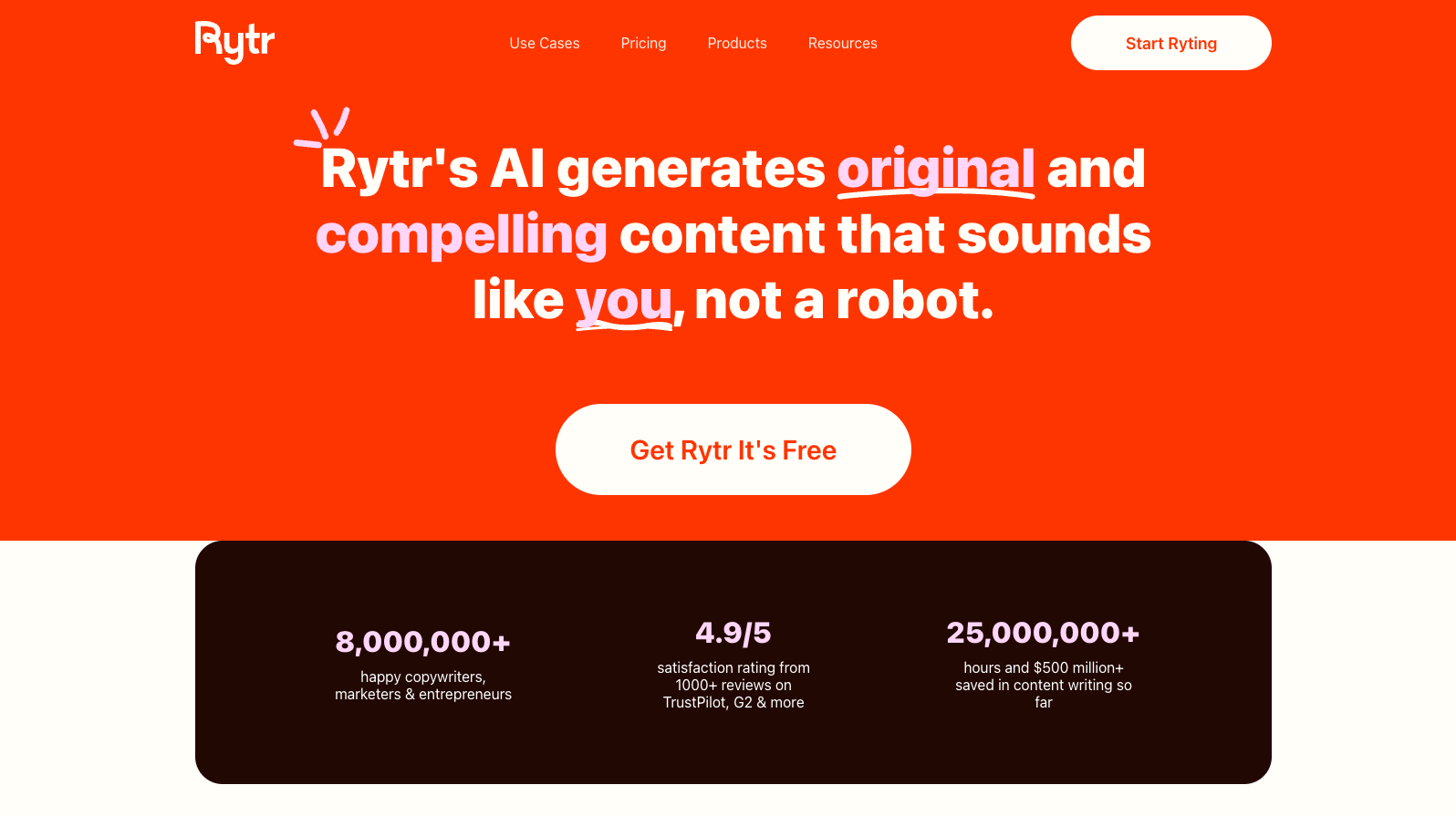
Rytr and Writesonic both generate AI content, but they are solving fundamentally different problems. Rytr is an ultra-affordable writing assistant that helps individuals draft short-form copy faster - emails, captions, CTAs, paragraph starters - with a generous free plan and an $9/month unlimited tier. Writesonic has repositioned itself as an AI Search Visibility platform: it monitors where your brand gets cited across ChatGPT, Perplexity, and Gemini, while its Article Writer handles long-form content. The tools overlap narrowly on blog drafting, but they are not substitutes. The person who benefits from Rytr and the person who benefits from Writesonic are rarely the same buyer.

What is Rytr?
“Free AI Writer, Content Generator & Writing Assistant”
Rytr is a general-purpose AI writing assistant built for individuals and freelancers. It generates short-form copy - emails, social captions, CTAs, SEO meta titles, paragraph starters - across 40+ use case templates.
Visit Rytr
What is Writesonic?
“AI Search Visibility Tracking & Optimization — from $39/month”
Writesonic has made a clear strategic pivot: it's no longer primarily an AI writing tool — it's an AI Search Visibility platform. The homepage leads with brand monitoring across ChatGPT, Perplexity, Gemini, and 10+ AI platforms.
Visit WritesonicOn raw affordability, Rytr is in a category of its own. The free plan delivers 10,000 characters per month with no credit card - an actual usable amount of content for someone testing AI writing. The $9/month Unlimited plan removes the character cap entirely, making it one of the cheapest unlimited-generation tiers in the AI writing space. For a freelancer, student, or solopreneur who needs help with short-form copy on a constrained budget, the economics are genuinely difficult to argue with.
Writesonic starts at $39/month Starter - more than four times the cost of Rytr's Unlimited plan, and that's before you factor in that several of Writesonic's headline features (GEO monitoring, Ahrefs integration, higher audit volumes) are locked behind plans starting at $99/month. Users looking for the AI search visibility features that Writesonic markets as its primary differentiator will need to spend meaningfully more than the advertised entry price.
For teams evaluating both tools on price alone, the gap is not incremental. The comparison is between a productivity add-on for individuals and a professional marketing platform. Both positions are legitimate - but they're priced for fundamentally different budget contexts.
Rytr wins on pricing and accessibility - the free plan and $9/month Unlimited tier are unmatched for cost-conscious buyers.
This is the dimension where the tools diverge most clearly. Writesonic's Article Writer is a genuine long-form content product: it integrates real-time web data via Google, pulls Ahrefs keyword data on higher plans, applies source citations automatically, handles smart internal linking, and publishes directly to WordPress. Users on Reddit and G2 consistently describe Writesonic as a stronger starting point for research-based, SEO-critical blog content compared to simpler assistants.
Rytr's long-form capability is assembled from short-form parts. Its Blog Ideas and Outline template generates a structure; its Blog Section Writing template drafts individual sections. But the human assembles those sections into a complete post, edits for coherence, adds research, and handles publishing manually. There is no end-to-end long-form article pipeline. Community feedback consistently notes that Rytr requires "significantly more manual assembly" for anything approaching a full SEO article.
At the same time, Writesonic's article output is not autonomous. Users still select the keyword, review the draft, and decide when it's publishable. The content frequently requires editing to remove generic phrasing. The quality floor is meaningfully higher than Rytr, but the human is not out of the loop. Both tools produce outputs that users describe as "good first drafts," not finalized content. See Jasper vs Writesonic for how Writesonic compares on long-form against another major general-purpose platform.
Writesonic wins on long-form content capability - it's a purpose-built article tool; Rytr is a section-by-section assistant.
Writesonic has made AI search visibility its defining product identity. The platform monitors where your brand is cited across ChatGPT, Claude, Perplexity, Gemini, and 10+ other AI platforms - tracking share of voice, sentiment, and competitor citation rates. Its AI Search Volume Explorer is built on 120M+ proprietary AI chatbot conversations, surfacing what real users ask AI assistants rather than traditional keyword approximations. The SEO site audit tool (up to 40 audits/month on Growth, scanning 1,200 pages each) and Ahrefs integration add a traditional SEO infrastructure layer that goes well beyond content drafting.
Rytr has none of this. There is no keyword research, no SERP analysis, no site audit, no AI citation monitoring. Rytr is a writing assistant: you bring the strategic direction, it helps you write faster. For users whose primary question is "where does my brand appear in AI search results?" or "what are AI users asking about my industry?" Rytr has no answer.
This is arguably the most lopsided dimension between the two tools - not because one is better at doing the same job, but because only one of them is doing this job at all. The relevant question for a buyer is whether AI visibility monitoring is on their priority list. If yes, Writesonic; if no, this dimension is irrelevant to the decision. For teams comparing Writesonic's GEO features against similar platforms, Frase vs Writesonic covers that overlap in detail.
Writesonic wins on AI search visibility and SEO tooling - Rytr doesn't compete in this category.
Rytr was built for exactly this job. The 40+ use case templates cover the breadth of everyday writing tasks that a marketer or freelancer encounters daily: reply to reviews, job descriptions, email subject lines, interview questions, product descriptions, social captions, cover letters, song lyrics, and more. The Chrome Extension brings all of this directly into Gmail, Google Docs, LinkedIn, and Twitter without switching apps. For a content creator or marketer who drafts copy across many formats throughout the day, the in-browser workflow removes meaningful friction.
Writesonic also offers short-form templates - its library covers over 80 use cases - but the platform's energy and positioning have shifted decisively toward AI visibility monitoring and long-form article generation. Short-form copy feels secondary to Writesonic's current identity. Users on G2 who use Writesonic primarily for quick copy tasks tend to note they're paying for features they don't use. There is no Writesonic Chrome Extension, which adds switching friction for in-context writing work.
For the buyer whose primary workflow is drafting emails, social posts, ad copy, and quick paragraph starters at low cost and high speed, Rytr's template depth, in-browser experience, and $9/month price point make it the more practical choice. Writesonic's short-form templates are serviceable but not the tool's main event.
Rytr wins on short-form copy and everyday writing tasks - it's the product purpose-built for this workflow at an unbeatable price.
The most consistent complaint about both tools across Reddit, G2, and community forums is the same: the output sounds generic. Rytr's template-based structure produces fill-in-the-blank copy that experienced editors identify immediately - phrases like "In today's competitive landscape," "it's worth noting," and the characteristic AI sentence rhythm that signals automated generation. Users report that Rytr often requires heavy rewriting to achieve a distinctive voice, particularly for any content where brand personality matters.
Writesonic faces an identical criticism at scale. G2 reviewers describe the article output as "good for first drafts but requiring significant editing for depth, tone, and accuracy." Users note that the platform can produce repetitive phrasing, especially when prompts are similar across articles. Neither tool has a dedicated AI-pattern removal step. Neither runs a claim-by-claim fact-checking agent. Both produce content that requires human editorial judgment before publishing - Rytr because its output is short-form fragments, Writesonic because its long-form output, while more complete, still carries detectable AI patterns.
The difference in editing overhead is real: Writesonic's long-form output needs less structural assembly than Rytr's fragment-based approach. But neither tool delivers ready-to-publish content that would survive editorial scrutiny at a professionally branded SaaS company. See Jasper vs Rytr for how Rytr compares on output quality against another generalist platform.
This dimension is a tie - both tools require meaningful human editing, just at different stages of the content process.
The pricing gap between these tools is not incremental - it reflects a fundamental difference in what each tool is selling. Rytr's Free plan provides 10,000 characters/month at $0, and the Unlimited plan delivers genuinely unlimited content generation at $9/month (or $7.50/month on annual billing). The Premium plan adds 35+ languages and multiple voice profiles at $29/month ($24.16/month annually). At no price tier does Rytr include SEO tooling, site auditing, keyword research, or AI visibility monitoring.
Writesonic Starter is $39/month - it includes GEO tracking (1 project), the Article Writer, SEO audit tools, Chatsonic, and Google Keyword Planner integration. Basic at $99/month adds Ahrefs integration, higher audit volumes (15/month at 750 pages), and multiple domains. Growth at $249/month scales further. The honest note is that Writesonic's most distinctive features - AI brand monitoring across multiple AI platforms at meaningful volume - are priced into the mid and upper tiers, not the entry plan.
For a buyer choosing between the two purely on budget: Rytr delivers more value per dollar for short-form writing assistance. Writesonic delivers more value per dollar for teams who actually need SEO tooling and AI visibility tracking and would otherwise pay separately for those capabilities. Buying Writesonic to use only its article writer at $39/month is paying for a platform you're not fully using.
Rytr's most significant limitation is scope ceiling. The platform was designed for short-form copy assistance, and that design constraint shows clearly when users try to push it toward full-article production. Reddit users who have outgrown Rytr consistently name the same friction: you can get a paragraph, but you still need to research the topic, structure the article, assemble the sections, add internal links, run SEO optimization, and publish. Rytr speeds up the drafting step in a much larger workflow - it doesn't replace the workflow itself.
The "generic output" problem is the second persistent limitation. Rytr's template-based approach generates fill-in-the-blank copy that trained editors and AI detectors identify immediately. Community feedback across Reddit and G2 is consistent: without significant rewriting, Rytr's output retains a detectable AI tone that homogenizes brand voice across all output. The My Voice feature on Unlimited and Premium plans improves this at the paragraph level, but it's a tone approximation for short copy - not a structured brand voice system that holds across a full article.
Rytr also has no fact-checking mechanism. Content is generated from training data and user input. For any use case where factual accuracy matters - competitor comparisons, product specifications, statistics - Rytr's output requires manual verification before publishing. At $9/month, this is an expected constraint; but for SaaS teams publishing content that reflects on product credibility, the absence of any validation layer is a meaningful risk. Rytr is also an English-only tool on its cheaper plans, with multilingual access locked to the $29/month Premium tier.
Writesonic's primary limitation in 2026 is a positioning gap between what it markets and what most users actually get at entry-tier pricing. The homepage leads with AI Search Visibility tracking across ChatGPT, Perplexity, and Gemini - a genuinely differentiated feature. But the GEO monitoring at meaningful volume and the Ahrefs integration that make the platform most useful for serious SEO teams are materially more expensive than the $39/month entry price suggests. Users who sign up at the Starter tier expecting a full AI visibility platform often discover they're working with a feature-limited version.
The article quality limitation is Writesonic's second persistent friction point. G2 reviewers and Reddit discussions consistently describe the Article Writer output as requiring "significant editing for depth, tone, and accuracy" before publication. The output is a better starting point than Rytr's fragment approach, but it still carries generic AI phrasing, occasional repetition across sections, and a tone that reads as automated rather than authored. Writesonic has no dedicated AI-pattern removal step and no claim-by-claim fact-validation agent - two gaps that matter for any brand publishing content as a proxy for product quality.
For context on how Writesonic's AI visibility features compare against specialized tracking platforms, Frase vs Writesonic covers that comparison directly. The workflow dependency is also real: a human still selects keywords, reviews article drafts, and approves content for publication. Writesonic is not an autonomous content pipeline - it's a well-equipped human-assisted writing and visibility platform that still requires your editorial judgment at every stage.
The most likely person Googling "Rytr vs Writesonic" is a freelancer or small business owner trying to decide whether to upgrade from a budget writing assistant to a more capable platform. For that buyer, the honest answer is: they're not really competing for the same job. Rytr is the right choice if short-form copy speed and affordability are the primary requirements - emails, captions, CTAs, paragraphs, product descriptions, across diverse formats, at $9/month or free. No other mainstream AI writing tool matches that price-to-volume ratio for everyday writing tasks.
Writesonic is the right choice if you need a platform that combines article production with SEO tooling and AI search visibility tracking. The Article Writer is meaningfully better for long-form SEO content than Rytr's assembled-fragment approach. The GEO monitoring, site audit tools, and Ahrefs integration represent a genuine stack that would otherwise require multiple separate tool subscriptions. For a marketing team that needs all of those capabilities under one account, Writesonic's higher price reflects real platform value.
The scenario where Rytr is arguably the better choice even for a team that wants longer content: if all you actually need is faster drafting and you're willing to handle the structure, research, and editing yourself. Paying $39+/month for Writesonic to use only its article writer - ignoring the GEO and SEO features - is paying for a platform you're underutilizing. For teams who want article production without the human editing overhead entirely removed from the equation, neither of these tools delivers that - and Alfa is worth evaluating as a third option purpose-built for autonomous SaaS content.
Both tools share one structural gap that no feature upgrade resolves: neither produces autonomous, research-backed content that a SaaS buyer would trust. Rytr generates short-form fragments that require assembly. Writesonic generates long-form drafts that require editing. In both cases, the human editorial judgment - research, fact verification, structure decisions, brand voice calibration, publishing - remains the buyer's responsibility. The content output from both tools consistently draws the same critique from experienced editors: detectable AI phrasing, generic structure, and no mechanism to validate factual claims against current sources.
Alfa runs differently because it was designed for a different job. Where Rytr and Writesonic both position as writing assistance tools, Alfa is a SaaS content pipeline built for 8 specific article types that convert buyers during product evaluation: comparison pages, alternatives guides, vs articles, product reviews, feature deep-dives, how-to guides, topic guides, and listicles. The Research Agent builds a live competitor dossier per article using DataForSEO. The Fact-Checker Agent validates pricing, feature claims, and positioning statements before the article is packaged. The Sub-Editor Agent strips detectable AI patterns so the output reads like a practitioner wrote it - not a content tool.
The three specific advantages that matter for SaaS teams: first, no human writing step - keyword in, CMS-ready article out, no draft to review. Second, claim-by-claim fact validation built into the pipeline - wrong competitor pricing doesn't make it to publication. Third, AI-isms removed before delivery - the output clears editorial scrutiny without a cleanup pass. At $49/month for approximately 9 autonomous SaaS articles, Alfa is not replacing a writing assistant; it's replacing a freelancer billing $500-$2,000 per article for the same content types.
The honest disqualifier: if your primary need is short-form copy volume across diverse formats - email drafts, captions, product descriptions, interview questions - Rytr at $9/month is a better fit for that workflow than Alfa. And if AI search brand monitoring is a priority alongside article production, Writesonic's GEO features cover that need in a way Alfa does not. Alfa exists for one job: autonomous production of the BOFU articles that convert SaaS buyers from organic search. For that specific job, it is not a generalist.