AirOps vs Rytr

AirOps vs Rytr

AirOps and Rytr both generate AI content. The similarity ends there. AirOps is a content engineering platform: multi-step workflow automation, AI search visibility tracking across ChatGPT and Perplexity, programmatic content at scale, and enterprise-grade human-in-the-loop review. Rytr is a $9/month personal writing assistant built around 40+ copy templates for emails, captions, product descriptions, and paragraph starters. One is content operations infrastructure; the other is a productivity shortcut. The confusion arises because both have "AI writing" in their marketing - but few tools in this space are more different in scope, complexity, and price.

Last updated: April 2026Honest comparison — no affiliate bias
The Tools

What are AirOps & Rytr?

AirOps screenshot

What is AirOps?

AirOps

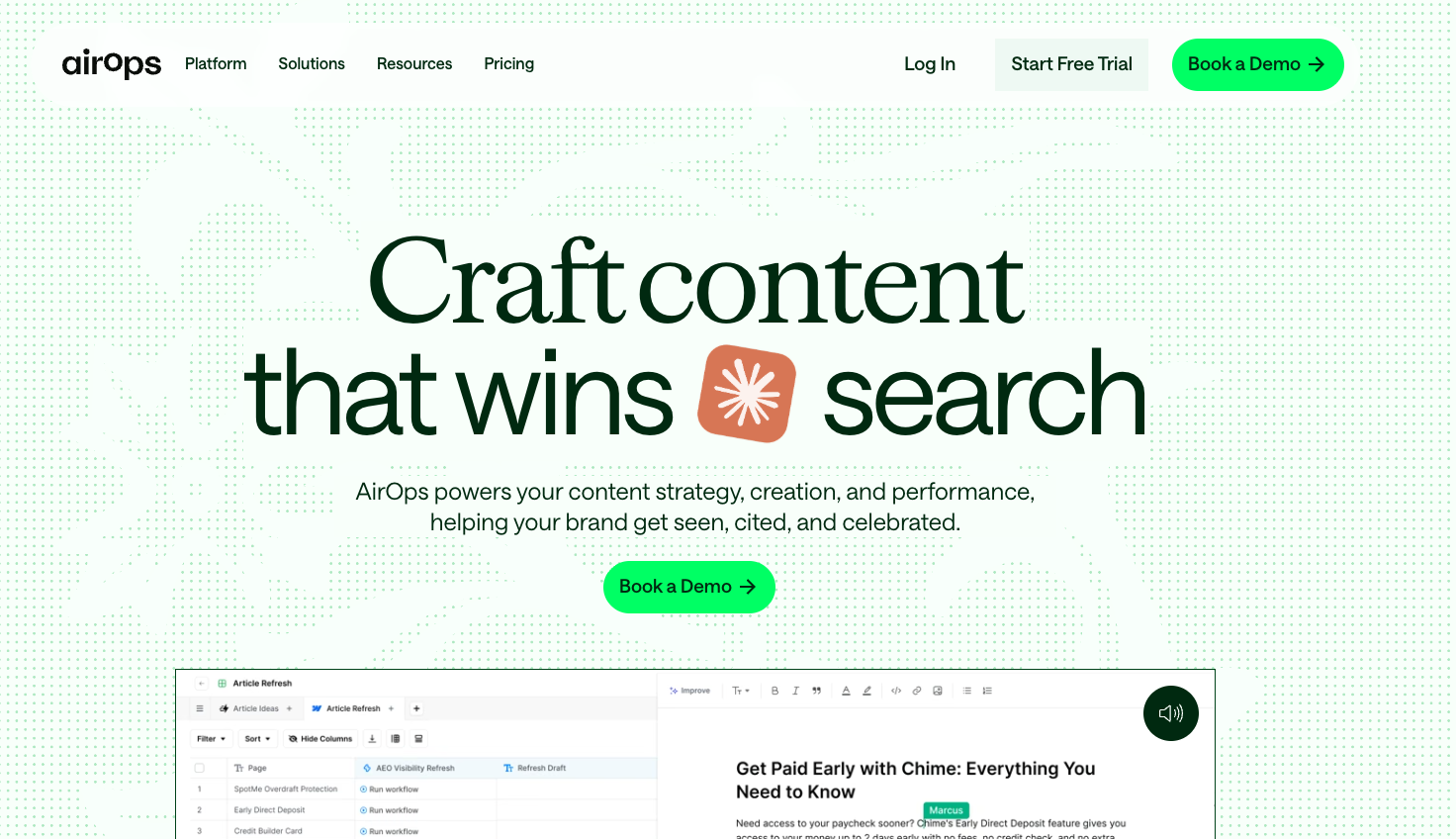
Craft content that wins AI search

AirOps positions itself as the first end-to-end content engineering platform - giving content and SEO teams visibility into what to create, workflows to create it, and human-review checkpoints to ensure quality before publishing. Its primary differentiator is AI search visibility tracking: surfacing where your brand appears (or doesn't) across ChatGPT, Perplexity, Google AI Overviews, and other LLMs, then feeding that data into configurable content workflows.

Visit AirOps
Rytr screenshot

What is Rytr?

Rytr

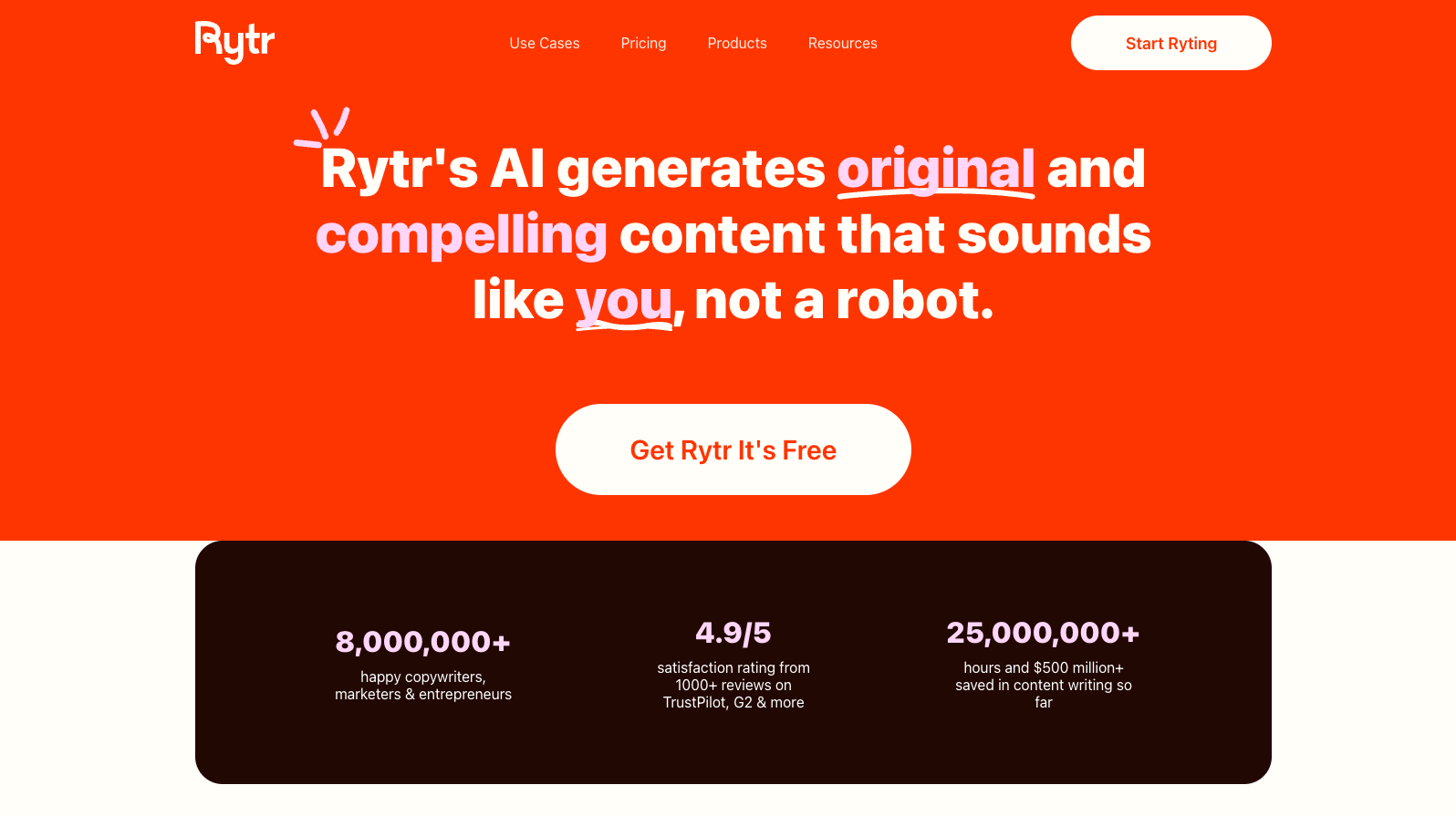
Free AI Writer, Content Generator & Writing Assistant

Rytr is a general-purpose AI writing assistant built for individuals and freelancers. It generates short-form copy - emails, social captions, CTAs, SEO meta titles, paragraph starters - across 40+ use case templates.

Visit Rytr
Feature Comparison

AirOps vs Rytr — Feature by Feature

Feature
AirOps
Rytr
Content Pipeline
Short-form copy templates (emails, captions, CTAs, descriptions)
Workflow platform, not a template-based writing tool
40+ use case templates - the core product experience
Long-form article drafting
Multi-step workflows produce structured long-form content at scale
Generates sections and paragraphs; loses coherence past ~500 words
Content workflow automation (multi-step pipelines)
Core product - Workflows, Grids, and Power Agents for any content operation
Template-based generation only; no multi-step workflow builder
Programmatic content at scale (data-driven pages)
Grid + data templates for hundreds of pages from structured inputs
Individual copy fragments only; no batch or programmatic production
Content refresh (update existing pages)
Dedicated Content Refresh module - identifies and updates underperforming pages
New copy generation only; no page refresh workflow
BOFU keyword strategy and content prioritization
Opportunity reports from Insights data; team must configure and act on them
User provides topic; no keyword or content strategy layer
AI Search & SEO
AI search citation tracking (ChatGPT, Perplexity, AI Overviews)
Core Insights layer - tracks brand mentions across all major LLMs
No AI search visibility tracking feature
Offsite monitoring (Reddit, 3rd-party brand mentions)
Dedicated Offsite module - find, secure, and measure external mentions
No offsite monitoring capability
SEO optimization for content
Built into workflows with live SEO data integrations (Semrush, DataForSEO)
SEO meta title and description templates; no real-time content scoring
WordPress and CMS publishing
CMS integrations available on Pro and above (WordPress, Webflow)
No CMS publishing integration; Chrome Extension for in-browser writing only
Output Quality
Dedicated fact-checking step
Human review provides the quality gate; no automated fact-checking agent
No fact-checking; generates from training data and user inputs
AI-isms removal (zero-detectable-AI policy)
Human editorial step catches AI writing patterns before publishing
No dedicated cleanup; output retains recognizable AI writing patterns
Brand voice configuration
Brand Kit and Knowledge Base connected to workflows by operators
My Voice tone matching on Unlimited/Premium plans; paragraph-level only
Plagiarism check
Not included
50 checks/month on Unlimited; 100 checks/month on Premium
Multilingual content generation
Enterprise plan supports multiple regions, personas, and languages
35+ languages on Premium ($29/mo); 1 language on Free and Unlimited
Platform & Access
Chrome Extension (write directly in browser)
Web platform only; no browser extension
Chrome Extension works in Gmail, Google Docs, LinkedIn, and any web editor
Human-in-the-loop review workflows
Configurable approval gates and review steps at every workflow stage
Solo tool; no structured approval or team review workflow
Multi-seat team collaboration
Pro Plan supports unlimited users; Enterprise for large teams
Solo tool only; no team or collaboration features
API access
Available on paid plans
API available
Pricing & Plans
Entry price (paid plan)
$199/month Solo Plan - task-metered with overages at $9 per 1,000 tasks
$0/month free plan (10K chars); $9/month unlimited content generation
Free tier available
$0 Solo Free - 1,000 tasks/month with no overages
Free forever plan with 10,000 characters/month, no credit card required
Cost predictability (no usage-based overages)
Task-based pricing - $9 per 1,000 tasks above Solo allotment; $6 on Pro
Flat subscription; no task metering or overage charges
Full support
Partial / limited
Not available
Feature Analysis

Where each tool actually wins

Pricing and Accessibility

The price gap here is not a rounding error - it is a statement about two entirely different product categories. Rytr's free plan delivers 10,000 characters per month with no credit card, making it one of the few AI tools with a genuinely useful free tier. The $9/month Unlimited plan removes the character cap entirely, and even Rytr Premium at $29/month adds 35+ languages and multiple voice profiles. For an individual writer or small team, this is among the most affordable unlimited AI writing options available anywhere.

AirOps's paid tier starts at $199/month - the Solo Plan - with additional overage billing at $9 per 1,000 tasks above the plan allotment. The jump to the Pro Plan is $1,999/month, creating one of the steepest pricing cliffs in the AI content space. AirOps does maintain a free Solo tier capped at 1,000 tasks with no overages, which lets teams test the platform. But the moment a team needs real workflow volume, the pricing becomes a serious consideration that small teams consistently flag in community discussions.

This pricing difference is structural, not just a number. AirOps is priced as enterprise content infrastructure; Rytr is priced as a personal productivity tool. The question a buyer should ask is not which is cheaper but which pricing model reflects the job they actually need done. For freelancers, solo marketers, and anyone with a limited content budget, Rytr is accessible in a way AirOps simply is not.

Rytr wins on pricing and accessibility by a wide margin - this is not a close dimension for the majority of buyers evaluating these tools.

Rytr has the edge

AI Search Visibility Intelligence

This is AirOps's most defensible and distinct capability, and Rytr has no equivalent feature at any price tier. AirOps's Insights layer monitors where a brand appears - and more importantly, where it does not appear - in responses from ChatGPT, Perplexity, Google AI Overviews, and other LLMs. It surfaces specific prompts, competitor mentions, and topic gaps, then connects that intelligence directly into content workflow recommendations.

The documented results from AirOps case studies are concrete: Chime grew from 24 to 68 priority question citations in weeks using AirOps AI search data. Carta achieved a 75% higher citation rate on pages created through AirOps insights. Ramp built a 10x ROI Reddit strategy from Offsite module data. These are measurable outcomes from named SaaS companies operating at scale.

Rytr has no AI search monitoring, no citation tracking, and no strategic intelligence layer of any kind. You bring the strategy; Rytr generates copy from it. For a team where knowing exactly which LLM queries surface competitors but not them is decision-relevant intelligence - and where that visibility gap directly informs what content to create next - AirOps provides something Rytr simply has no architecture for.

AirOps wins decisively on AI search visibility - it is the most differentiated dimension in this comparison and the clearest reason an established content team would choose AirOps over any writing assistant.

AirOps has the edge

Content Workflow Automation

AirOps was built to be content operations infrastructure. Its workflow builder chains multi-step AI calls, pulls data from external sources like Semrush and DataForSEO, integrates human approval checkpoints, and pushes finished content into CMS platforms. Teams at Ramp, Carta, and Webflow have used it to build proprietary content operations that would otherwise have required custom engineering. The Grid interface handles bulk content operations across hundreds of rows, and Power Agents provide pre-built workflow templates for common content programs like content refresh and programmatic page generation.

Rytr has no workflow automation layer. Each interaction is a single-generation event: you pick a template, fill in the fields, generate the output, and decide what to do with it. There is no chaining of steps, no data integration, no conditional logic, and no team review workflow. For a solo writer drafting email copy, that simplicity is precisely the appeal. For a content team trying to systematize a production process across 30 articles per month, Rytr does not provide the operational infrastructure.

The gap matters most for teams producing content at any meaningful scale. If you need to generate hundreds of location pages from a data template, refresh 50+ articles per month based on performance signals, or build a localization pipeline that adapts content for multiple markets, Rytr is entirely the wrong tool for that job. For context on how AirOps's automation compares to a tool with more overlap in workflow features, the AirOps vs Frase comparison covers that territory.

AirOps wins on content workflow automation - Rytr does not attempt to compete in this dimension.

AirOps has the edge

Short-Form Copy and Everyday Writing Tasks

This is the dimension where Rytr earns its large user base and where AirOps is simply not designed to compete. Rytr's 40+ use case templates cover the full range of everyday marketing copy tasks: email subject lines, reply-to-reviews, product descriptions, social captions, call-to-action copy, job descriptions, interview questions, paragraph starters, cover letters, and song lyrics. None of these require workflow engineering, data integration, or a multi-week onboarding program. You pick a template, write a short brief, and generate options in seconds. The Chrome Extension drops this capability directly into Gmail, Google Docs, LinkedIn, and Twitter without leaving the application.

AirOps is not a short-form copy tool. It is a workflow platform, and using it to generate a social caption or email subject line would be operationally absurd - like using a CNC machine to sharpen a pencil. AirOps's strength is in systematic, multi-step content operations, not instant copy fragments. Users who switch from Rytr to AirOps frequently report that they keep Rytr running alongside it for everyday short-form tasks that do not warrant a full workflow build.

For a freelancer handling diverse client content across formats, or a solo marketer writing daily emails and social posts, Rytr at $9/month covers the majority of their writing workflow in a way AirOps never intended to. See the Jasper vs Rytr comparison for how Rytr's short-form utility stacks up against another tool with more overlap in that space.

Rytr wins on short-form copy and everyday writing tasks - this is its native territory.

Rytr has the edge

Learning Curve and Time to Value

Rytr's time to value is measured in minutes. Sign up, pick a template, write a two-sentence brief, and get three copy variations in under 30 seconds. There is no configuration required, no workflow to design, no data mapping to understand, and no onboarding to complete. The interface is intuitive enough that new users rarely need documentation to begin generating useful output. G2 reviewers consistently rate Rytr among the easiest AI tools to adopt and maintain - a meaningful advantage for individuals who want to spend time writing, not learning software.

AirOps's learning curve is one of the most commonly cited limitations in community reviews, and users on G2 and Reddit are consistent in describing it. The platform is closer to infrastructure than a writing assistant: building a useful AirOps workflow requires understanding data mapping, prompt engineering, conditional logic, and the platform's specific step types. Some users report needing 10-20 hours of hands-on experimentation before producing a production-ready workflow. Teams without dedicated content operations staff or technical resources often struggle to extract meaningful value in the early weeks.

Reviewers on Reddit are candid about this asymmetry: AirOps rewards teams that invest the setup time, but the time-to-first-value is genuinely weeks, not hours. For an individual or a small marketing team that needs AI writing help today rather than a content system next quarter, AirOps's complexity is a real barrier. The AirOps vs Jasper comparison covers this ease-of-use gap in more detail against a tool with a similar enterprise orientation.

Rytr wins on learning curve and time to value - the gap is significant enough to influence buyer decisions even among teams that eventually choose AirOps.

Rytr has the edge
Pricing

What you get at each price point

AirOps
Solo (Free)
$0month
  • 1 user
  • 1,000 tasks/month included
  • No overages — tasks capped at allotment
  • Basic templates
  • Live chat support
Solo Plan
$199month
  • All Solo (Free) features
  • Expanded template library
  • $9 per 1,000 tasks overage (above monthly allotment)
  • Community and live chat support
Pro Plan
$1,999month
  • Unlimited users
  • Advanced workflows
  • $6 per 1,000 tasks overage (above monthly allotment)
  • Priority support
Scale / Enterprise
Custom
  • Unlimited tasks
  • Brand kits, SSO, and enterprise integrations
  • Multiple regions, personas, and languages
  • Dedicated Account Manager and 1:1 expert onboarding
  • Contact sales for pricing
Rytr
Free
$0/month
  • 10,000 characters per month
  • 1 language
  • Chrome Extension
  • 20+ pre-programmed tones
  • Community access
  • No credit card required
Unlimited
$9/month (or $7.50/month billed annually)
  • Unlimited AI content generation
  • 1 tone match (My Voice)
  • 50 plagiarism checks per month
  • 1 language
  • Doubled character input limit
  • Chrome Extension
  • 20+ pre-programmed tones
  • Priority support
  • Community access
Premium
$29/month (or $24.16/month billed annually)
  • Unlimited AI content generation
  • Multiple tone matches (My Voice)
  • 100 plagiarism checks per month
  • 35+ languages
  • Tripled character input limit
  • Custom use cases
  • Chrome Extension
  • 20+ pre-programmed tones
  • Priority support
  • Community access

The pricing structures of these two tools reflect entirely different product philosophies. Rytr Free is $0/month with 10,000 characters and no credit card. Rytr Unlimited is $9/month (or $7.50/month annually) for unlimited AI content generation, 1 tone match via My Voice, and 50 plagiarism checks. Rytr Premium is $29/month ($24.16/month annually) for multiple voice profiles, 35+ languages, and custom use cases. Annual billing saves approximately 20% across all Rytr plans.

AirOps Solo Free is $0/month with 1,000 tasks capped and no overages. AirOps Solo Plan is $199/month with task-based overage billing at $9 per 1,000 tasks above the allotment. AirOps Pro Plan is $1,999/month with a reduced overage rate of $6 per 1,000 tasks. The task-based pricing model means actual monthly costs vary with workflow complexity and usage volume - a Pro user running 100,000 tasks pays $2,539, not $1,999. AirOps Scale and Enterprise plans are custom-quoted.

For a realistic team comparison: a 3-person marketing team using Rytr Premium costs $87/month with no surprises. A single-user AirOps Solo Plan costs $199/month before overages. The economic decision is not whether AirOps is expensive - it clearly is, relative to Rytr - but whether the workflow automation, AI search intelligence, and enterprise content operations justify that investment for your specific team's needs.

Honest Assessment

Where each tool falls short

Where AirOps falls short

AirOps's steepest barrier is the learning curve, and this is not a minor friction point. The platform is designed by and for content operations professionals - people who can think in terms of workflow logic, data mapping, prompt engineering, and multi-step pipeline architecture. Users across G2 and Reddit consistently report needing weeks before AirOps workflows become genuinely useful, and teams without dedicated technical or content ops staff often abandon the platform during onboarding. For a marketing team that needs to produce content this month, not design a content system this quarter, AirOps's complexity creates a very real risk of non-adoption.

Cost unpredictability is the second structural issue. AirOps's task-based pricing means your monthly bill isn't fixed. Every AI model call, API action, and multi-step validation consumes tasks. A team running complex workflows at high volume can blow past their plan allotment quickly, and overage charges of $6-$9 per 1,000 tasks accumulate faster than most teams expect when building actively. The gap between the Solo Plan at $199/month and the Pro Plan at $1,999/month is also a significant cliff - teams that outgrow Solo face a 10x price jump before reaching the next tier.

AirOps also requires an existing content strategy to be effective. The platform scales what already works; it does not tell you what to create. Teams without a proven editorial process, clear keyword targets, or a structured content brief workflow often find themselves automating the production of content that does not perform. Like a factory floor, the quality of AirOps output is directly tied to the quality of the workflow design feeding it. Poor workflow architecture produces poor content efficiently. For teams still figuring out their content direction, simpler tools like Rytr or Frase offer a lower-stakes starting point.

Where Rytr falls short

Rytr's fundamental ceiling is scope. The platform was designed for short-form copy assistance, and that constraint surfaces immediately when users attempt to push it toward full-article production. Community feedback across Reddit and G2 is consistent on this point: Rytr generates useful paragraphs and copy fragments, but asking it to produce a complete, coherent 1,500-word blog post results in repetitive phrasing, structural drift, and logical gaps that require substantial reconstruction before the content is publishable. Users who outgrow Rytr consistently cite this ceiling: the workflow savings are narrowest in exactly the scenario where they most wanted a productivity gain.

The output detectability issue is Rytr's second persistent limitation. Despite the My Voice feature on Unlimited and Premium plans, Rytr's output carries recognizable AI writing patterns - the formulaic openers, the template-driven paragraph structures, the rhythmic cadence that both human editors and AI detectors flag immediately. My Voice approximates tone at the sentence level for short copy; it does not resolve the identifiable patterns that accumulate across a full-length article. For brands where E-E-A-T signals and publication credibility matter, content that reads as machine-generated creates compounding risk with each article added to the site.

Rytr has no research layer. For content whose primary purpose is to rank on Google - SaaS comparison pages, alternatives guides, how-to articles - Rytr provides almost nothing that addresses the underlying content strategy problem. You still need to identify keywords, understand what ranks, map the competitive content landscape, apply on-page SEO signals, and handle internal linking and publishing entirely without Rytr's assistance. For buyers whose core question is 'will this content rank?', Rytr is not the right tool to answer it. Tools like AirOps or Frase address that research and optimization layer explicitly.

Our Verdict

The honest answer

The most common buyer evaluating AirOps vs Rytr is a content manager or SaaS founder trying to decide whether to invest in serious content infrastructure or start with an affordable writing assistant. The honest answer is that these tools are not competing for the same job - and recognizing that distinction makes the decision straightforward.

Rytr is the right choice if you are an individual writer, freelancer, or small team that needs faster short-form copy at a price that doesn't require a business case. At $9/month for unlimited generation, no mainstream AI writing tool matches Rytr's value for everyday copy tasks - emails, captions, product descriptions, paragraph starters. The free forever plan makes it rational to start before spending anything. If you're working alone or with a small team and your content volume doesn't justify workflow infrastructure, Rytr solves the immediate problem.

AirOps is the right choice for an established content or SEO team that needs content operations infrastructure - specifically the combination of AI search visibility tracking, systematic workflow automation, and programmatic content at scale. If your primary need is knowing where your brand appears in ChatGPT and Perplexity, building automated content pipelines, or refreshing 50+ articles per month based on performance signals, AirOps provides operational depth that Rytr never attempts to match. The teams getting most value from AirOps - Ramp, Carta, Webflow, Chime - are organizations with dedicated content ops staff, clear editorial frameworks, and content budgets that absorb a $199-$1,999/month platform cost.

The scenario where Rytr beats AirOps even for a team that wants better content outcomes: if your primary bottleneck is drafting speed and your research and strategy are already handled by Ahrefs, SEMrush, or a dedicated SEO platform, Rytr at $9/month is a lighter-weight productivity layer without the complexity tax AirOps carries. For SaaS teams that need BOFU articles produced autonomously without a writer or workflow engineer in the loop, neither tool was purpose-built for that job - and Alfa approaches it from a different angle worth evaluating.
A third option worth considering

Consider Alfa instead

Both AirOps and Rytr share a structural gap that sits underneath the surface tension of this comparison: neither produces autonomous, verified SaaS content without meaningful human involvement. AirOps requires a team to design the workflow, connect the data sources, configure brand context per pipeline, and review outputs before publishing. Rytr requires the writer to pick the template, research the topic, assemble the sections, fact-check the claims, optimize for SEO, and handle publishing. In both tools, the human is doing most of the intellectual work - the AI is accelerating individual steps, not removing the process.

For SaaS companies specifically, this matters beyond editing overhead. Comparison pages, alternatives guides, and vs articles - the content that ranks for commercial-intent keywords and actually converts buyers into trial signups - require factual accuracy at the claim level. A wrong competitor pricing number or misrepresented feature on a comparison page doesn't just require an edit; it ends credibility with the exact buyer profile most likely to convert. AirOps's human review layer makes teams responsible for catching these errors. Rytr's short-form generation layer doesn't attempt to produce this content type at all. Neither tool automates the validation step.

Alfa's pipeline runs the entire production process autonomously. The Research Agent builds a live competitor dossier using DataForSEO. The Strategy Agent maps commercial intent and BOFU keyword clusters. The Writer Agent produces the full article from that research. The Fact-Checker Agent validates every pricing and feature claim against the research dossier before the article is packaged - wrong information doesn't appear in draft, let alone publication. The Sub-Editor Agent removes the detectable AI writing patterns that both AirOps and Rytr leave in their output. The Art Director Agent generates brand-aligned visuals. The SEO Optimizer Agent handles on-page optimization. The Packager Agent delivers a formatted, CMS-ready article.

If you're a content team with existing staff that needs workflow infrastructure and AI search intelligence, AirOps is the right tool for that. If you need a low-cost writing assistant for everyday short-form copy, Rytr at $9/month is the rational answer. Alfa doesn't compete for either of those use cases. It exists for one specific job: autonomous production of the SaaS articles buyers read during product evaluation - comparison pages, alternatives guides, and vs articles - without a writer, workflow engineer, or editorial reviewer in the loop.

FAQ

Common questions

Continue reading

Alfa vs AirOps

See how Alfa compares directly to AirOps

Alfa vs Rytr

See how Alfa compares directly to Rytr

All Alfa comparisons

Browse all Alfa vs competitor pages

More head-to-head comparisons

See all tool vs tool comparisons