Copy.ai vs Rytr

Copy.ai vs Rytr

Copy.ai and Rytr both started as AI writing tools. The similarity mostly ends there. Copy.ai has explicitly repositioned itself as a GTM automation platform - its hero copy now reads "Goodbye AI Copilots" and its real automation features start at $1,000/month (Growth plan). Rytr has stayed exactly where it started: a lean, affordable writing assistant for individuals who need short-form copy faster, at $9/month for unlimited generation. The buyer most likely to Google this comparison is a content creator or marketer who tested one tool on a free tier and is wondering if the other is meaningfully better. The honest answer is that these tools now serve almost entirely different jobs.

Last updated: April 2026Honest comparison — no affiliate bias
The Tools

What are Copy.ai & Rytr?

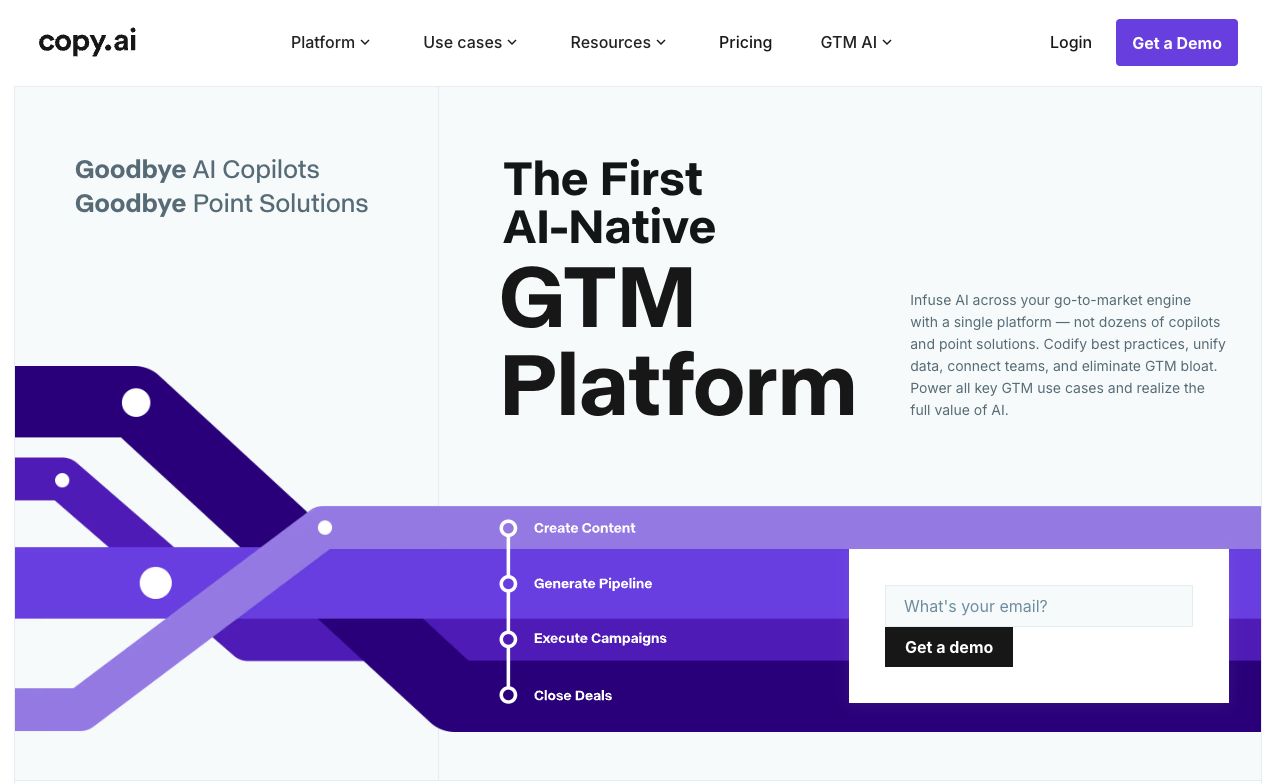
Copy.ai screenshot

What is Copy.ai?

Copy.ai

Goodbye AI Copilots. The GTM AI Platform.

These tools are not really competing. Copy.ai has explicitly pivoted away from being an AI writing tool - their current positioning is 'Goodbye AI Copilots, Goodbye Point Solutions.' It's now a GTM automation platform whose primary use cases are sales prospecting cockpits, inbound lead processing, CRM enrichment, deal coaching, and account-based marketing.

Visit Copy.ai
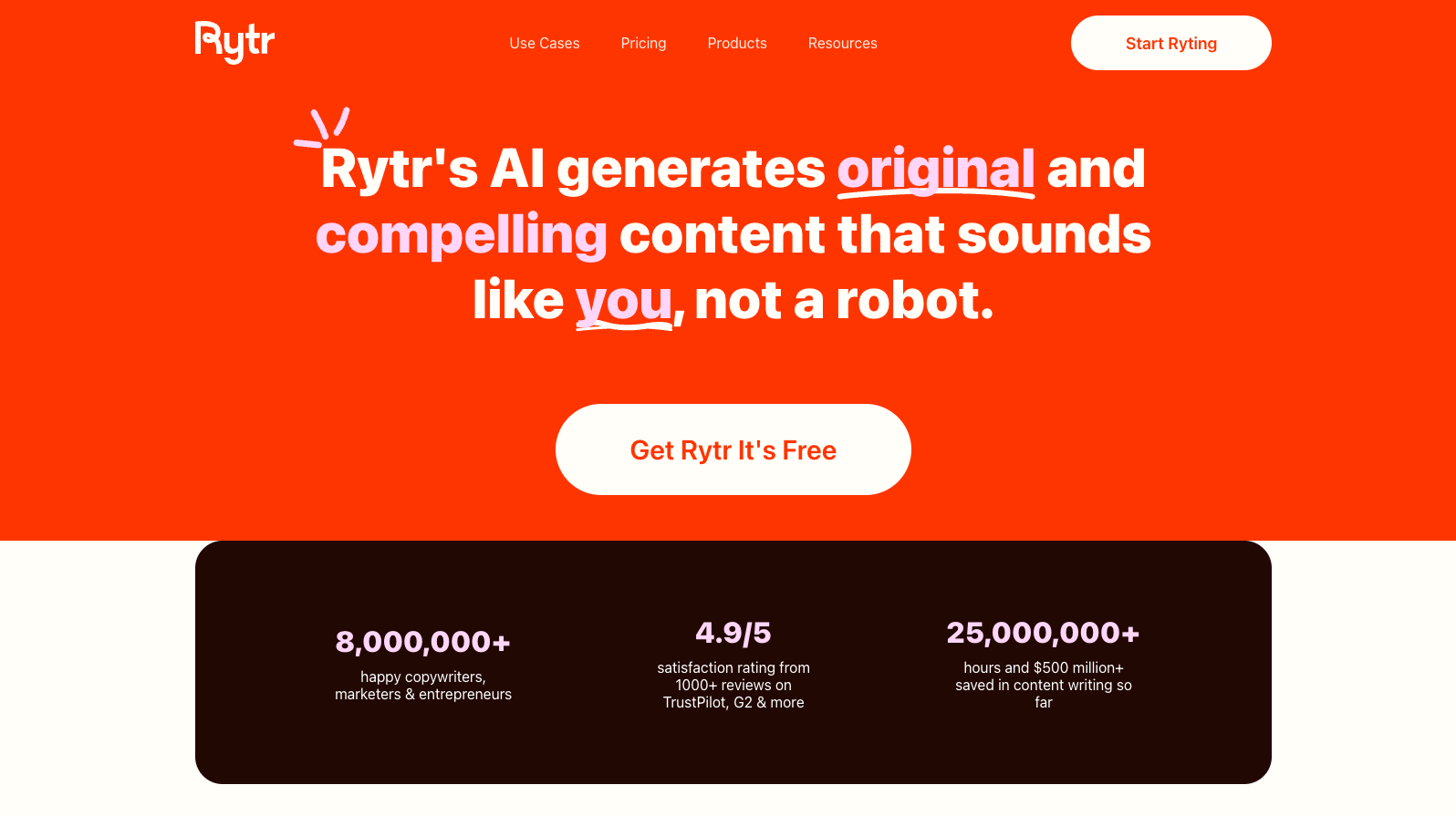
Rytr screenshot

What is Rytr?

Rytr

Free AI Writer, Content Generator & Writing Assistant

Rytr is a general-purpose AI writing assistant built for individuals and freelancers. It generates short-form copy - emails, social captions, CTAs, SEO meta titles, paragraph starters - across 40+ use case templates.

Visit Rytr
Feature Comparison

Copy.ai vs Rytr — Feature by Feature

Feature
Copy.ai
Rytr
Content Pipeline
Short-form copy templates (emails, captions, CTAs, descriptions)
Short-form copy generation available via Chat plan; core product has pivoted to GTM workflows
40+ use case templates - the core product experience, optimised for everyday short-form tasks
Long-form blog article drafting
Configurable content workflow - requires setup; no preconfigured article pipeline
Blog section templates generate fragments; human assembles and edits into a full post
GTM workflow automation (lead enrichment, prospecting, ABM)
Core differentiator on Growth/Scale plans - Prospecting Cockpit, CRM enrichment, deal coaching, 8 other GTM use cases
Not a feature; individual writing assistant only
Autonomous end-to-end article production (no writer)
Configurable workflow possible but requires user to build and prompt research, draft, and editing steps
Writing assistant - human selects template, reviews output, assembles full articles manually
Content repurposing (blog to social, email, ad formats)
Automated multi-format repurposing workflows via Workflow builder on Growth/Scale
Social media and email templates available; no structured repurposing workflow
Chrome Extension (write in Gmail, Docs, LinkedIn)
Web platform only; no in-context browser extension
Chrome Extension works across Gmail, Google Docs, LinkedIn, Twitter, and any web editor
Output Quality
Brand voice storage and enforcement
Infobase + Brand Voice available across workflows; must be explicitly connected per workflow run
My Voice tone matching on Unlimited/Premium plans; paragraph-level, not pipeline-wide
Dedicated fact-checking step
LLM output; no dedicated validation agent; human review expected for accuracy
Generates from training data and user inputs; no fact-checking layer
AI-isms removal (zero-detectable-AI policy)
Not a pipeline step; output retains AI writing patterns
No cleanup step; template-based output is identifiable to AI detectors and experienced editors
Plagiarism check
Not included
50 checks/month on Unlimited; 100 checks/month on Premium
Multilingual content generation
Translation and Localization is a dedicated use case - included in GTM workflows
35+ languages on Premium ($29/month); 1 language on Free and Unlimited
Platform & Data
Unified GTM data layer (Tables, CRM sync)
Tables - queryable data foundation for AI automation; used for 100,000+ product descriptions at scale
No data layer; individual copy generation from user prompts only
Multi-LLM routing (GPT-4o, Claude, Gemini)
Explicit multi-LLM access with user-level model selection across OpenAI, Anthropic, and Gemini
Single underlying model; no user-selectable LLM routing
API access
Available on Growth and Scale plans
API available on all paid plans
Team collaboration and multi-seat access
75 seats on Growth, 200 seats on Scale; built for team workflows
Solo tool only; no team or collaboration features
Pricing & Plans
Entry price (individual/freelancer tier)
$29/month Chat plan - chat interface only; no workflow credits and no GTM automation
$0/month free plan (10K chars/month); $9/month Unlimited for unrestricted generation
Workflow automation entry price
$1,000/month Growth plan required for any workflow automation; steep cliff from $29/month Chat
No workflow automation feature at any price point
Free forever plan (no credit card)
Free tools available; self-serve trial on Chat requires account setup
Free forever plan with 10,000 characters/month, no credit card required
Enterprise compliance (SOC 2, SSO, private instances)
SOC 2 Type II, SSO, private instances, designated account team on Scale ($3,000/month)
No enterprise compliance tier; individual and freelancer tool
Full support
Partial / limited
Not available
Feature Analysis

Where each tool actually wins

Pricing and Accessibility

Rytr's pricing is the starkest differentiator between these two tools. The free plan delivers 10,000 characters per month with no credit card - a genuinely usable amount for someone evaluating AI writing assistance before committing to anything. The $9/month Unlimited plan removes the character cap entirely, making it one of the most affordable unlimited-generation tiers in the market. Even at the top of Rytr's pricing, $29/month Premium adds 35+ languages and multiple tone profiles. The per-feature value ratio is difficult to compete with at the individual and freelancer price point.

Copy.ai's pricing is structured around a significant cliff that most new users discover too late. The $29/month Chat plan delivers a chat interface with no workflow credits - meaning no workflow automation and no GTM features. The actual automation capability starts at $1,000/month on the Growth plan. For a content creator or marketer who signed up for Copy.ai expecting a writing assistant like the one it used to be, the discovery that any real automation costs $1,000/month is a consistent source of frustration in community reviews and Reddit discussions. The platform is now priced for revenue teams and enterprise GTM automation, not for individuals who want to write faster.

For any buyer arriving at this comparison who primarily needs writing assistance at a budget they can absorb personally, the economics favour Rytr by an overwhelming margin. The free tier alone wins the accessibility dimension - Rytr wins on pricing and accessibility.

Rytr has the edge

Short-Form Copy and Everyday Writing Tasks

This is where Rytr is most at home, and where Copy.ai has explicitly stepped back. Rytr was built specifically for the everyday short-form tasks that marketers, freelancers, and solopreneurs need faster: email subject lines, social media captions, product descriptions, CTAs, job posts, paragraph starters, interview questions, and topic ideas. Its 40+ use case templates are the product - each template takes a brief input and generates ready-to-edit copy in seconds. The Chrome Extension brings this capability directly into Gmail, Google Docs, LinkedIn, and Twitter without leaving the window you're already working in. Community feedback consistently rates Rytr's ease of use among the highest in the budget AI writing tier.

Copy.ai's short-form copy capability exists but is no longer the company's focus. Their current homepage explicitly positions away from the "AI copilot" category and toward workforce-scale GTM automation. For teams that need AI-generated emails, social posts, or campaign copy as part of a larger automated workflow, Copy.ai's Workflows feature can chain these tasks together programmatically. But for an individual who simply wants to draft a cold email or generate caption options, that infrastructure is disproportionate - and the $29/month Chat plan delivers copy generation without any of the workflow automation that justifies the platform's complexity.

For the buyer whose primary need is fast, high-volume short-form copy across everyday formats, Rytr wins on short-form copy and everyday writing tasks - it's a purpose-built tool for this use case at a price that individual users can easily justify.

Rytr has the edge

Workflow Automation and GTM Capabilities

This dimension is not a close comparison - it's the reason Copy.ai repositioned as a platform in the first place. Copy.ai's Workflows feature allows revenue and marketing teams to codify multi-step GTM processes as AI-powered sequences: research a prospect, analyze their pain points, generate a personalized outreach sequence, and update the CRM - all in a single automated flow. The platform's nine stated use cases - Prospecting Cockpit, Inbound Lead Processing, Deal Coaching and Forecasting, Account Based Marketing, CRM Enrichment, Translation and Localization, Lead Account Intelligence, GTM Systems Integrations, and Content Creation - are each powered by this workflow layer. The Tables data foundation connects account data, CRM records, and content assets into a queryable layer that automation can draw from. Teams have used this infrastructure to generate 100,000+ product descriptions from structured data in a single workflow run.

Rytr has none of this. It is a writing assistant, not a workflow automation platform. You input a brief, receive copy fragments, and handle everything else manually. There is no workflow builder, no CRM integration, no lead enrichment, no account research, and no multi-step automation of any kind. Rytr does not compete in this category and does not try to. See AirOps vs Copy.ai for how Copy.ai's workflow capabilities compare against another content engineering platform in this tier.

Copy.ai wins on workflow automation and GTM capabilities - and it is not close. If workflow automation is the reason you are evaluating these tools, Rytr is not in this conversation.

Copy.ai has the edge

Long-Form Content Quality

Neither tool is a long-form content powerhouse, and the community feedback on both is strikingly similar: useful for drafting starting points, frustrating for producing complete, publication-ready articles. Copy.ai's content workflow - even when configured for long-form output - generates prose that reviewers on Reddit and G2 consistently describe as "generic," "corporate," and lacking emotional resonance. The platform has no dedicated SERP research step, no fact-checking agent, and no cleanup pass to remove the identifiable AI writing patterns that experienced editors flag immediately. Long-form output requires the same human assembly, research validation, voice injection, and editing that all LLM-based drafting tools demand.

Rytr's long-form approach is structurally different but arrives at the same result. The tool generates individual sections - a blog intro here, a section body there - which a human then assembles into a coherent article. The sections lose logical thread past a few hundred words, ideas loop back on themselves, and the transitions between sections require significant rewriting. Users on Reddit who push Rytr toward full blog production consistently describe the same ceiling: the fragment quality is adequate, but the work to stitch them into a real article is nearly as much as writing it from scratch. See Jasper vs Rytr for a deeper analysis of how Rytr's long-form limitations stack up against a tool more invested in the long-form use case.

This dimension is a tie - both tools require substantial human editorial work to produce a publication-ready long-form article, just from different assembly workflows.

Roughly equal

Output Detectability and Brand Consistency

This is a dimension where Copy.ai has invested more, even if the gap remains meaningful. Copy.ai's Infobase and Brand Voice features let teams store company context - product descriptions, personas, competitive positioning, style guidelines - and connect them to workflow runs to ensure content output stays on-brand. For a marketing team running large volumes of campaign copy through automated workflows, this configuration layer provides meaningful consistency across outputs, even if it requires deliberate setup per workflow.

Rytr's My Voice feature approximates brand tone at the paragraph level for short-form content on the Unlimited and Premium plans. Users provide a writing sample; Rytr attempts to mirror the tone in generated copy. Community feedback is consistent: it works adequately for simple, repetitive short-form tasks like social captions or email subjects, but breaks down for anything requiring sustained voice across multiple sections. The underlying output patterns - the formulaic openers, rhythmic sentence structures, and characteristic fill-in-the-blank prose - remain identifiable to both AI detectors and experienced editors regardless of the My Voice setting.

Both tools share the same structural gap: no dedicated AI-pattern removal step. Neither runs an editing pass to strip the detectable AI writing tells before output is delivered. For brands publishing at volume, this compounds negatively with each article. Copy.ai's brand consistency infrastructure gives it a slight edge in this dimension for teams running configured workflows - Copy.ai wins on output detectability and brand consistency, narrowly, specifically for teams using Infobase and Brand Voice correctly. Solo users without that configuration see little difference between the outputs.

Copy.ai has the edge
Pricing

What you get at each price point

Copy.ai
Chat
$29/month
  • 5 seats
  • Unlimited words in Chat
  • Unlimited Chat projects
  • Access to OpenAI, Anthropic, and Gemini models
  • No workflow credits - Chat interface only
Growth
$1,000/month
  • 75 seats
  • 20,000 workflow credits/month
  • Workflow automation and custom agents
  • 20+ tech integrations and API access
  • All Chat features included
Scale
$3,000/month
  • 200 seats
  • 75,000 workflow credits/month
  • Full workflow automation at scale
  • Guided jumpstart implementation
  • Designated account and support team
  • SOC 2 Type II, SSO, private instances
Rytr
Free
$0/month
  • 10,000 characters per month
  • 1 language
  • Chrome Extension
  • 20+ pre-programmed tones
  • Community access
  • No credit card required
Unlimited
$9/month (or $7.50/month billed annually)
  • Unlimited AI content generation
  • 1 tone match (My Voice)
  • 50 plagiarism checks per month
  • 1 language
  • Doubled character input limit
  • Chrome Extension
  • 20+ pre-programmed tones
  • Priority support
  • Community access
Premium
$29/month (or $24.16/month billed annually)
  • Unlimited AI content generation
  • Multiple tone matches (My Voice)
  • 100 plagiarism checks per month
  • 35+ languages
  • Tripled character input limit
  • Custom use cases
  • Chrome Extension
  • 20+ pre-programmed tones
  • Priority support
  • Community access

The pricing gap here is one of the most dramatic in the AI writing space - and it matters because it reflects a complete mismatch in target buyer. Rytr Free is $0/month with 10,000 characters and no credit card. Rytr Unlimited is $9/month (or $7.50/month billed annually) for unlimited AI content generation, 1 tone match via My Voice, and 50 plagiarism checks. Rytr Premium is $29/month ($24.16/month billed annually) for multiple tone profiles, 35+ languages, custom use cases, and 100 plagiarism checks.

Copy.ai Chat is $29/month for 5 seats and unlimited words in the chat interface - with zero workflow credits and no automation capability whatsoever. Copy.ai Growth is $1,000/month for 75 seats, 20,000 workflow credits, 20+ integrations, and API access. Copy.ai Scale is $3,000/month for 200 seats, 75,000 credits, guided implementation, a designated account team, and SOC 2 compliance. The pricing cliff between Copy.ai Chat ($29) and Growth ($1,000) is the most significant hidden gotcha in this comparison: most buyers who sign up for the Chat plan based on the entry price discover that any workflow automation - the actual competitive advantage of the platform - costs $1,000/month to access.

For an individual writer comparing Rytr to Copy.ai on price: the honest comparison is $9/month (Rytr Unlimited) vs $29/month (Copy.ai Chat) for basic AI writing assistance. At neither price point are you getting full workflow automation. If automation is your goal, the real comparison is $9/month (Rytr) vs $1,000/month (Copy.ai Growth) - at which point you're no longer comparing writing tools.

Honest Assessment

Where each tool falls short

Where Copy.ai falls short

Copy.ai's most significant limitation for the majority of buyers evaluating it is the pricing cliff. The $29/month Chat plan is consistently described in community feedback as a "watered-down" entry point that lacks the workflow credits that make the platform useful as a GTM automation layer. Users who sign up expecting the workflow automation they saw in marketing materials discover that real automation starts at $1,000/month. Reddit discussions and G2 reviews from 2024-2025 capture this frustration repeatedly: former Copy.ai users in the "AI writing tool" category say the platform's pivot away from individual content creators toward enterprise GTM teams has left them without a clear home on the pricing page.

The platform complexity has also increased substantially as Copy.ai added Workflows, Tables, Infobase, and multi-LLM routing. Users who came to Copy.ai for its original simple, fast copy generation interface describe the current product as harder to navigate, with the "simple" interface now masking a much more complex underlying system. For a freelancer or solo content creator, this complexity overhead provides no value - and the features that would justify it are behind the $1,000/month paywall.

Output quality for content remains a persistent critique. G2 reviewers and Reddit users consistently note that Copy.ai's LLM-generated copy sounds "robotic," "generic," and "corporate." The Infobase and Brand Voice features help teams enforce consistency, but they don't resolve the underlying AI writing patterns that experienced editors flag immediately. There is no dedicated fact-checking step - human review is expected for any content where accuracy matters. For SaaS teams publishing comparison pages or feature claims, this is a meaningful gap that the platform does not address architecturally. See Copy.ai vs Jasper for how Copy.ai's content quality compares against a tool still positioned primarily as a writing platform.

Where Rytr falls short

Rytr's fundamental limitation is scope ceiling. The tool was designed for short-form copy assistance, and this constraint becomes visible the moment users try to push it toward full-article production. Community feedback across Reddit and G2 is consistent: Rytr speeds up one step in the content process - the drafting of individual fragments - without compressing or removing the others. Users who expect to replace a content writer with a $9/month tool discover that they still need to research the topic, structure the article, assemble the sections, verify facts, optimize for SEO, handle internal linking, and publish. The workflow savings are narrower than the entry price implies for anyone trying to produce full-length research-backed content.

Output detectability is Rytr's second persistent limitation. The template-based structure produces fill-in-the-blank prose that both AI detectors and experienced editors flag immediately - the formulaic openers, the rhythmic sentence patterns, the characteristic AI transitions ("It is worth noting," "In today's competitive landscape," "With that in mind"). The My Voice feature on Unlimited and Premium plans approximates tone for short-form copy but does not resolve the identifiable AI writing patterns in longer outputs. For brands publishing at volume, this compounds negatively with each article in the eyes of readers who have developed sensitivity to AI-generated content.

There is no SEO research layer. Rytr generates copy from training data and user prompts - it has no mechanism to analyze SERPs, identify keyword gaps, or score content against competitors. For a content creator whose primary goal is organic search visibility, Rytr provides almost nothing that a platform like Frase doesn't include as a minor feature alongside its full research infrastructure. The Rytr vs Writesonic comparison covers how this gap plays out against a tool that attempts to bridge simple copy generation with SEO features at a comparable price point.

Our Verdict

The honest answer

The most likely buyer searching "Copy.ai vs Rytr" is a content creator or marketer who tried one of these tools on a free or low-cost plan and is wondering whether the other is a better deal. For that person, the honest answer is: these tools are no longer really competing for the same job, and choosing the wrong one wastes both money and time.

Rytr is the right choice if you primarily need short-form copy assistance - emails, captions, CTAs, product descriptions, paragraph starters - at a price point that individual creators and freelancers can absorb. The free plan is genuinely usable, and the $9/month Unlimited tier delivers unrestricted generation at a price almost no alternative in this category can match. The Chrome Extension is a practical differentiator for anyone who drafts content across multiple web tools throughout the day. For a freelancer, solopreneur, or solo marketer who writes their own content and wants to draft faster, Rytr is the rational choice between these two - it stays focused on the job it was designed for.

Copy.ai is the right choice if you need GTM workflow automation at the team or enterprise level. The Workflows feature, Tables data layer, CRM integrations, and multi-seat collaboration infrastructure are genuinely valuable for marketing and sales teams automating prospecting, lead enrichment, ABM, and campaign content at volume. But that capability requires the $1,000/month Growth plan. The $29/month Chat plan is a writing interface, not an automation platform, and any buyer comparing it to Rytr's $9/month tier is comparing two tools at similar entry prices with fundamentally different scope - and similar limitations for everyday writing. If GTM automation is your goal, Copy.ai is the right choice. If writing assistance is your goal, Rytr wins on price and focus by a wide margin.

A third option worth considering

Consider Alfa instead

Both Copy.ai and Rytr share one structural gap that runs beneath the surface of this entire comparison: neither produces autonomous, research-backed articles that remove the human writing step. Copy.ai's content workflows output LLM-generated draft copy that requires a human to research the topic, verify the facts, apply SEO signals, and decide when the result is publication-ready. Rytr generates copy fragments a human assembles into a full piece. The recurring community critique across both platforms is the same: the AI accelerates one step, but the human editing overhead downstream remains substantial. For teams whose bottleneck is the volume of articles they can publish - not just the speed of a single paragraph - neither tool resolves the constraint.

For SaaS companies specifically, this gap is most acutely felt in the content types that drive commercial-intent organic traffic: comparison pages, alternatives guides, and vs articles. These content types demand factual precision at the claim level - competitor pricing, feature parity, integration support, known limitations. A wrong number in a comparison page surfaces to exactly the buyer you're trying to convert. Copy.ai's LLM output has no dedicated fact-checking step. Rytr generates from training data with no live research layer. Both leave the accuracy burden on the human editor, which means the human is still in the loop for the most critical part of the content process.

Alfa approaches this differently. The Research Agent builds a live competitor dossier per article using DataForSEO - current pricing and feature data, not training data from months ago. The Fact-Checker Agent validates every claim in the draft against that dossier before the article is packaged. The Sub-Editor Agent runs a dedicated pass to remove the identifiable AI writing patterns that both Copy.ai and Rytr leave in their output - the same patterns community reviewers consistently flag across both platforms. The Strategy Agent surfaces the highest-converting BOFU keyword opportunities specific to your SaaS product. The Packager Agent delivers a CMS-ready article. The human writing step is not reduced; it is removed for the content types that drive SaaS trial signups.

If you are a revenue team that needs GTM workflow automation across sales, marketing, and ops, Copy.ai is the appropriate platform - Alfa doesn't touch those workflows. If you are an individual writer who needs affordable copy assistance for everyday tasks, Rytr at $9/month is the rational answer. Alfa competes for one specific job: autonomous production of the BOFU articles that SaaS buyers read during product evaluation - comparison pages, alternatives guides, vs articles, product reviews, and how-to guides - without requiring a human writer, researcher, editor, or fact-checker in the loop.
FAQ

Common questions

Continue reading

Alfa vs Copy.ai

See how Alfa compares directly to Copy.ai

Alfa vs Rytr

See how Alfa compares directly to Rytr

All Alfa comparisons

Browse all Alfa vs competitor pages

More head-to-head comparisons

See all tool vs tool comparisons